Jul 21, 2006

Big Books. Lots of Big Books.

We wash a load of laundry at the adjoining campground, but there is no way to dry it--the dryer is out of order. We drive in to Vik for groceries and a visit to the bank. The bank features something we had admired on our ferry ride: original art! I count nine pieces of art...watercolors, screen prints, oils...not including the photographs, or additional artwork that might be hiding in offices. Way to go, Iceland! Support those artists!

The Brydebud General Store/Museum, which was once the site of the regional cooperative, is an interesting stop. The store was built on Heimaey in 1831, taken apart, then moved here to Vik and reassembled. Lots of old pictures and historical items are on display here.

Next we spend some time enjoying the black sand beaches of Vik, and admiring the two trolls who were in the process of stealing a three masted ship when they were caught, and frozen, by the rising sun. They are still there in the harbor looking like a rock formation, strangely enough, and called Reynisdrangar.

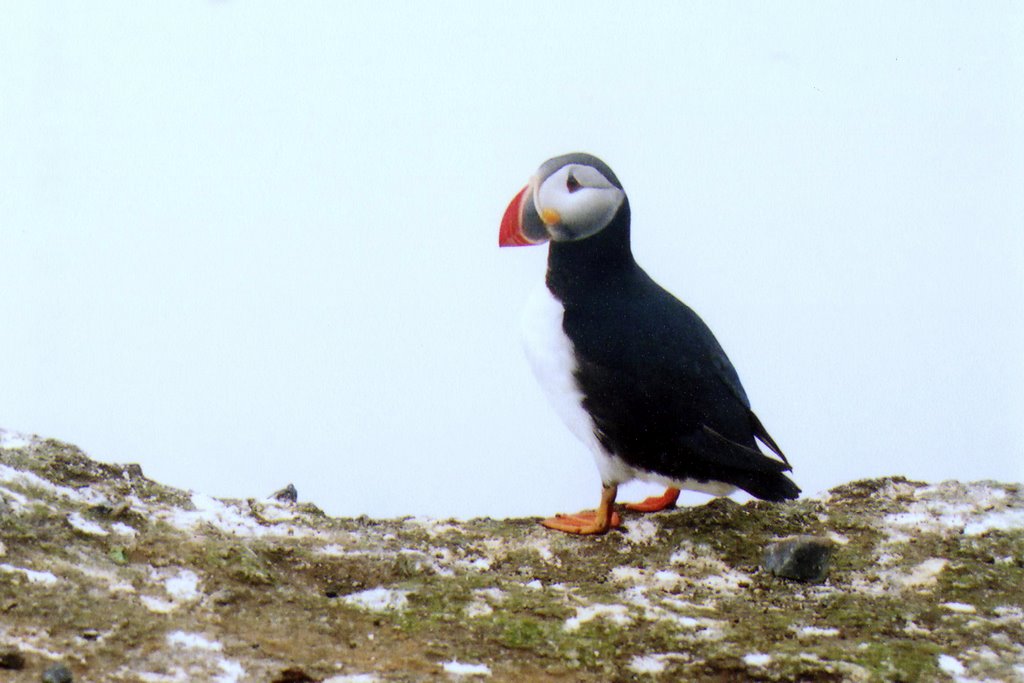
We were excited to see puffins at a distance on Heimaey; today at Vik we see them much closer, and find we can now identify their unique flight. Poor puffins...they have stubby bodies and short wings, so they aren't very aerodynamic. They have to flap their wings continuously and fast, 400 times per minute, and they are unable to glide. They work hard to fly! They swoop around the cliffs, float on the ocean, and dive down for fish, staying underwater for up to a minute. On the cliffs they can be seen with several small fish drooping from their bright orange beaks like little moustaches. They average 10 fish per trip, but have been known to carry 62 fish at once! Puffins live more than 20 years, and usually mate for life. Click here for the answers to 26 questions about puffins!
We tear ourselves away from birdwatching and sketching, and drive along the coast to the next big glacier where we take a scenic detour at Skaftafell National Park. Well, it would be scenic if it weren't raining so hard. It's foggy as well-- what will turn out to be one of the few "bad weather" days of our trip. We spend more time inside the park's information center than we do outside, because we get a drenching just coming in. Lunch is a picnic inside the car, with steamed up windows.

Now we drive along the edge of the giant glacier Vatnajokull, third largest in the world. It's hard to imagine how massive and huge it is; you can't see all of it at once, except from the air. The road changes from paved to gravel and back, and many bridges are one-laned, with small pull asides on the longer ones so that cars can pass. We go by the twisted steel remains of a huge bridge, mishappen from glacial flooding that followed a volcanic eruption. We reach Jokulsarlon late in the day, and John relates in his journal:

Jokulsarlon, the frigid lagoon with blocks of ice in shades of blue, floating silently. An occassional seal's head breaks the surface. We are encountering more people with less command of English--the waitress has to refer us to someone else so we can be understood. The large Icelander tells us there are no more boat tours [on the lagoon] today because they lost electricity. We should come back tomorrow. "Look to someone wearing a yellow lifewest and that be me!" Driving away from Jokulsarlon we drive through thousands of sea terns, swarming like gnats in the summer.

We are staying at Gerdi tonight, to be close to the lagoon for tomorrow's visit. As we drive along the road we see HUGE BOOKS in the distance! Books as large as a one-story building, as tall as doors, an entire "shelf" of them lined up, the length of a house. All different colors and shapes, with titles on the spines! What on earth? The books are the turn-in to Gerdi, where we find our farmhouse accomodation. We check into an attractive building with lovely rooms. We have private rooms tonight, and we proceed to spread out our clean but wet laundry on the heat registers. We walk up hill, past the horse barns and farm equipment, to the BOOKS--which, it turns out, form the outer wall of a museum to a dead ancestor and writer who once lived at this farm. We hadn't heard of Thorbergur Thordarson, for of the dozens of books he wrote only one has been translated into English. At his museum we eat a small, overpriced dinner and are dumbfounded at the creative, elaborate displays that tell the story of this author's life. There are reconstructions of his house and study, old pictures, furniture and belongings...all of this, out in the middle of nowhere!
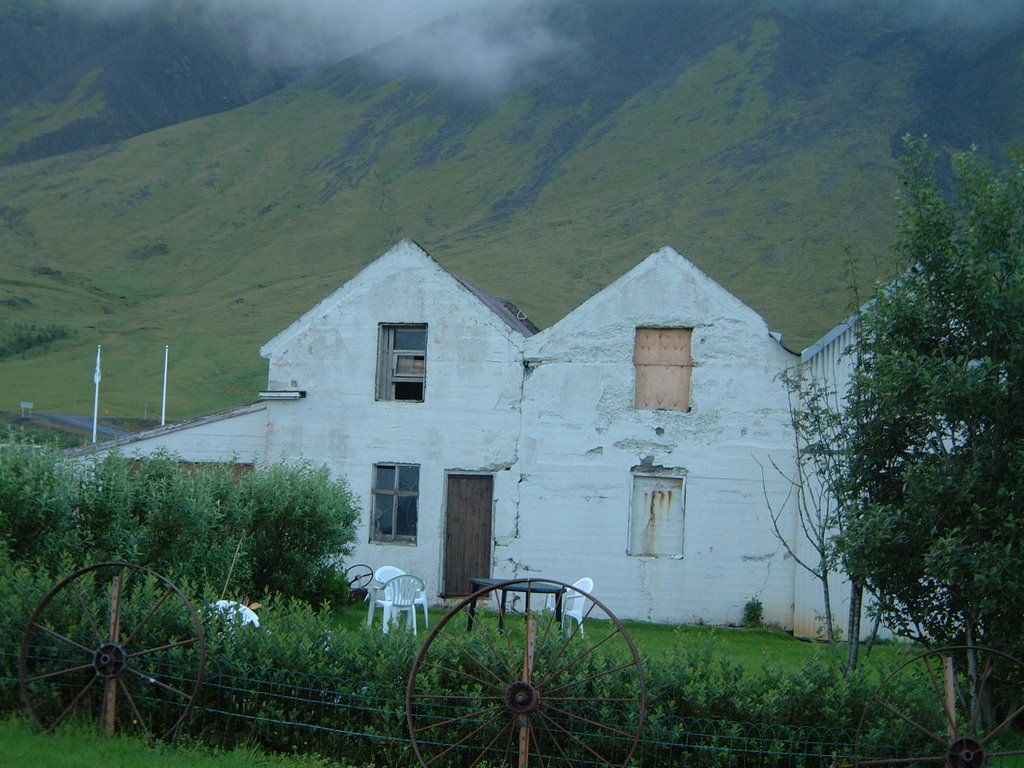
The most amazing item is a black and white photo of strong looking Icelandic men climbing the steep cliffs behind Gerdi to retrieve sheep that are stuck on the hillside, many hundreds of feet in the air. We discover that every face, ravine and crag of the huge mountain rising above us is named, so that the sheep farmers can communicate with each other as they climb different locations on the mountain to retrieve their sheep each year. These sheep wander higher and higher, as they summer in the grassy pastures, and can become stuck in inaccessible locations. Then, strong men with ropes go to fetch them. In order to believe this incredible story we pull out our binoculars and, sure enough, high up in the cliffs of the mountain sheep are scattered! During the rest of our trip we notice sheep in high mountain terrain, and we expect to see them tumbling down, but never do.

Fog and clouds roll in and out, and we get just a few glimpses of the towering mountain behind Gerdi; mostly it's obscured, and only a few peaks are visible.


High 53°F Low 52°F
Jul 20, 2006

Atop a Volcano

Out of the house at 8 a.m., a record for this holiday so far! We walk a few blocks to the Kokuhus bakery and sample 6 different pastries for breakfast. This is a great place! We determine to come back and buy sandwiches for our return trip on the ferry late this afternoon.

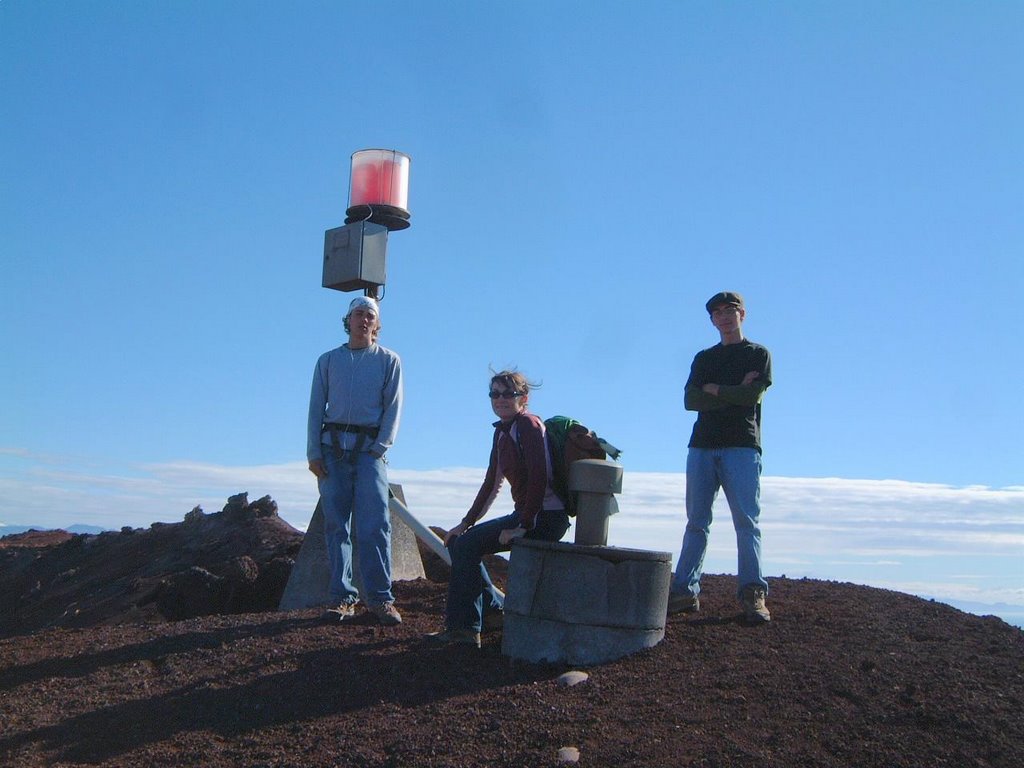
As I write in my little journal I am seated on lava at the top of Mt. Eldfell, 725' high. It is a perfect day: warm, slight breeze, cloudless, and I have a 360° view of all the islands, the mainland, the glaciers, and the sparkling ocean. This is heaven, as long as I don't allow myself to think of the scary hike back down. The "boys" (all three) are exploring the summit. They find a puffin colony below, and Ruth's "bread oven."

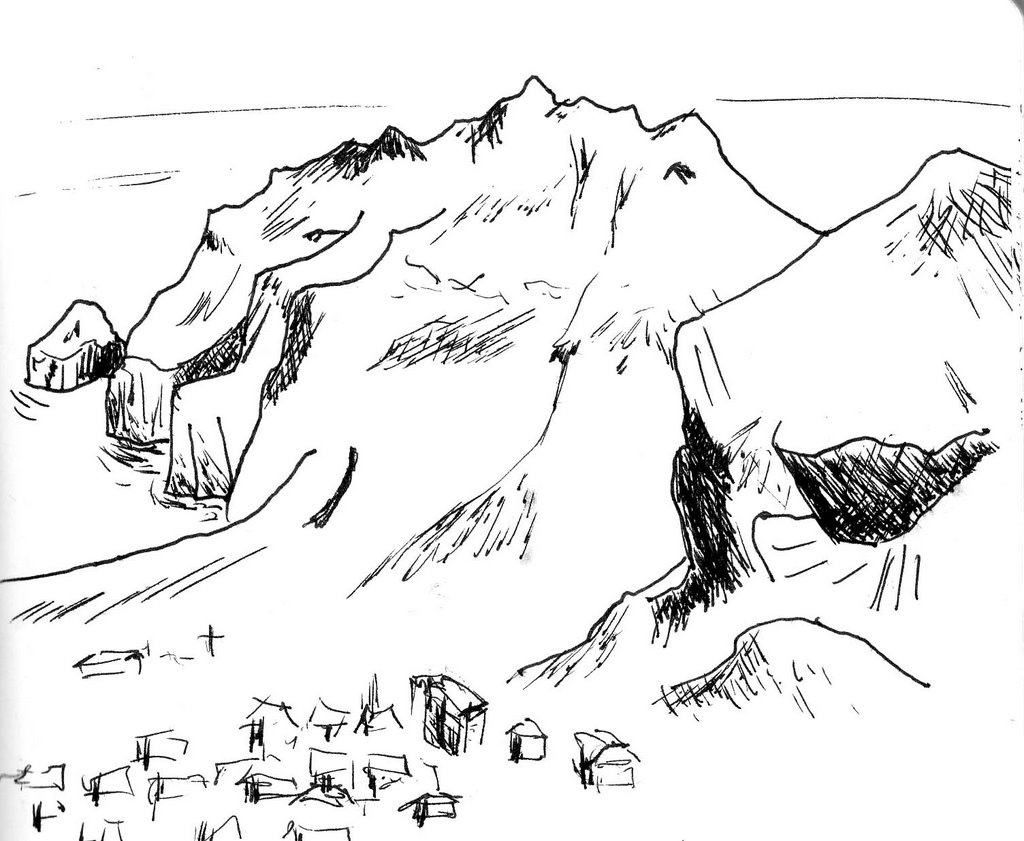
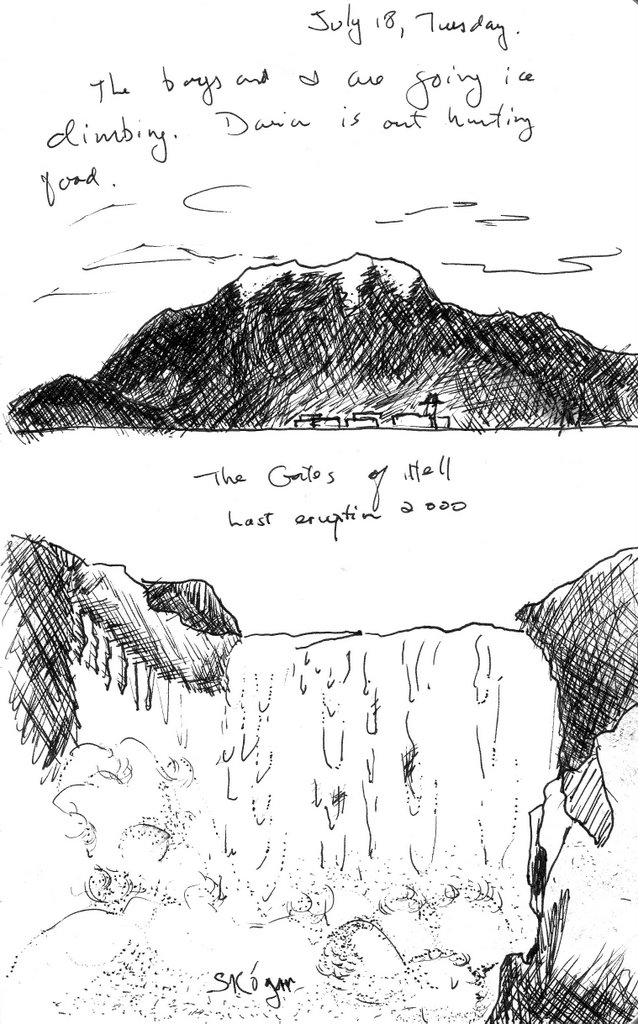
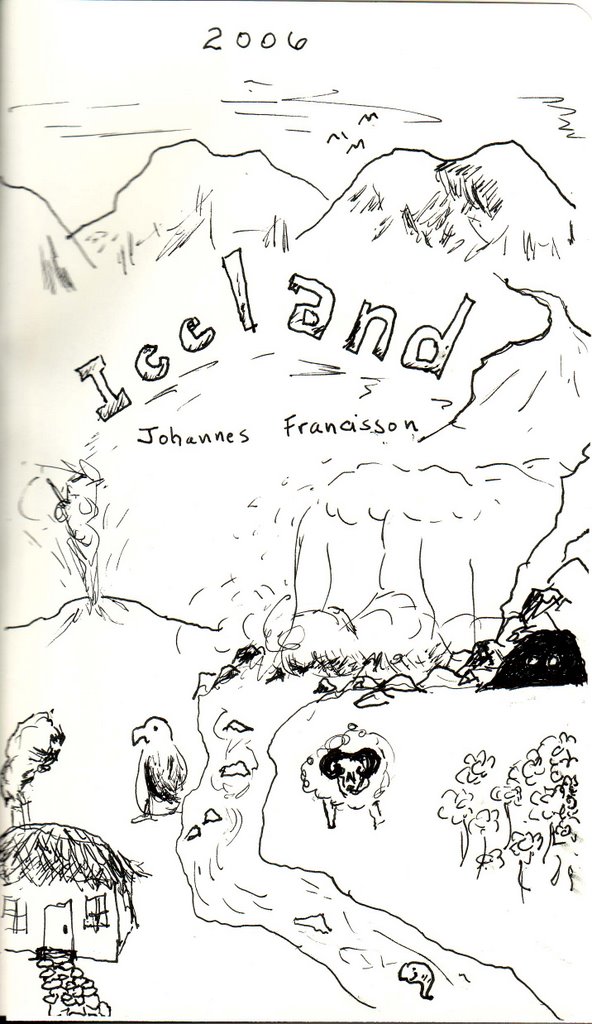
The story behind this volcano and its eruption is fascinating. John McPhee creates a dramatic cliffhanger in The Control of Nature (1989)--a book about "places in the world where people have been engaged in all-out battles with nature." A large section of the book describes the 1973 eruption on Heimaey and the ensuing campaign to save the island's all-important harbor. A six-month battle took place in which sea water was pumped, with hand-held hoses and by boat, in an effort to cool and direct the lava. Not only was the harbor saved and the future of the island guaranteed, but the harbor was actually improved and made more secure by the extended lava flow. John's drawing shows the view west from Eldfell.

We hike back down to the guesthouse, and speculate that the temperature must be close to 75°F. Later we find that it was only 61°--are we becoming acclimated to Iceland? Whatever the temperature, we spend some quiet moments enjoying the flowers in Ruth's garden before we embark on our next adventure, which is...Peter's first horseback ride!

Ruth's daughter Sudrun ("Sunray") accompanies us to the horsefarm, and acts as a co-guide. The other guide is Fannay (possibly spelled differently), the new school principal for the island. Since Icelanders use first names almost exclusively, we ask Fannay what the students will call her when school begins. She replies that they will address her by her first name, of course--"we want to be friends."

They take us on spirited, surefooted Icelandic horses, which are the size of ponies. We ride English-style, and get to experience the famed tolt, or 5th gait of the Icelandic horse. We find the tolt to be somewhat between a fast walk and trot, and incredibly smooth. Fannay takes us down country roads, across fields, along the black sand beach, and to steep cliffs where sheep graze and puffins fly. (The sheep come in many colors, and apparently the genuine Icelandic sweather need use no artificial dyes.) The horses are comfortable moving at a tolt through rough, rocky terrain. We are able to see a lot of the island, for Fannay keeps us at a quick pace. Unlike the sluggish walk that trail horses in the U.S. are encouraged to maintain (by guides who probably want to ensure the riders' safety at the expense of their pleasure) Fannay frequently breaks us into a tolt or canter, glancing mischieviously over her shoulder to assess our progress and our enjoyment. This is exhilarating fun on a lovely, hot sunny day: the still ocean is spread out before us, with grassy-topped islands in crazy shapes scattered about.

Fannay and Sudrun deliver us back to town with just enough time to spare so that we can pack, pay for our room, get to the bakery, and race over to the ferry--at a human trot, rather than a tolt. Just in time, we board the ferry, select our seats, eat our late lunch, and lay down on comfortable couches inside, or stretched out on benches outside, for some serious naps.

Back on the mainland we pile back into our car and drive east, counterclockwise along the Ring Road, with Heimaey visible offshore. We stop in Selfoss for groceries and a Thai meal, where our waitress enlightens us to the fact that people don't tip in restaurants in Iceland. News to us! Later I scour my three guidebooks and find absolutely no mention of this key fact: key, because food prices are extremely high even without tipping!

We stop at Skogafoss so that I can see the lovely falls at twlight. You may recall that John, Gabe and Pete saw them on their ice-climbing expedition...so, we have retraced their journey of two days ago, and are now going beyond the point where they traveled. We hike to the top of the falls, in the lovely light of 10:30 in the evening, and Peter steps close to the falls to take pictures, probably enjoying John's discomfort. I look the other way, for on this trip I have already discovered that teenage boys on steep cliffs are best ignored if one requires peace of mind.

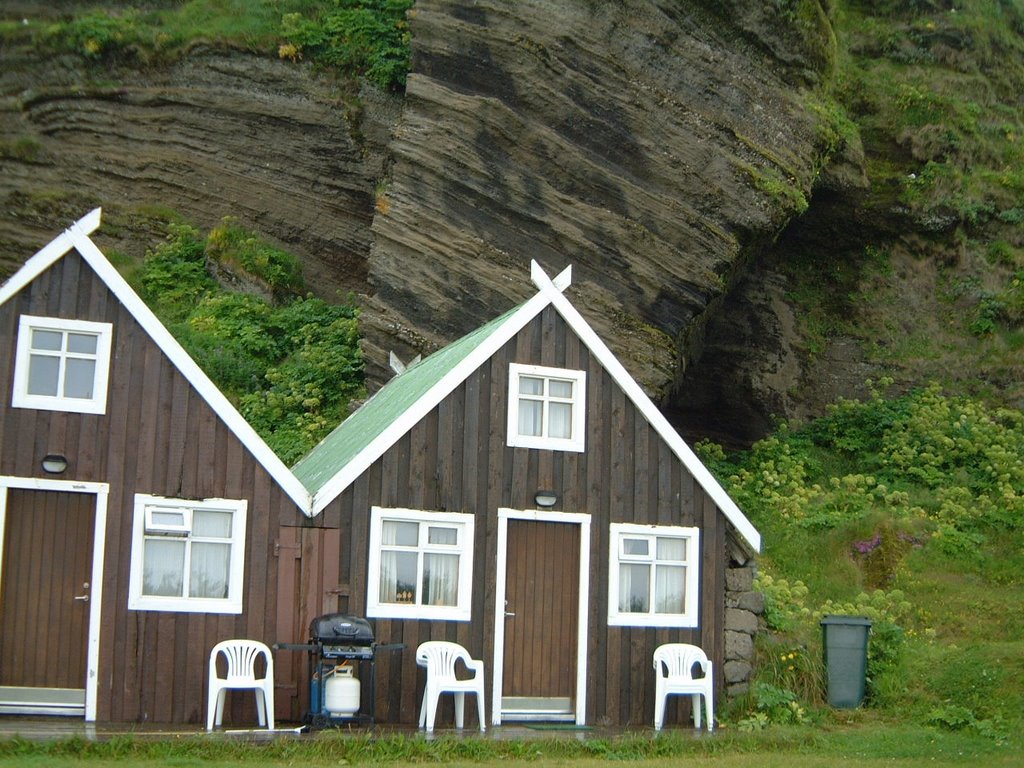
Our lodging consists of a quaint cabin in Vik (pronounced "week") and is surely one of the best places in town, situated at the base of a huge, rocky overhang where noisy fulmars nest. A waterfall runs next to our cabin, "Sumarhusid Hotturinn." We have a kitchen, living area, loft and bath. In the guestbook we discover a fine drawing by a previous guest, showing a family cozily inside the cottage while behind, deep in the rocky cliff, a troll in a cave stirs a great pot of human limbs! I really want to steal this drawing. I refrain. We sleep very well in this idyllic, troll-infested setting.
High 61°F Low 51°F

Jul 19, 2006

Top Three

Happy Birthday to Antonia (#24) back in the States, and Happy Anniversary to Antonia and Jonathan (#2)!

Gabe and Pete are sleeping, so John and I head out of town, down the same road we took two days ago to Thingvellir. It's our last day in Reykjavik, unless we decide to return on the day before we leave Iceland. We don't want to waste time: already we are faced with the unfortunate fact of not having visited one museum in Reykjavik! (A good wintertime activity? Reasons for returning to Iceland #2 and #3: Reykjavik museums and the Northern Lights.)

So today we are going to visit Gljufrasteinn, the home and museum of author Halldor Laxness. Thingvellir, Gljufrasteinn, and Drangey Island are the top three personal shrines on my Iceland list.

Halldor Laxness (1902-1998) won the Nobel prize in 1955, in part for his book Independent People. In an introduction to this book Brad Leithauser says:
When I tell people I meet that my favorite book by a living novelist is Halldor Laxness's Independent People and am asked what it's about, my reply is, "Sheep."

...My reply is actually less facetious than might first appear, for while the book does keep large issues constantly in mind (the largest: mortality and memory and love and duty), it is also very much about...[sheep].
We come close to hitting a herd of sheep on the road, one at a time. In case you're curious, sheep are not too smart. They exhibit that irritating characteristic common to squirrels and deer: it's impossible to predict which way they will dash when they panic--or they might just freeze. It's safer not to honk the horn, and just wait for them to amble off.

Gljúfrasteinn is nestled in a large, lovely valley with imposing mountains nearby, across the road from Laxnes horse farm. Laxness's name, a pseudonym he took in 1923, means "of Laxnes."

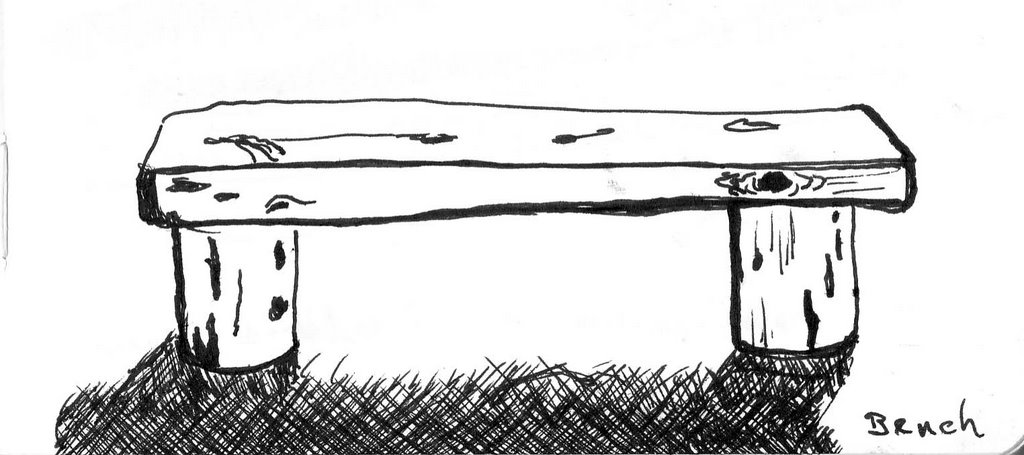
First we walk around through the gardens to the back of the house, and have our picnic lunch on a bench in an alcove shaded by small birches and wildflowers. The nearby stream tumbles over smooth boulders and forms myriad small waterfalls.

The house itself is elegantly plain: medium sized, white plaster with lots of windows. It isn't a showplace; it's a house meant to be lived in. The orginal furnishings, art, music and books are still in place, so it's very easy to imagine Laxness and his family living here. The audio tour is excellent: it is less obtrusive than a tour guide, and the recording includes the voices of Laxness and his wife. You can stand in his study, see the desk he stood at to write, look out the window at the very view that he saw daily. You can enter his bedroom, and see the art and objects he kept close to him. You can see his Steinway piano--the very same one that Bill Holm has played. When I see the grandfather clock in the hallway--ticking et-ERN-it-Y---(the one that the clock in The Fish Can Sing was modeled on) my throat closes up and I choke back tears.

We have an interesting talk with a man who works in the visitors center about our favorite Laxness books, and about movie versions of them. They have many copies of his books for sale, in a variety of languages. I would next like to read: Salka Valka, The Atom Station, and the story about Mosfellskirkja.

As we drive back to Reykjavik, we see (for the first time) the snow-covered mountain Snaefellsjokull in the far distance. You can't always see this from Reykjavik, but it's a beautiful sight. This is the glacier that Jules Verne used for the setting of Journey to the Centre of the Earth, and it is believed to be one of the world's most powerful and spiritual places.

Back to town, it's time to each lunch and pack up. We go with Gabe and Peter down to the harbor to eat at Tommy Burger. I have an absolutely delicious veggie burger accompanied by a coffee milkshake. What makes the veggie burger so good is that they use a mix similar to what is used for felafels, and it really works. Try it yourself!

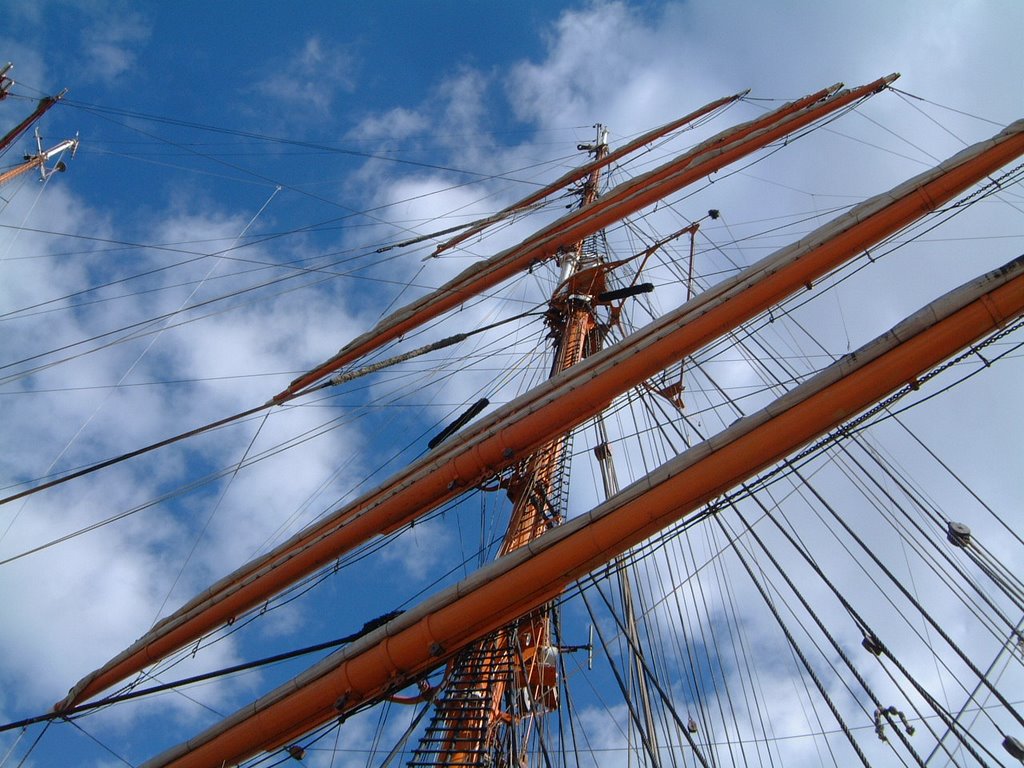
It's a sunny day in Reykjavik which means that, even though the temperature is only about 60°F, many of the natives are walking around in shorts and sandals, eager to soak up the sun. We find a large, four-masted schooner docked in the harbor, and as we approach it we find that it is a Russian training vessel, the shipmates are offering tours, and the tours are free! We take one.

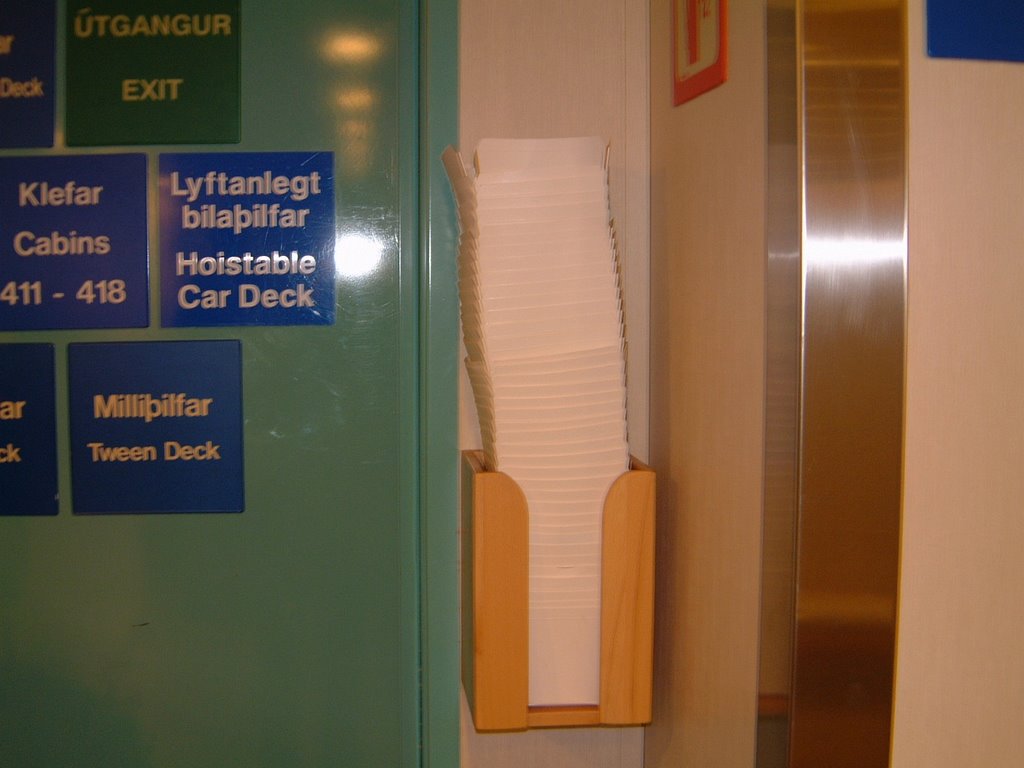
Leaving Reykjavik we have a 45-minute drive to catch the ferry for the Westmann Islands, where we will be staying on Heimaey. Our ferry trip is almost 3 hours. We admire features of our ferry, Herjolfur. First, we observe a stack of containers that look like large chinese take-out boxes. We suspect that these are conveniently provided for when the seas aren't so smooth as they are today. Convenient! Plus, we discover original art hung throughout the ship: oils, watercolors, photographs. Many of them feature Icelandic landscapes, and are quite good.

As we approach the fourteen Westmann Islands, they emerge as unique, odd shapes on the horizon that become steadily more bizarre as we approach. Like Iceland, these are volcanic islands, and our destination, Heimaey, is the only one that is inhabitated, unless you count sheep. Count sheep? We're not even tired yet!

The sheer black/green cliffs of Heimaey are beautiful, with birds everywhere as we come in to the harbor at 10:45 p.m. We disembark and walk through the quiet town until we find Guesthouse Hrithrith, and meet the German owner Ruth, who gives tours to the volcano and bakes bread there in the hot lava. (She is a full-time baker in the winter.) We have interesting midnight conversations in the guesthouse kitchen with a geologist from Scotland and a Chinese translator and his friend from the UK.

John and Gabe go for separate midnight walks on Heimaey. John walks by the cemetary without incident, and then to the lava area. Back at the guesthouse, the boys and I compare the cool features of our different sleeping bags. Gabe wins, with his "Penguin" bag. (That's not the name of the bag, but just that he looks like a penguin in it due to the color design. We offer to get him an orange bill and feet so we can rename it the Puffin bag.)

High 60°F Low 48°F

Jul 18, 2006

The Reykjavik Social Club

Who is going ice climbing on a glacier today? And who is staying behind to socialize in Reykjavik? The guys are going ice climbing...even the one who is old enough to know better. The gal has other plans...plans to stay alive, warm and dry.

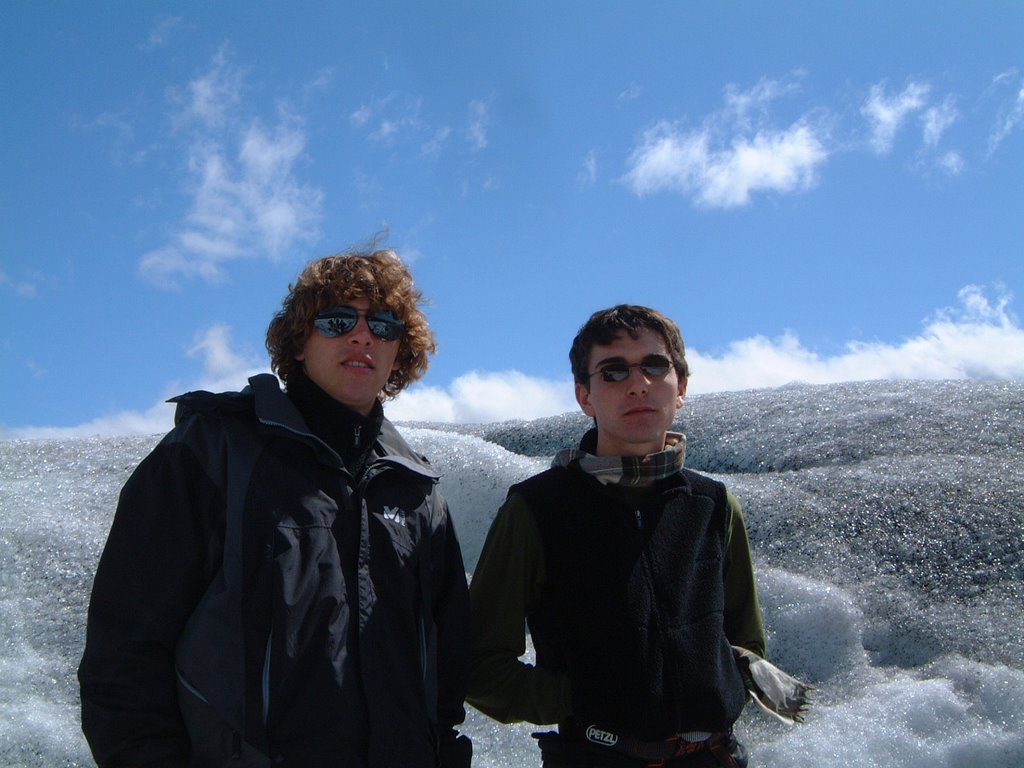
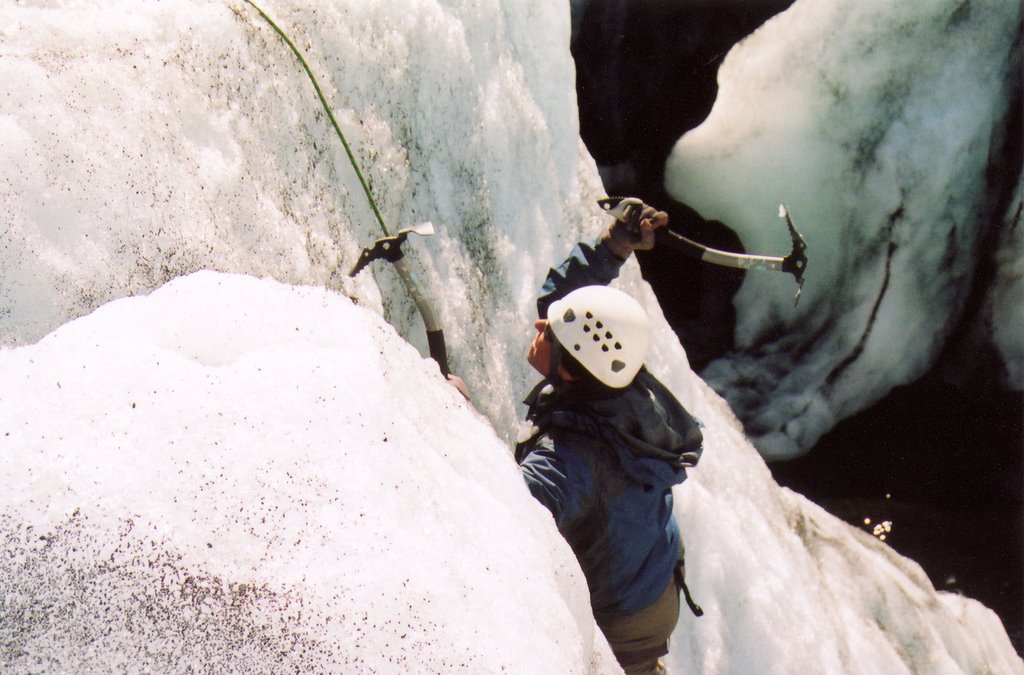
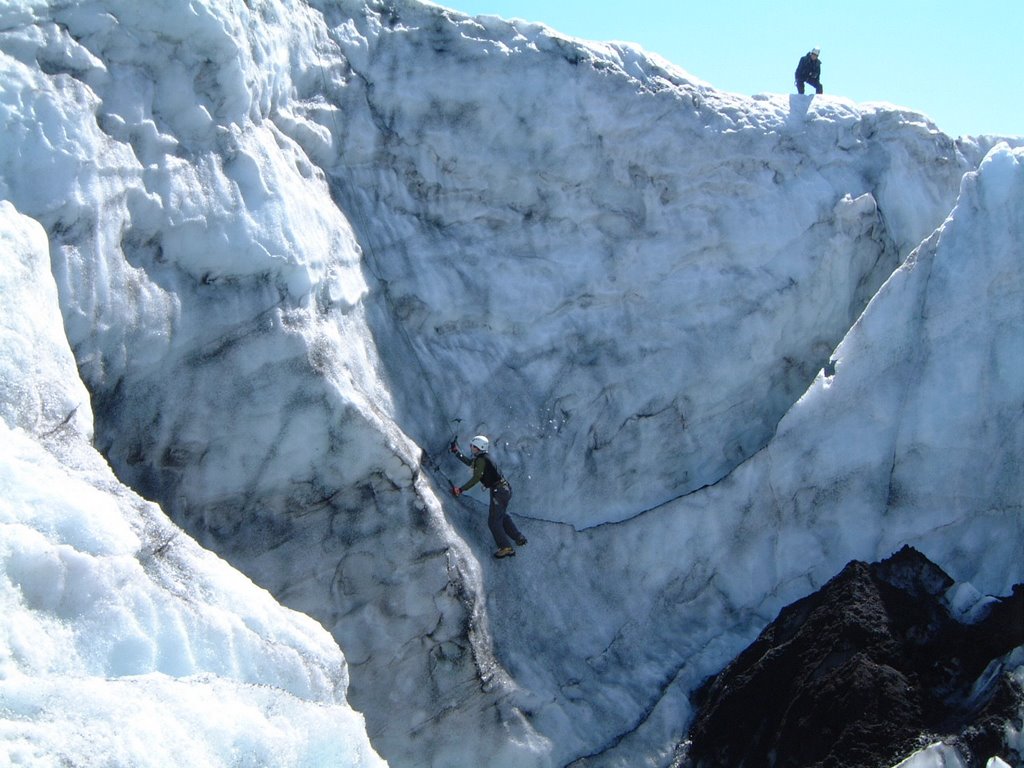
Arctic Rafting Nordic Icemeister Jon, my three guys, and Linda and Tony (a dentist and a doctor from Australia) head off to a finger of the Myrdalsjokull Glacier for a testosterone-filled day. Pete and Gabe have done some rock climbing, but this version of the sport entails spike crampons (on your shoes), helmets (take a wild guess), a harness, ice picks, and long underwear (not a legal requirement). After conquering the basics of ice-picking, rappelling, and then putting the various skills together, our Newbie Icemeisters are let down a large rim and allowed to claw their way back up. Way to go! Peter's trip evaluation: "It wasn't fun, but it was a rush."

On the way back they reward themselves with pastries and a stop at Skogafoss, where they have a New Age experience involving the waterfall and being encircled in a--yes, circular--rainbow. Far out.

Little do they know that when they return to Reykjavik they will find our guesthouse room occupied by someone else, that I have moved out, and that I haven't told them where I, or their things, have gone! But more about that later...

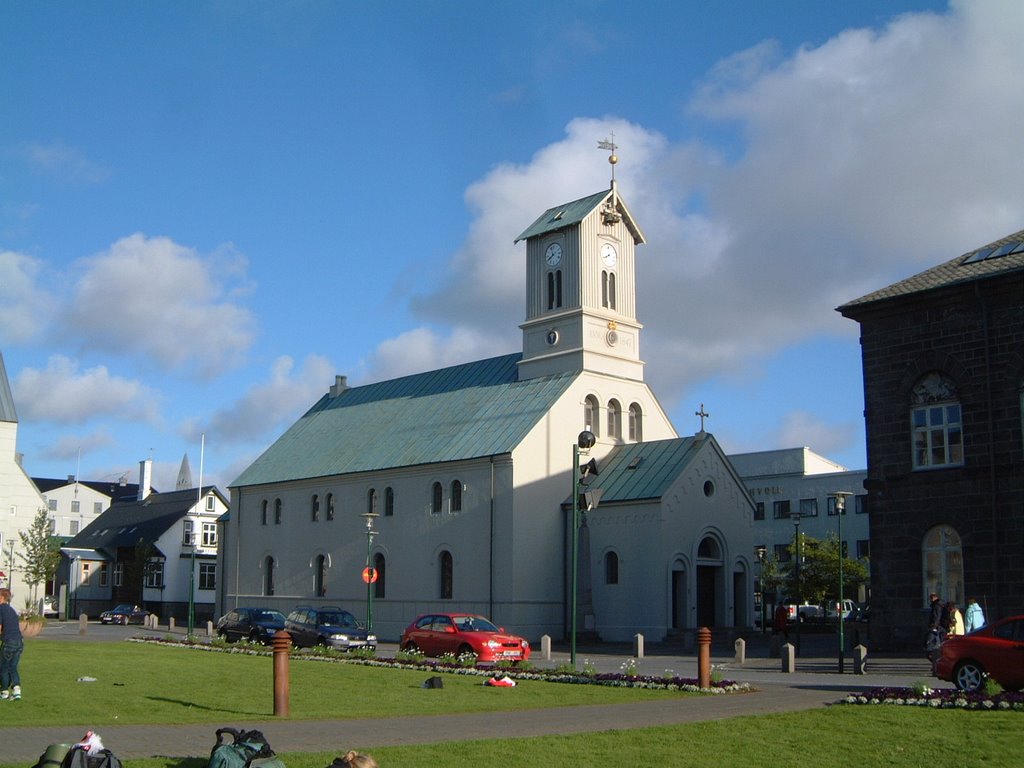
Today I get to spend time with some friends. I have made arrangements to meet Wincie for lunch at Hornith--an Italian cafe with delicious seafood soup. Wincie sings in the Reykjavik Cathedral Choir, and I got to know her through Bill Holm's stories. She is one of two friends who alerted me that Bill was reading one of his stories on Prairie Home Companion when it broadcast from Reykjavik last month--and the story Bill read was a funny and very poignant story about the Cathedral Choir. So I get to meet the delightful Wincie in person. We talk about literature, religion, politics, travel, music. I give her two CDs featuring the choir at St. James's Episcopal Church in Richmond: Jazz Mass, and the recording of their performance in Gloucester. John and I didn't get to hear Wincie's choir when we stopped by the Cathedral on Sunday, for they take a break during the summer. First reason to return to Iceland: to hear Wincie and her choir sing at the Cathedral.

During the afternoon I have an hour or two to spend getting to know Reykjavik a little better. I am able to identify the house where Halldor Laxness was born, as well as the one where Magnus Magnusson lived (see review of Dreaming of Iceland, April 20), each just a block apart.

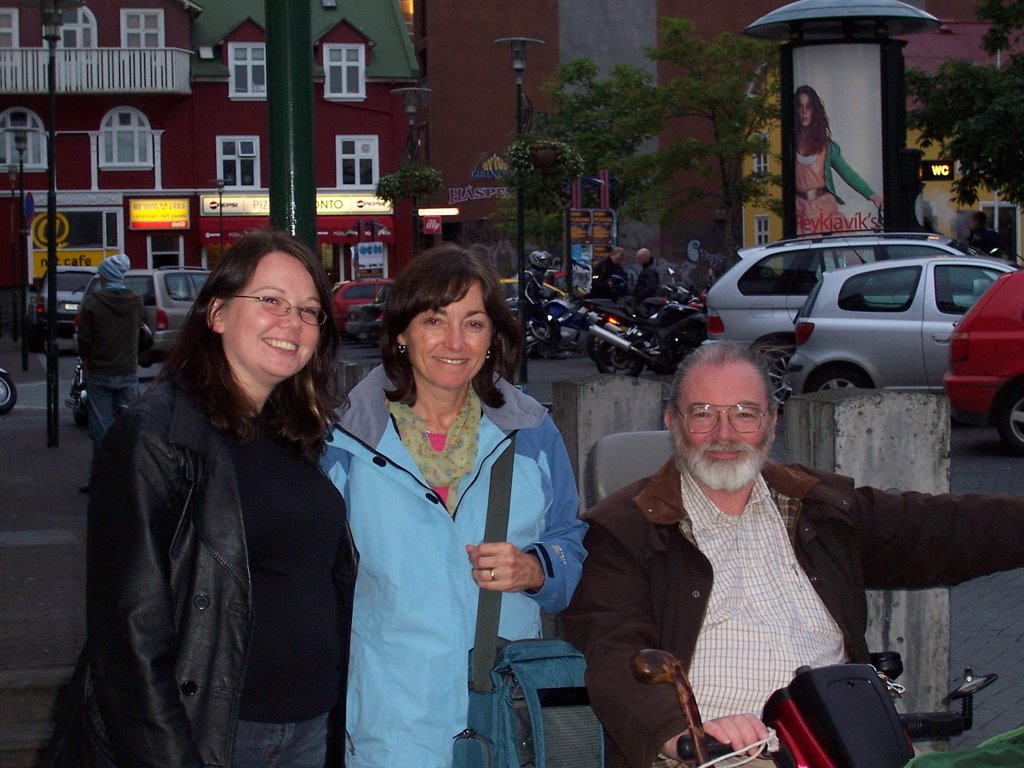
Next I find the coffee shop where I am to meet Gunnella. She has recently returned from living in Edinburgh, and is getting ready to move to Tokyo for a year and a half. No one could be easier to talk to than Gunnella, and there is so much to talk about. The afternoon passes quickly, and soon her Dad, Thor, comes to the coffee shop to meet us. We discuss dinner plans, and wonder whether we should wait for the ice climbers to return. I have the bright idea of inviting them over to see if the guys have returned. Plus, I want them to see our lovely "flat": this morning I was asked by Thor and Sonja (of the guesthouse) if I would mind changing rooms, as another family was arriving that needed our quarters for a week. So, could we move a few doors down for our last night? I agreed as soon as I saw the lovely, two-storey flat, remodeled in Scandinavian modern. So much room! So, I left a note on our "old" room door, which John didn't see, and moved out.

Thor and Gunnella want me to experience dried fish and Brennivin, so we stop and pick up some of the fish, and walk up the hill to our flat. (The liquor store is closed so I am off the hook for trying Brennivin, or "the Black Death--sledgehammer schnapps" made from potatoes and caraway.) It is exciting to host friends in my new flat in Reykjavik, even if it is for just a half hour, in a flat I am to inhabit for a mere 24 hours! Still, it feels like home. When we leave, it smells like a pretty fishy home.

We are hungry and tired of waiting so Gunnella, Thor and I walk back downtown to dine at Einar Ben, a venerable establishment. Thor selects the wine, and the food is delicious, although we don't do it much justice as we are more engrossed with talking than with eating. Thor has a dry sense of humor, and Gunnella and her Dad relate memories in an endearing way, interrupting each other to finish stories ("sorry, but..."), and generally showing every sign of being on a very close bandwidth. John and Peter find us, and we all spend some time at Thor's house after dinner. Thor had travelled the Ring Road in May, so we look at his map and pictures, download pictures we have taken, and have a wonderful evening. Gunnella gives me a CD of our pictures, Thor gives me his map of Iceland, and I give Gunnella a copy I've brought her of Believer magazine. We walk home through the pre-twilight night of Reykjavik, and marvel at the day we've had.
High 54°F Low 48°F

Gates of Hell

Jul 17, 2006

Photo reprise

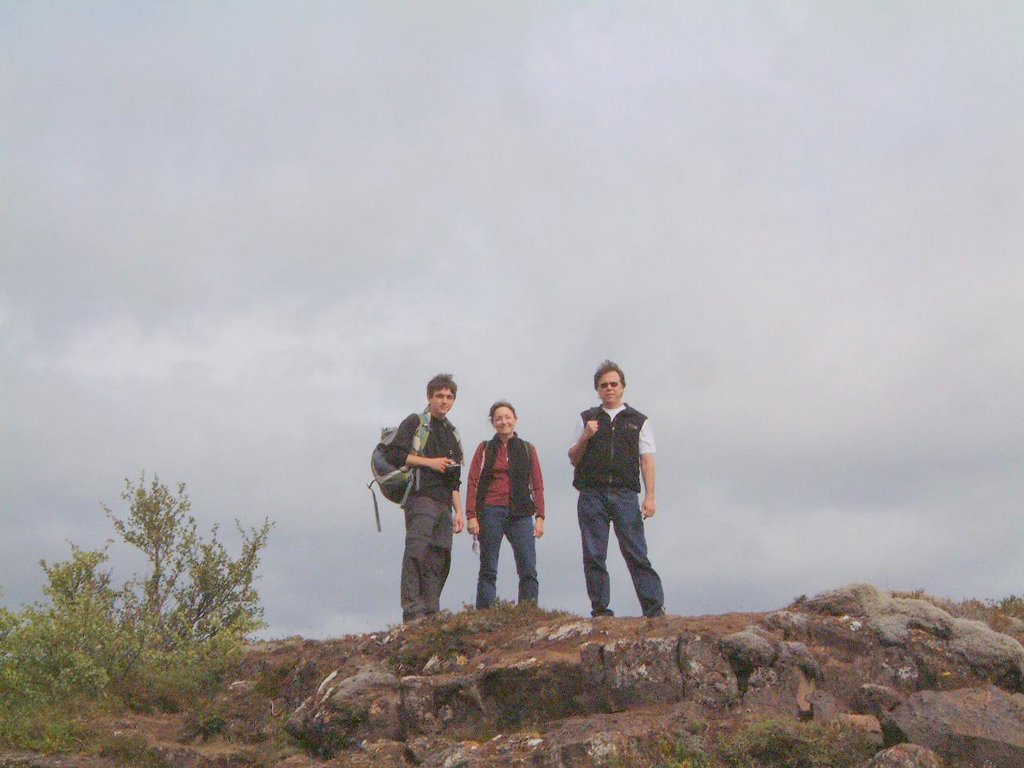
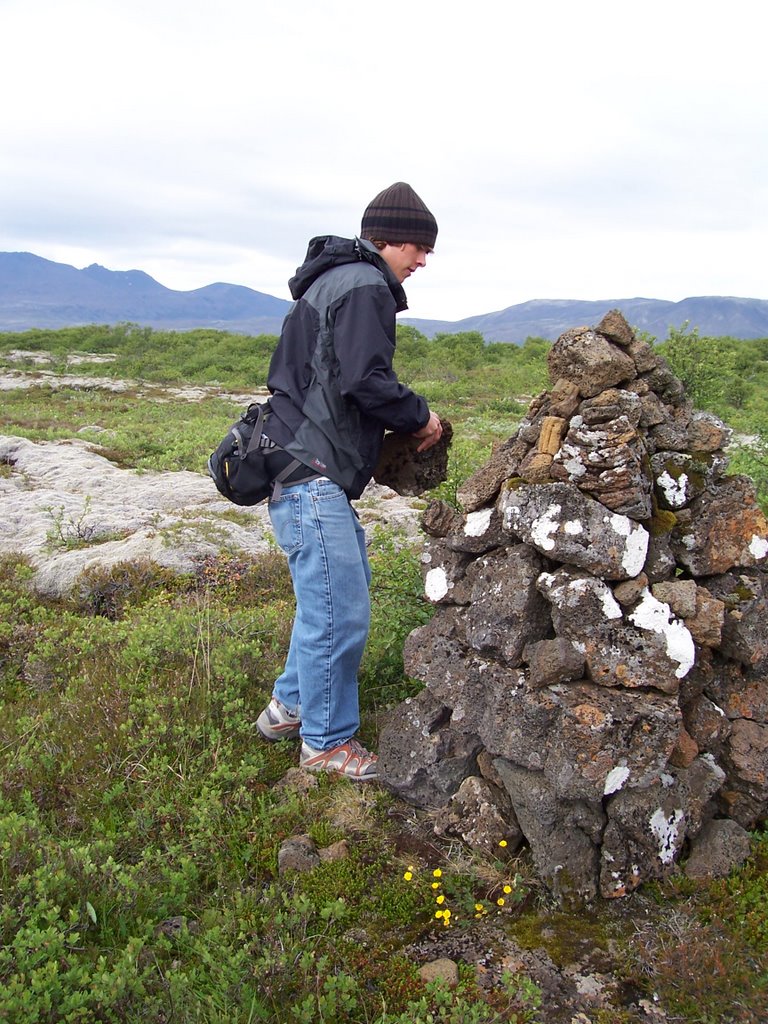
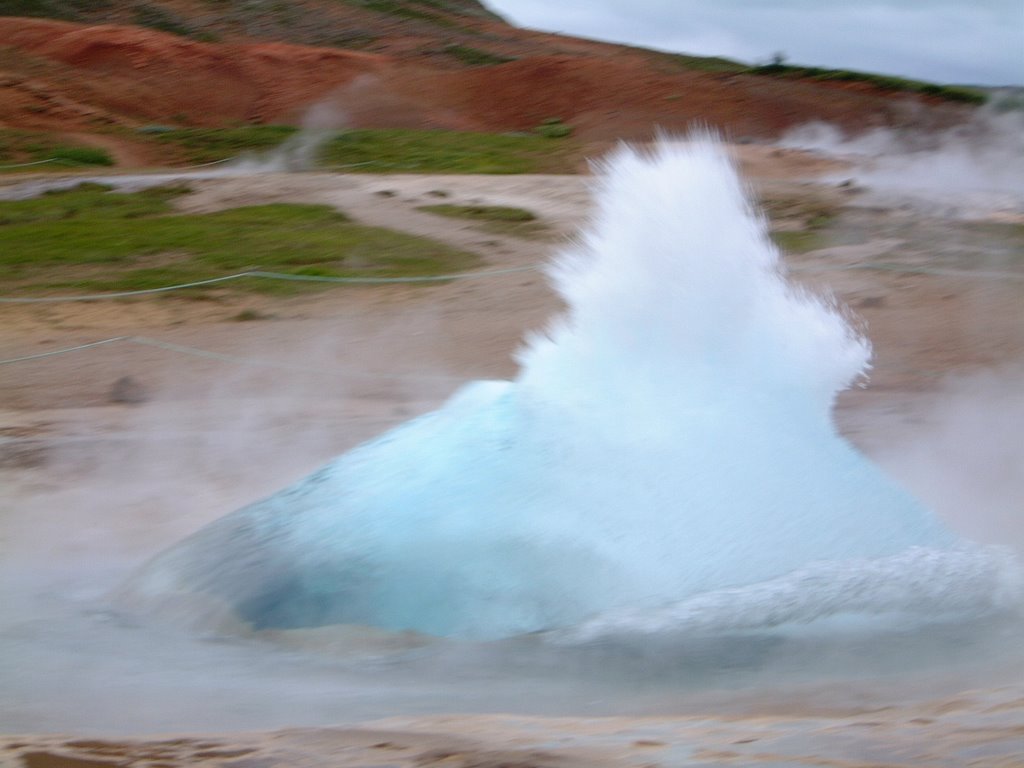
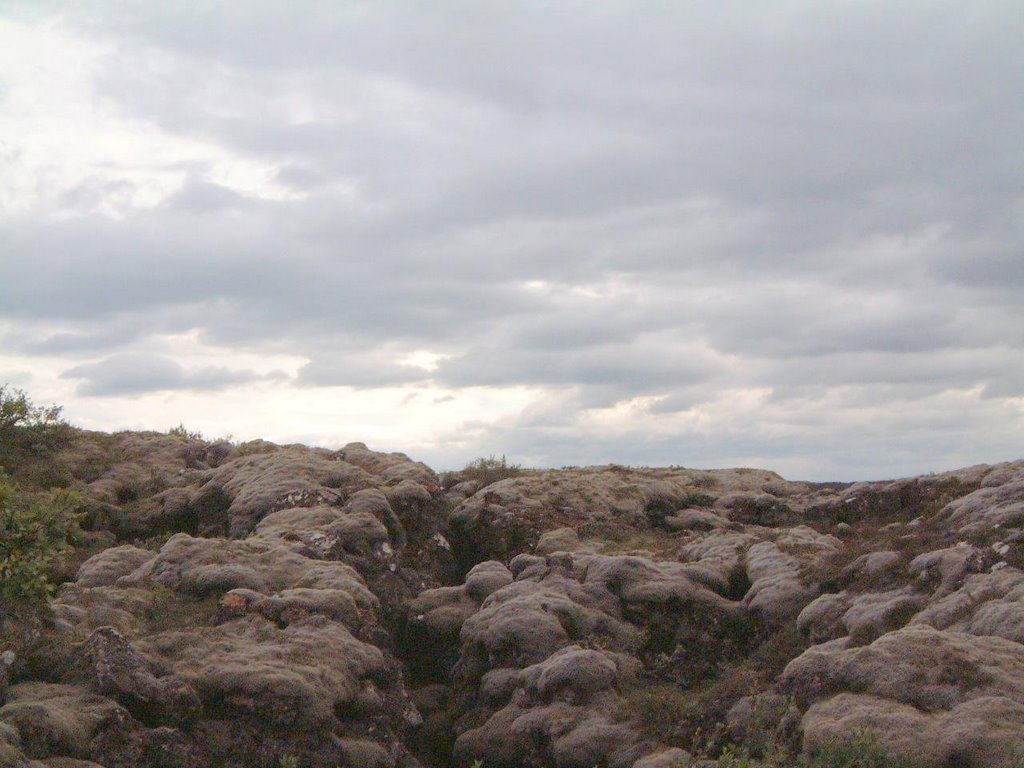
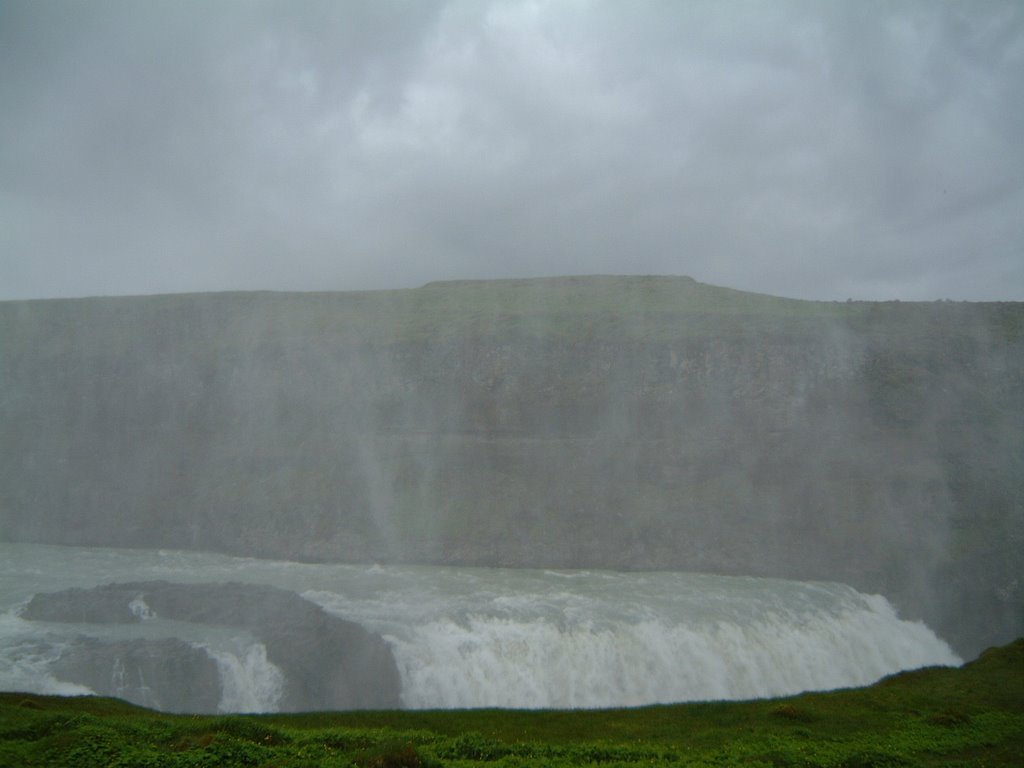
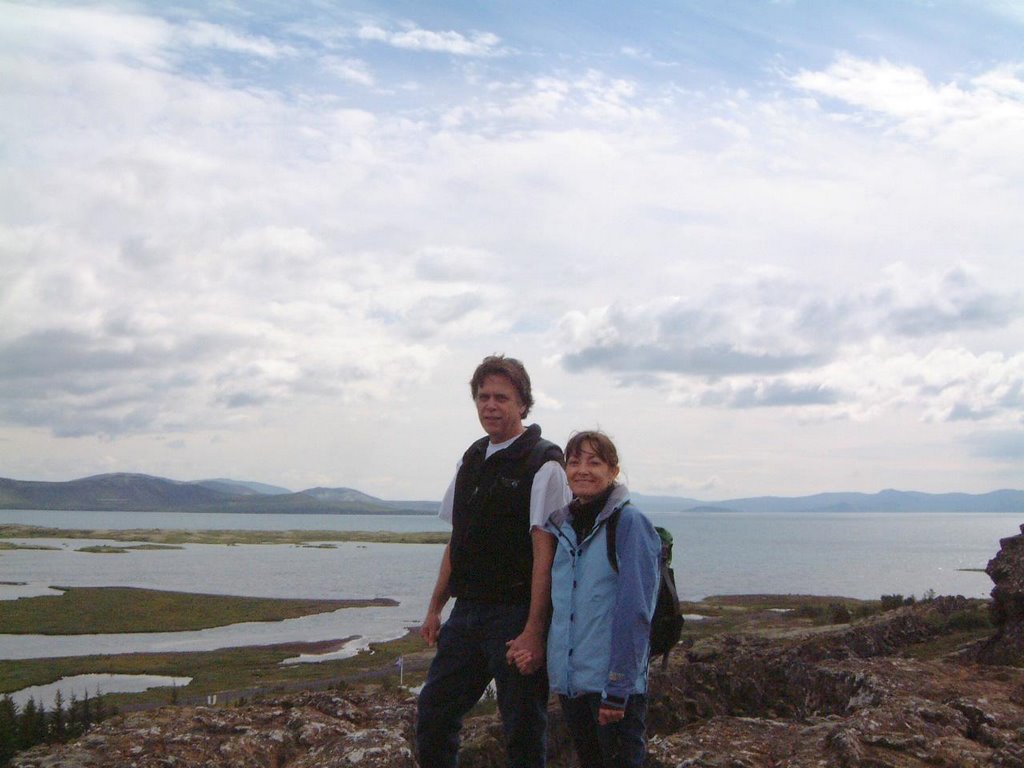
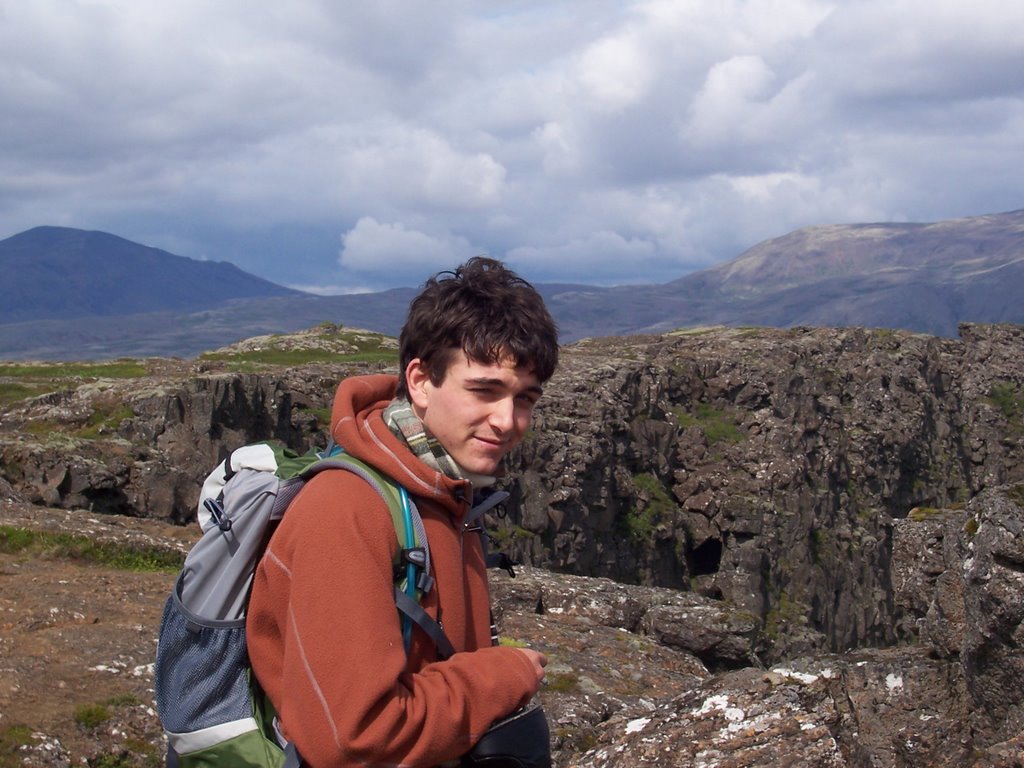
We need more photo documentation! At least until I get some slideshows set up. So, to meet customer demand, here we have: The Magnificent Three, Peter feeding the Troll a rock, Strokkur Ready to Blow, Moss Fields Forever,Strokkur, Gullfoss.

The Center of Iceland

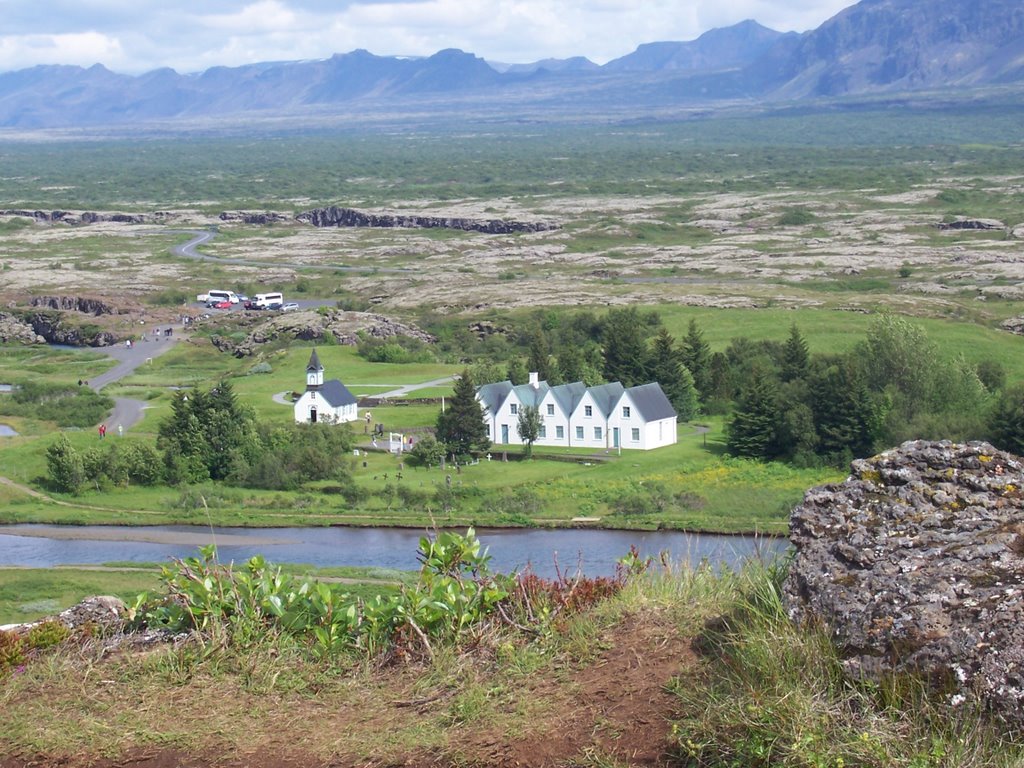
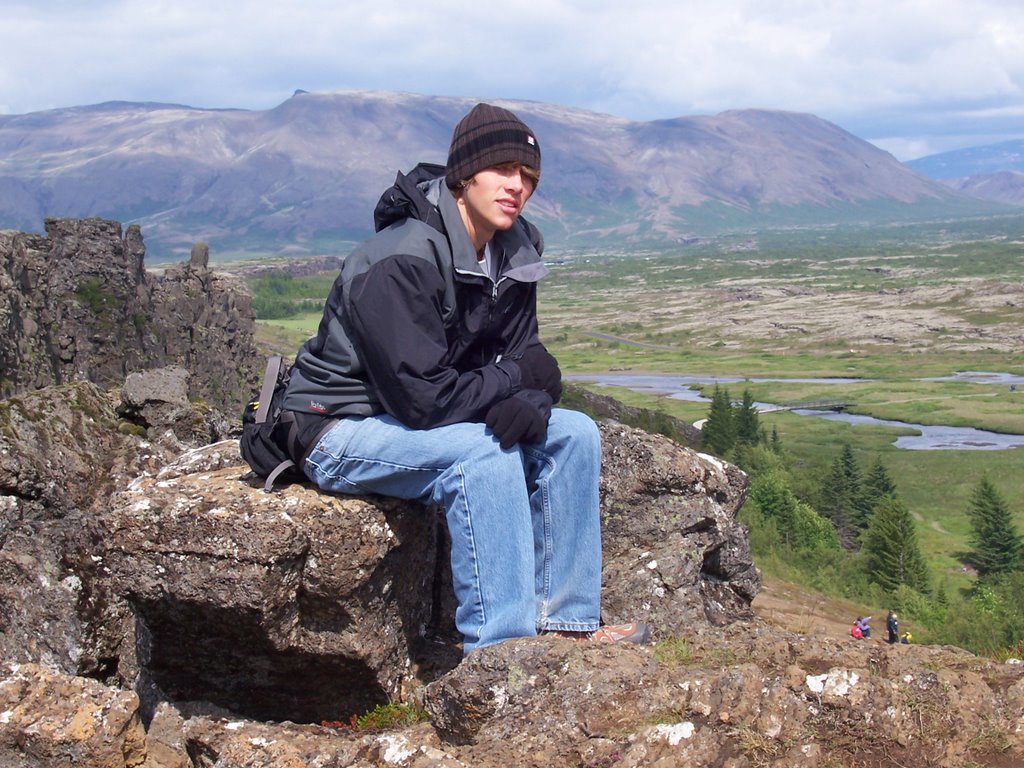
Where is the center of Iceland? Not the geographical center. The center of Icelandic consciousness, culture and history must surely be Thingvellir. It is located just 45 minutes northeast of Reykjavik, yet it has the feel of another place and another time.

What is Thingvellir? The idea that first comes to mind is the birth of government in Iceland. Around the year 930 the Althingi, or general assembly, first met at Thingvellir. Members of the assembly traveled from all over Iceland to this location, which was peculiarly suited to the purpose for a number of reasons. Thingvellir is the site of Iceland's largest natural lake, and its wide plain made it a practical place for large numbers of people to congregate.

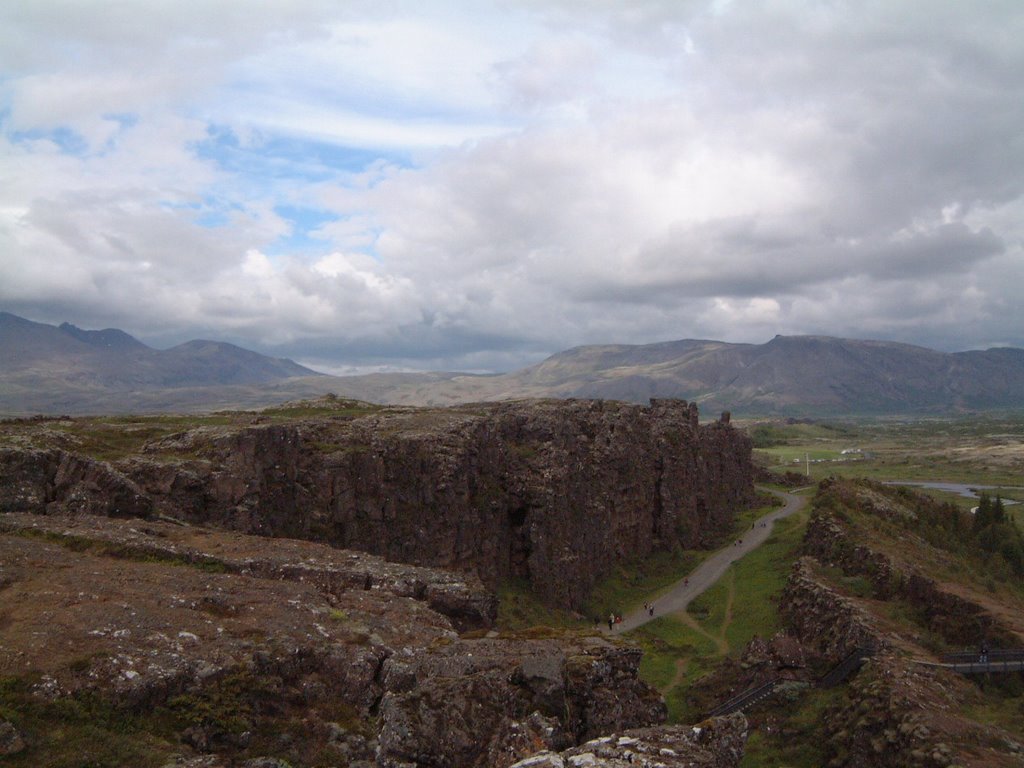
I anticipate that visiting the hangout of founders, lawmakers, heroes and outlaws of Icelandic history will be stirring. But I am taken aback by the compelling physical nature of Thingvellir. The high ridge that runs along its edge is a very imposing, dramatic backdrop to the Law Rock. Waterfalls spill down the side of the ledge, and plant life is varied and abundant.

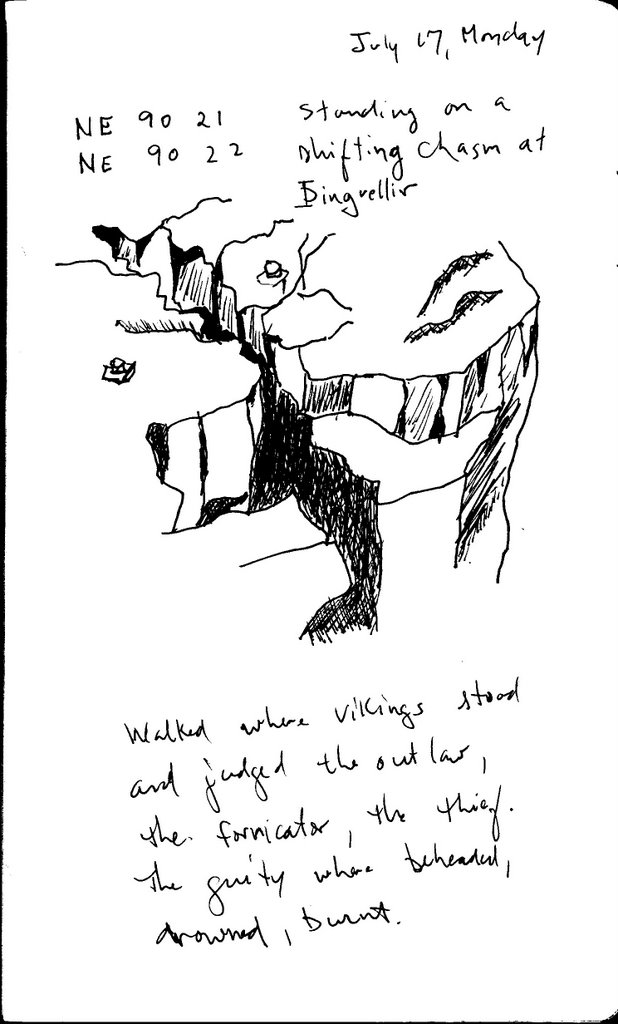
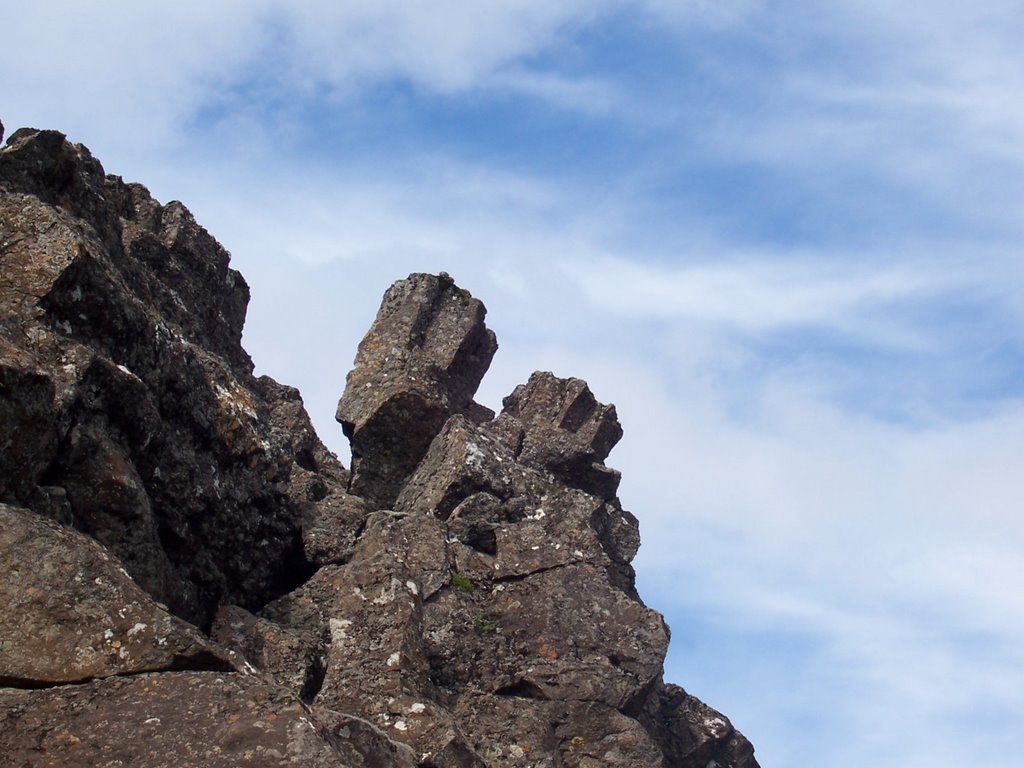
Geologists, too, find their Mecca at Thingvellir. It is here that the American and Eurasian tectonic plates meet, and here that the earth's crust is slowly pulling apart. In fact, John notices two small, brass knobs embedded high in the ledges that appear to be markers, indicating the extent of this movement over time. Hey, 70 meters over 10,000 years may not seem like much to you, but to a geologist...


We trek all around the huge, fantastically formed gorge, ledges, and the lovely plain with its small church. Gabe is curious about something on the map of the area. Skogarkot, the receptionist informs him, was an old farm that had been in use from ancient times until the 1930's. We decide to take a hike there, through the lava fields. Moss beds masquerade as lava: it's hard to tell whether your foot will sink inches into deep moss or strike hard rock until you actually step. I find places where the moss is so thick that it makes a delightful mattress when I lay down in it. Tall rock piles mark the trail with worrying frequency: they are so close together that we ask ourselves if lava-sandstorms, fog or snow make it necessary to mark the trail with such closely placed markers. We add our rock offerings to the tall rock piles as we pass by. Despite having left our picnic lunch in the car, and it is now long past lunch time, the hike is well worth it. We find the old homefield, with a rock fence delineating it and rock cellars marking the old farmhouse.

We leave the magical, evocative valley, and head off through countryside in the direction of a waterfall. We got off to a late start from Reykjavik today: in addition to other errands we stopped by Arctic Rafting, a company that provides guided outdoor adventures. We promised to call or stop by their office by 8:30 pm tonight to find out if enough people signed up for the trip and to confirm tomorrow's plans. The problem is, no cell phone coverage in this area, and it's getting close to 8. Must we skip the waterfall, after driving so far, in order to arrange our plans for tomorrow? Although we are told that there aren't pay phones at the gas stations, we decide to pull in one anyway, and ask.

As we pull into the Esso parking lot, about 45 minutes away from Reykjavik, John asks, "isn't that the Arctic Rafting van?" It is! It has pulled in right ahead of us! I go into the convenience store, and accost people until I find the employee from Arctic Rafting. He obliges by "phoning home" to the office, and all the arrangements fall into place. Love those cosmic coincidences!

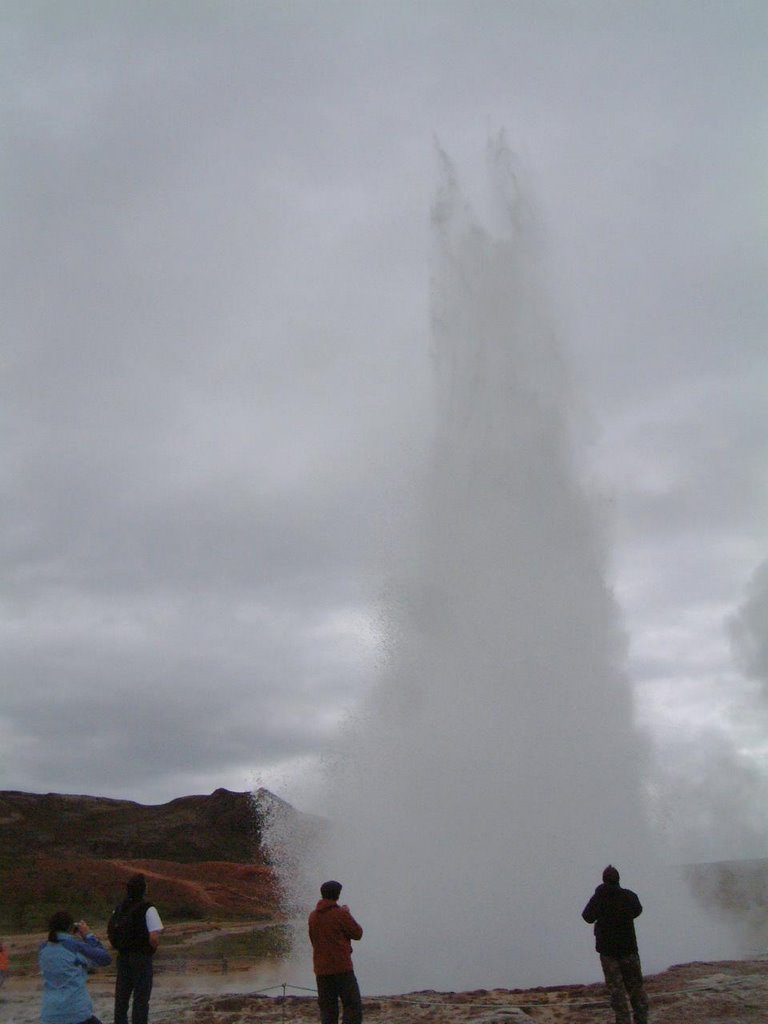
On our way to the falls, Gabe asks about a plume of "smoke" that he sees far in the distance. I confess to knowledge of a geyser in the area, and it is clear that we have found it. "Geysir"--the big one--decided to go on an extended vacation years ago and no longer discharges. But "Strokkur" is very impressive, and we stay much longer than we intended to watch him perform over and over again, every 10 minutes.

We reach the waterfall, the famous Gullfoss, when it should be dark. But it isn't, it's misty and dusky, and a lovely light in which to view the falls. You can get as close as you like...no danger signs and fences. I don't like to get too close...but other people in our party do. The cafe at the falls is still open, so we can have a late dinner. The view even includes a glacier in the distance. We buy an Icelandic bumper sticker and patches for our backpacks, and drive back along a route dotted with steam rising from geothermal pockets, marveling at the good fortune we've had throughout the day...especially when the Arctic Rafting van materialized right before our eyes. What a day! Home at 11:30; still light. High 54°F Low 42°F

Jul 16, 2006

Meeting Iceland

Note: You can click on any of the pictures to enlarge them!

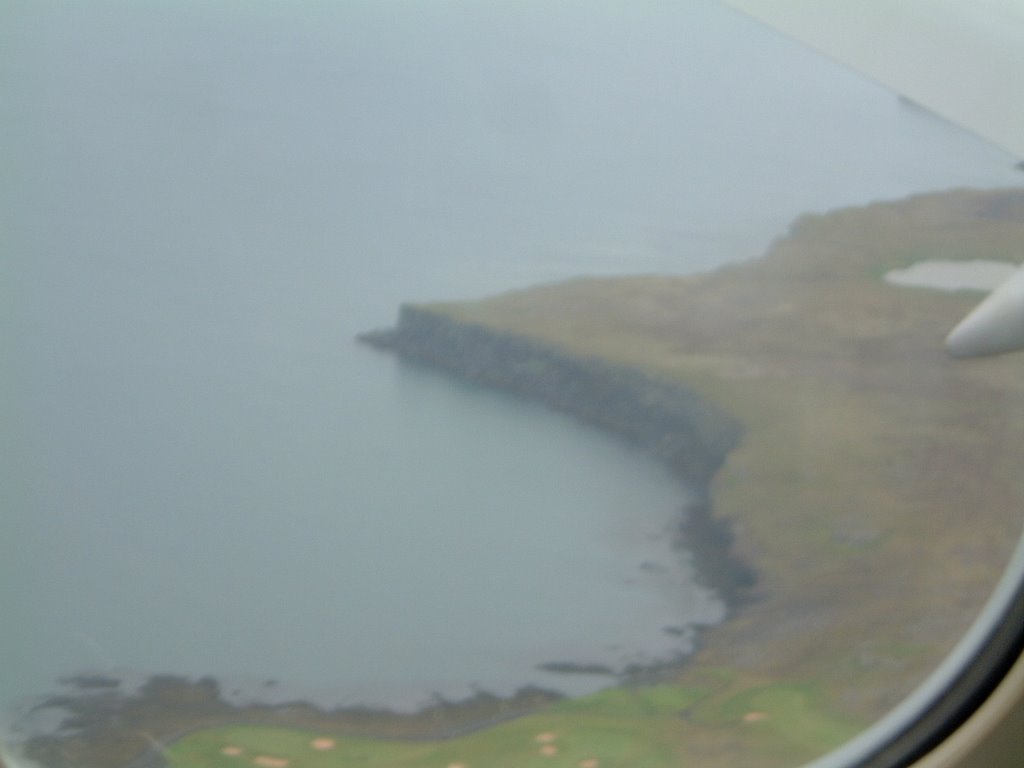
6 a.m., and I see Iceland for the first time. As we descend through the low cloud cover I can see the outline of the coast through the fog. It's an emotional moment for me, and not because of the golf course (which you can barely see at the bottom of the picture).

The trip from the airport, in our rental car, takes us across a huge lava field with outlandish lava formations that seem even stranger in the fog. It takes us 45 minutes to reach the capital city of Reykjavik, which contains about 200,000 people (two-thirds of the total population of Iceland).

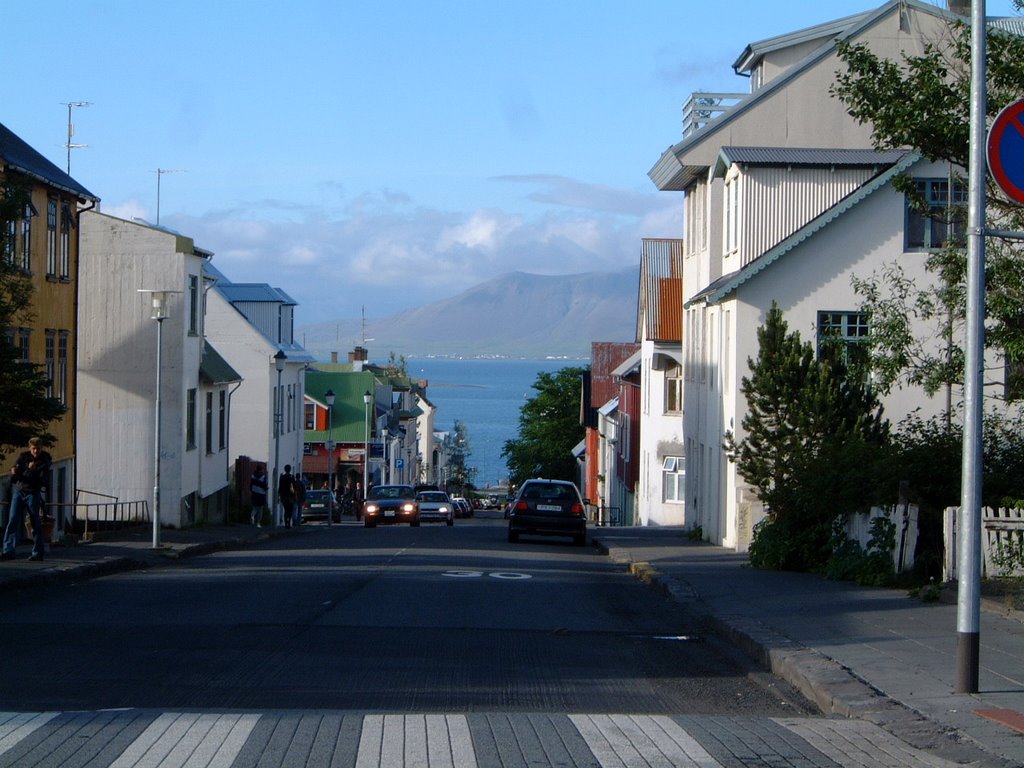
Reykjavik is situated on a large bay, and features many hills. Our overwhelming impression is of color: vibrant houses in intense, saturated hues, metal roofs of dark red or green, blue sky and sea, lots of flowers (which seem to be on steroids: I've never seen such large dandelions or lupines). Even when it is raining, Reykjavik never appears dull. The city offers a lot of visual texture, with corrugated iron siding complementing wood board and batten siding, roof lines of many shapes, and all kinds of architectural details.

But enough about Reykjavik! What about us, the Icelandic Neophytes? Over the next two weeks we will never see John without his daypack, which conveniently has a pocket for his notebook, pen and pencils.

Click on picture to enlarge:


During the course of the day we investigate a variety of coffee shops. The theme for the day is rain, rain, rain and coffee, coffee, coffee! Fortunately the rain seldom lasts for long, but it ingrains in us a habit that will last the entire trip: we never go anywhere without either wearing our rain jackets, or having them tucked into our daypacks.

We return to Three Sisters Guesthouse where, we had been told: "We, and Iceland, will take care of you." Sonja and Thor show us to a comfortable room slightly below street level with lots of windows, room for 4, its own bath, and best of all a kitchen! We wake Peter up and move in. Three Sisters is right in City Centre, the historical part of town. You can walk everywhere, and the picture shows how close we are to the harbor.

We spend our first day getting acclimated. We buy food at the grocery store and walk all over town. We find the Tourist Office, the banks, the bookstore, and the landmark Hotel Borg (like a trip back to the 1930's with its art decco designs).

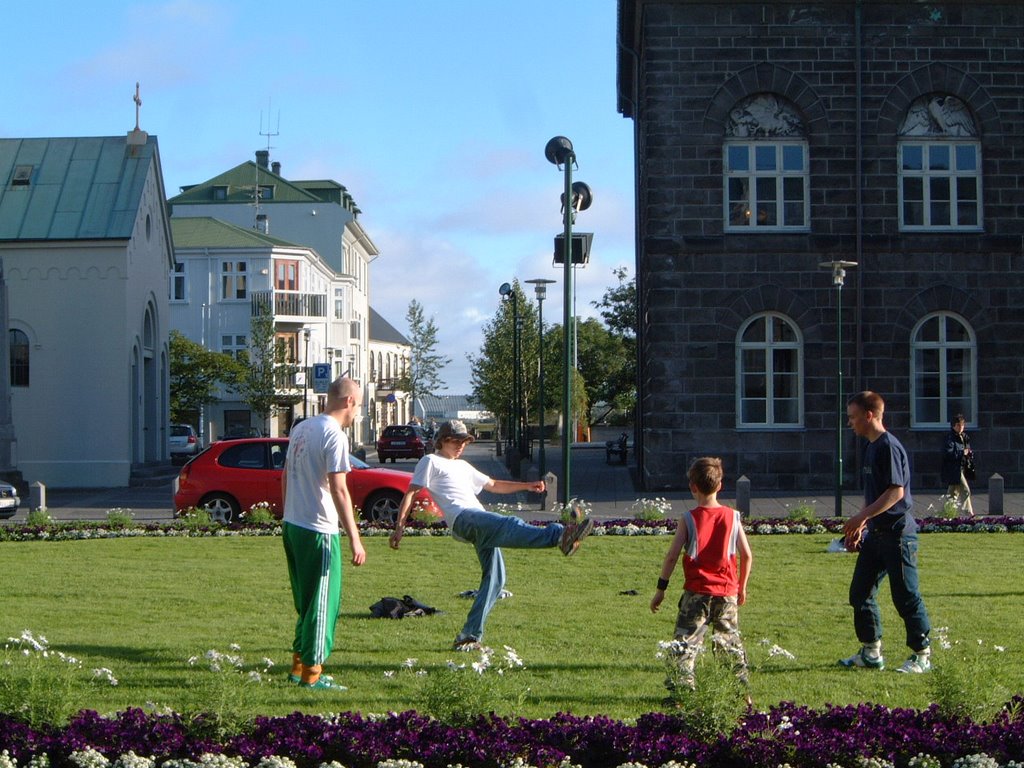
Peter meets up with some Icelanders and finds that hacky sack is an international language.

Late in the evening John, Gabe and I walk along the shore that borders the city. We encounter some women who tell us about an art exhibit they have just installed in a lighthouse offshore that can only be reached during low tide.

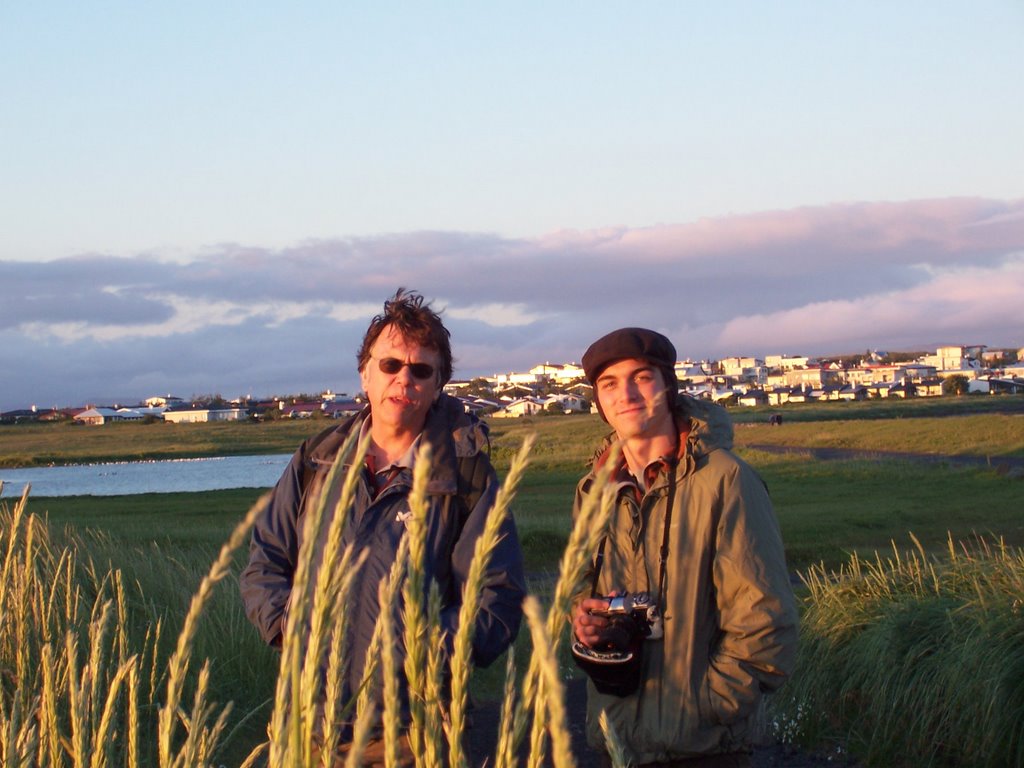
Light extends the day--night and darkness never come--and it is difficult to go to bed with the late evening light beckoning. These two pictures were taken at about 11:00 in the evening:


Iceland High Today: 52°F
Low 46°F

Jul 15, 2006

The Challenge

We were challenged to each do a drawing a day while in Iceland. All four of us plan to keep a journal...but who will meet the Challenge? John gets off to an excellent start in the Richmond airport and en route to Reykjavik:

Anticipation


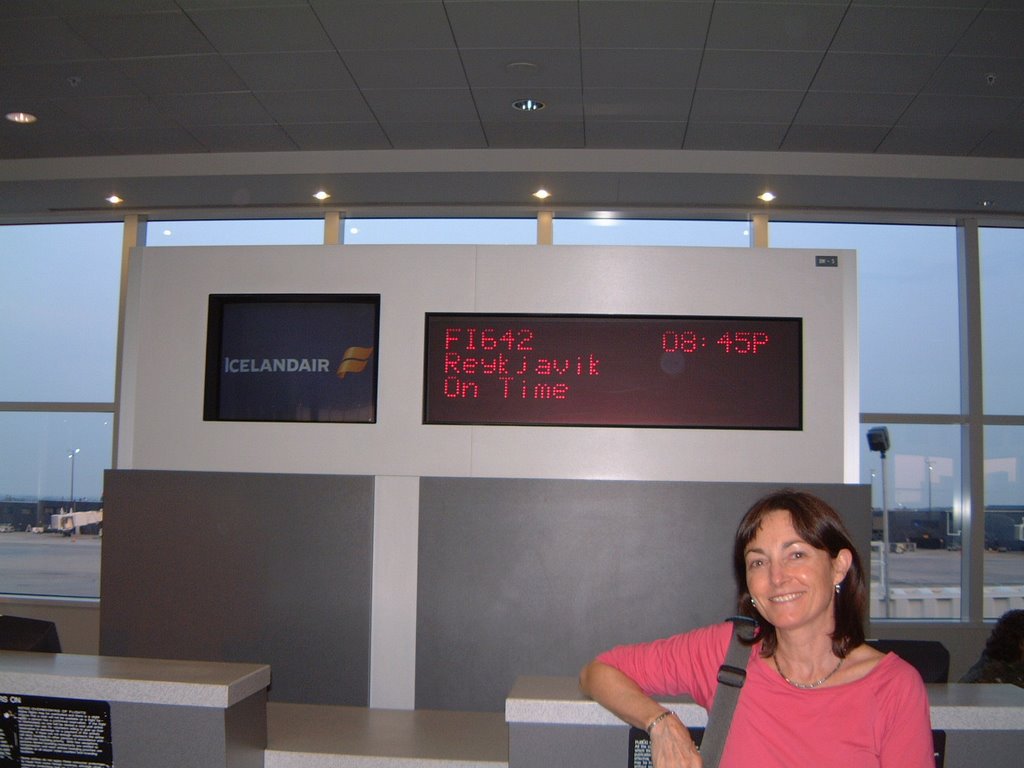
On time and ready! We are flying out of BWI (Baltimore) --one of our efforts to keep within our budget this trip. Will we? The suspense builds...

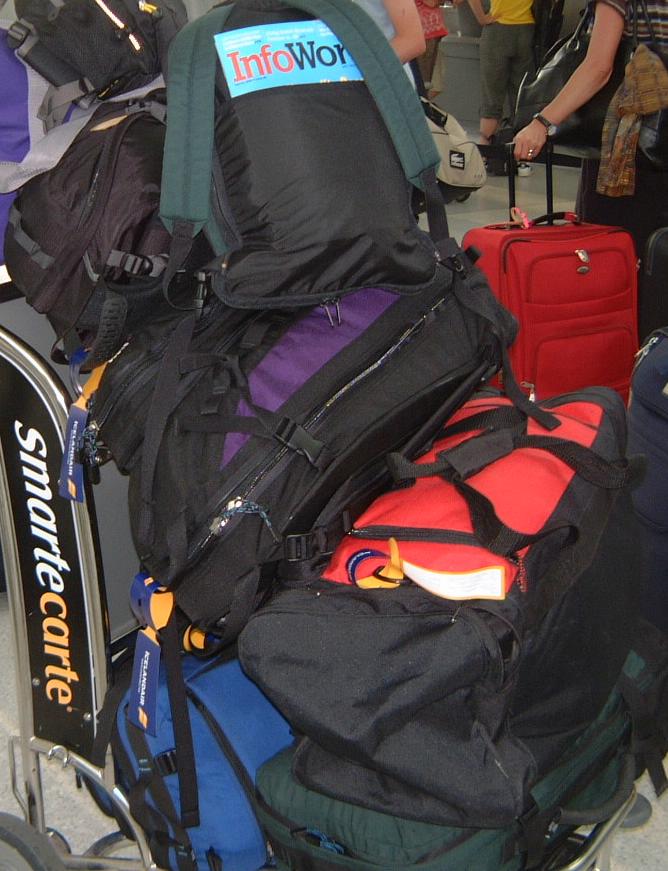
We are traveling "light." Each of us has one large backpack. Well, and a few extras: small backpacks, a large cooler that packs flat, a duffel bag. But for our family, this is much better than usual. I am particularly proud of having packed my hiking boots, sleeping bag, and ALL of my clothes in my backpack.

An odd coincidence occurs as our plane is ready to arrive at the gate. Peter finds out that his friend Josh is on it. Josh has taken Icelandair to and from Germany, with a short stopover in Reykjavik. He is on the same plane that will return to Iceland with us on board. Peter meets Josh at Customs to catch up before we leave.

Yes, we're flying Icelandair despite their not having recognized the excellence of my essay last spring, when they awarded their Spring Break trip to Someone Else. I am still trying to Get Over It.

My family graciously gives me the window seat, to afford me the earliest possible glimpse of Iceland. 8:45 pm and we're off!

Jul 14, 2006

One More Day...

To get ready for our trip to Iceland! Will 12 days be enough to see everything? I think not! Will we have fun despite wind, rain and cold? I think so! Will we run out of money? If we do, you'll hear from us! I will post blogs of each day of our trip...but not until our return. Iceland, here we come! My dream is about to come true.

Jul 4, 2006

Complete Sagas of Icelanders
Vidar Hreinsson, General Editor; Introduction by Robert Kellogg. Reykjavik: Leifur Eiriksson Publishing, 1997. 5 volumes.

What nicer gift for Christmas or a birthday than this? Everything you'd ever need, saga-wise. This set is a beautiful edition. The physical design of the spine and cover, the binding, and the typography are all superior. As the preface states, this set contains the "first complete, coordinated English translation of The Sagas..., forty in all, together with forty-nine of the shorter Tales...". It goes on to say that "editorial coordination has been a constant quest to balance the shared and independent characteristics of the sagas, and to re-create in English their diverse but distinctive world." They are organized by broad subject categores, such as "Tales of the Supernatural," "Regional Feuds," and so on. Reference materials are found at the end of Volume 5. All this, for just $500.

Sagas of Icelanders: A Selection

Preface by Jane Smiley; Introduction by Robert Kellogg. New York: Viking, 1997. 782 pg.

A more affordable book, containing ten sagas and seven tales reprinted from The Complete Sagas of Icelanders in one, large volume. The introduction, maps and reference materials provide context for the material, and are also excerpted from the Complete Sagas.

The selection...includes texts from most periods in the 'Age of Writing', but its chief aim is to show the diversity of good literature within the family saga canon, and it contains representatives of all main literary types, set in virtually all the known Viking world.If you don't have the money or the shelf space for the Complete Sagas, then this is an excellent alternative.

Or what about another favorite of mine, the Penguin Classics: small, transportable paperbacks, convenient to carry with you. The Penguin sagas have really excellent translators such as Hermann Pálsson and Magnus Magnusson. Many of the best sagas are available in Penguin editions...search the Penguin site using the term "sagas."

Jul 3, 2006

No Such Thing
Directed by Hal Hartley, 2001
Filmed in Iceland


Only two puffins--need I say more? A loosely updated Beauty and the Beast. Good makeup and special effects; cute girl; great scenery. Billed as a fairy tale, this is a distinct case of confused identity. Nothing more to say, unless you want to hear the negatives. If you want the negatives, watch the film.

Jul 2, 2006

Saga of Grettir the Strong
Translated by Bernard Scudder, Edited with an introduction and notes by Ornolfur Thorsson, Penguin, 2005.


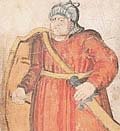
Illustration: Grettir the Strong
from a seventeenth century manuscript
in the Arni Magnusson Institute, Iceland


This saga takes place in the eleventh century, and was probably written near the end of the Middle Ages and the beginning of the Renaissance, around the 16th century. It is possibly one of the bloodier sagas, with people being killed for all of the typical reasons: insults, revenge, theft, revenge, a little temper tantrum, fights with trolls and ghosts, revenge. But there is more of it in this saga, because Grettir...well, Grettir just isn't very socially adjusted. He is the strongest man in Iceland and much of Norway, but he never learns from his mistakes. He can sometimes forsee his future, but is unable to change it. Which is to say, he is unwilling or unable to change himself. What more dire future could a person face?

Grettir takes a "saga tour" of Iceland during his long period of outlawry; many vignettes of historical places, figures and tales are interwoven into Grettir's story. It contains violence, magic, feats of strength, passion and lust, and humor. The bulk of the story is made up of Grettir losing his temper, killing someone (or many someones), and being driven off somewhere else because, surprisingly, he makes people nervous. However the last quarter of the book really picks up as Grettir begins his exile on Drangey Island with his brother Illugi and servant Glaum.

Drangey Island is the ideal spot for an outlaw. In Grettir's time it was jointly owned by several landholders, and populated only by sheep. The only way to ascend the steep cliffs that protected the island from intruders was, and is, by way of a ladder. Grettir and his companions attained the summit, pulled up the ladder, and had enough lamb to last them several years, to say nothing of natural spring water and a limitless supply of birds for meat and eggs. The landowners were entirely helpless to rescue their sheep or their land, or to evict Grettir.

The story of how Grettir was overcome and outwitted involves many individuals over many years. It culminates in a crone, or witch, who places a curse on him. When Grettir realizes what she has done, he hurls a rock over the cliff of Drangey at the woman, resulting in this typically wry dialogue:

A great shriek was heard. The rock had hit the old woman on her thigh and broken it.
Then Illugi said, 'I wish you hadn't done that.'
'Don't find fault with me for that,' Grettir said, 'but it disturbs me that it didn't hit her hard enough, because a crone's life wouldn't be too great a price to pay for both of ours.'
'How could she pay for us?' asked Illugi. 'That wouldn't make us worth much.'

Although this saga deals primarily with outlaws and warriors, near the end of the story some selfless and honorable characters emerge, in some surprising places. Another really intriguing aspect of the tale is that so many of the physical places where events occured are identifiable places that can be visited, such as Grettir's Lift, Drangey Island, Haerring's Leap, and Grettir's Pool.

We plan to visit them all, just a few weeks from now.