
Showing posts with label sketch. Show all posts
Showing posts with label sketch. Show all posts
Jul 29, 2006


Jul 27, 2006
Views of Snaefellsjokull
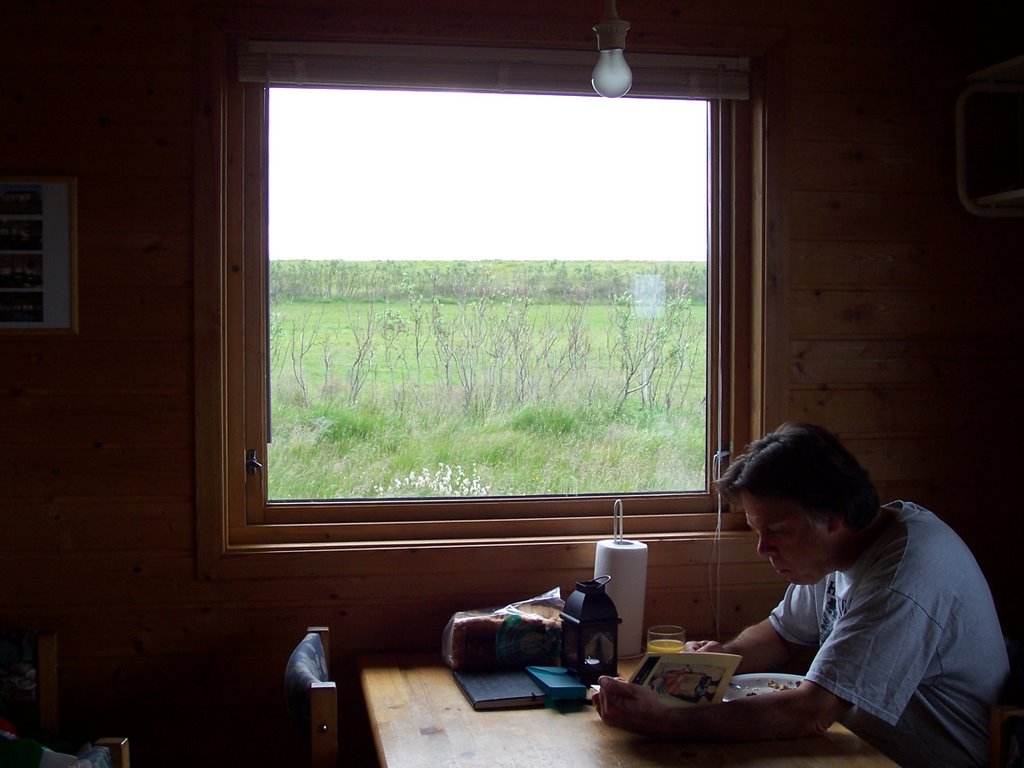
Trying not to think about this being our next-to-last day in Iceland. But...we can see the elusive peak of Snaefellsjokull today; surely that must be good karma. That must mean we're coming back!
On the good karma scale: the weather has cleared up, and no rain means we can go horseback riding; we have only lost one thing this entire trip (Pete's swim suit got left behind at the hot springs pool yesterday); we all are in possession of our passports.

On the bad karma scale: horseback riding here costs a lot more than on Heimaey; our guides are a little more cautious for our safety, which means a slower pace; we can't visit Litla Hruan/Little Lava. Oh, and John is about to lose his wallet.
It's a great day for a two-and-a-half hour horseback ride. This is Peter's second horseback ride in his life! It is cloudy and cool but the cloud cover isn't low, which means we can also see the Eldborg volcano and lots of other interesting sights. I have a horse that is "go-ey," a term that means active. Our guides are Emma (whom I met yesterday) and Sara. Emma is a horsewoman from France, and Sara is an Icelandic college student; both of them are working here for the summer. I ask Emma if she misses French wine, and she replies no, that she doesn't drink. I ask her how she enjoys Icelandic food, but unfortunately she doesn't enjoy much of it: she's vegetarian. Hmm, not eating fish leaves you with few options in Iceland. I ride next to Emma and learn a lot about Icelandic horses and their unique gaits, dressage, and all kinds of things pertaining to horses.
 Pete, Sara, Emma and horses
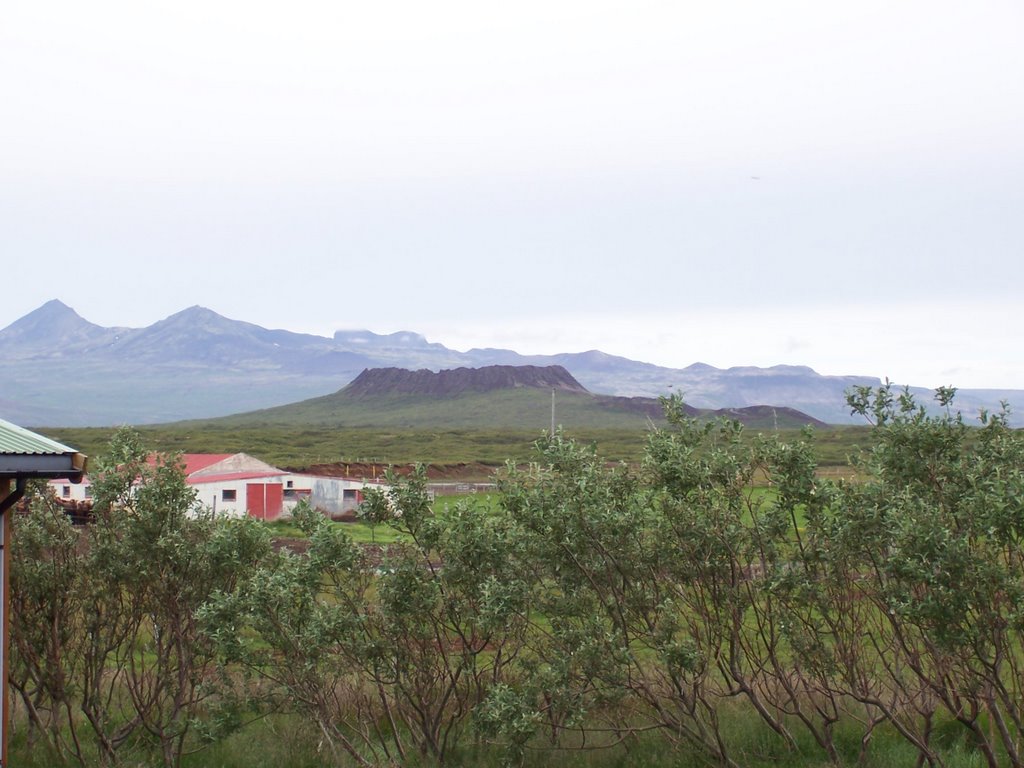 Back at the cabin we enjoy the steamy hot tub. All of our muscles are relaxing in the heat, except John's. John's muscles are not relaxed. John's muscles are very tense. While John was tolting around the Icelandic lava fields his wallet s-l-o-w-l-y worked it's way o-u-t of his pocket! John doesn't admit defeat easily, let me tell you. He goes to look for his wallet, conscripting Pete and Gabe to help him. They end up retracing the entire horseback ride, on foot. When I see that they have returned 1) without smiles, and 2) without the wallet, I refrain from asking them if they tolted all the way.
Quote from John:
There was something out there. I don't know what it was. Maybe it was trolls who stole my wallet. I'll have to find out and write a saga of my own.Oooh ooooh! Sounds like...another trip to Iceland! A discovery trip! John finds out if huldafolk have his wallet, and that he must bargain with them to get it back! Will he sell his soul? His wife? A hint: in the upcoming series, John bargains with the huldafolk by promising them...his two cats and his joint-custody dog Foo! Uh oh, is divorce on the horizon? Will Darien permit family members to be sold off in this callous manner? Tune in...
We drive back to Reykjavik, after a stop at a police station in Bogarnes to report the missing wallet (they weren't too interested...they also weren't wearing policeman uniforms...definetly the casual look in Iceland). Three Sisters has room for us again tonight! It feels like coming home to be chatting with Thor and Sonja, and back in our "old" room. We haven't had many meals out lately, so we treat ourselves to a very special meal for our last night in Reykjavik. The restaurant we select is near Wincie's cathedral, in the old part of town.
Vid Tjornin is a charming place (Tjornin is the name of the small lake in the center of Reykjavik, nearby), and has a casually elegant charm: floral wallpaper, lots of vintage china, old photos, a nice view from the windows. Peter says he has never eaten in such a fancy place, and that he is glad his job at Bottega has taught him how to! Tonight is a record for the trip: $275. USD--that is with three entrees for four people, and two desserts shared among four. No wine. It is worth it though (especially since we are under budget for the trip).
The table next to us has a mix of people from Iceland and visitors from various European countries. The hosts treat one of the men to hakarl (putrefied shark, aged for 5 months or so), washed down with Brennevin (liquor made with potatoes and caraway). Gabe, Pete and I are very eager to treat John to this national delicacy, but he declines our offer. Darn, now that would have been entertaining.
I call Gunnella and her Dad Thor and make dates for tomorrow. The "boys" hang out until 3 or 4 am, meeting up with various groups of young people and perfecting the Icelandic words Ja and Nei.
Meanwhile, John and I walk around the city until late in the evening looking for Skarphedinsdottir's gallery, but it has moved. We hear live music several places: good jazz, and blues in Icelandic, which is kind of weird. Late night, good weather, people young and old wandering all over the city. Too bad the evening has to end!
Jul 25, 2006
Goodbye Hofsos and Holm
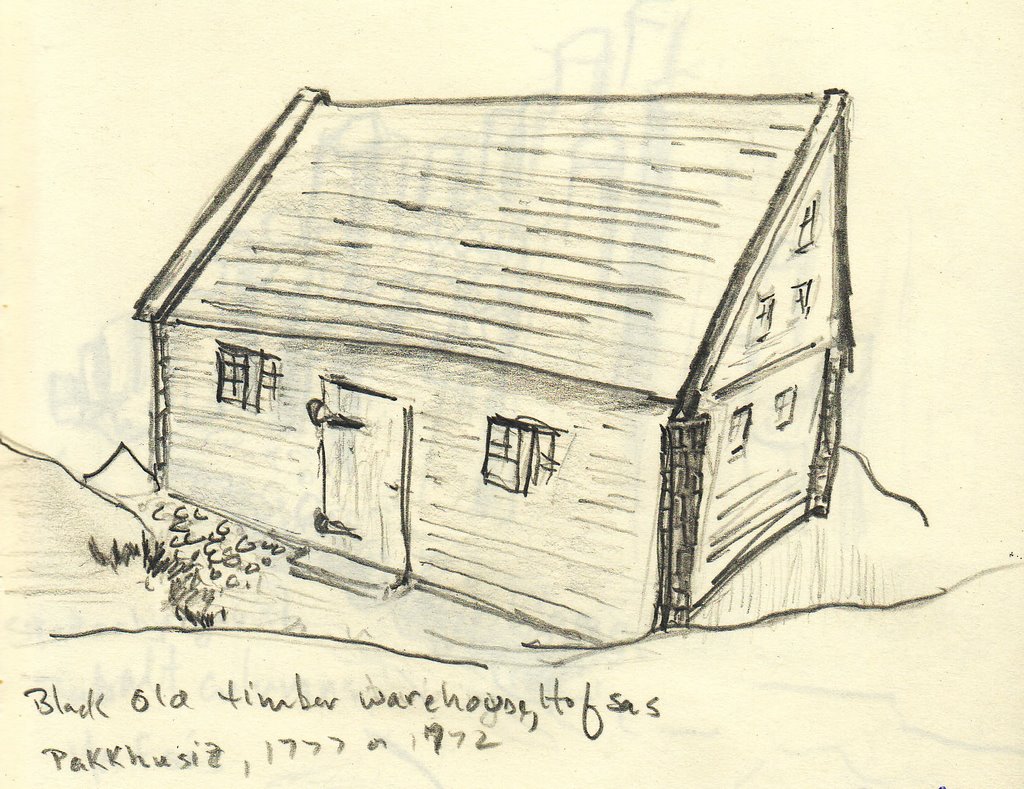
John and I have an eventful morning while the boys sleep late. I had a great idea last night, just before I fell asleep. I was thinking about the hours Gabe and Pete have spent kicking rocks (acting like the rocks were hacky sacks or soccer balls). I figured that I could find a ball at the market, and it would be overpriced and poor qualilty, but it would get a lot of use. So John and I venture out, to the laundry, the bank, the post office and the market. Along with the obligatory pastries we buy a soccer ball! Just what you'd expect for the equivalent of $10. USD., but a very worthwhile investment-- by the end of the trip the soccer ball will be completely worn out!

After breakfast we walk along a little path down to huge basalt column stacks, hexagonal in shape, along the shore. John stops to sketch them, naturally.
We walk through town to the Icelandic Emigration Center museum, which is a won
 derful place for kids and adults alike. It focuses on the Icelanders who emigrated to the U.S. and Canada, primarily at the end of the 19th century. What is so great about the museum is that it provides lots of personal histories with pictures, letters, newspaper clippings, and objects from people's daily lives. All of the exhibits are done in a very tasteful manner: not slick, but artistic and professional.
John notices Bill Holm outside talking to someone, so I go out to see him. I realized last night that during our previous conversation I never told him that his books were the impetus for my reading Icelandic literature, and that he was directly responsible both for my passion for Iceland, and our being here on this trip! I am able to convey my heartfelt thanks for the way in which his books have led me on a path to where I am right now. I confess to disappointment that I don't have his books along so that he can sign them (Antonia made me take them out during our "Take Out" packing party), and he tells me to send them to him in Minnesota to sign. Thank you, I will!
We talk some more about the book he is working on, Icelandic horses (his next chapter--I tell him about my Shih Tzu/tolt theory, and he is unable to confirm it), and he confesses amazement that we'd gone to Drangey yesterday in the fog! He is a little put out that Hofsos has been foggy every day for weeks. I am enjoying Hofsos anyway, but I can imagine how stunning the view must be when you can see across the fjord to Drangey and the snow-capped peaks beyond. Bill recomends that we visit Holar, Siglufjordur, the Icelandic Folk Music Museum and the Herring Museum--all places we want to go, but which will have to wait for our next trip. We have a hug and kiss goodbye; alas, John isn't around to take my picture with Bill Holm. I have great memories, though, of meeting the man whose words introduced me to Iceland.
We head back to our house, Karastigur, to eat lunch with the boys and pack up. Just as we sit down to eat there is a knock at the front door. Who can it be?
I open the door to discover a bank officer! There was a little misunderstanding at the bank when John signed over two traveller's checks (in the wrong place) resulting in this personal visit by the banker, who politely requests that we stop by to rectify the matter. Only in Iceland would a banker pay a house call!
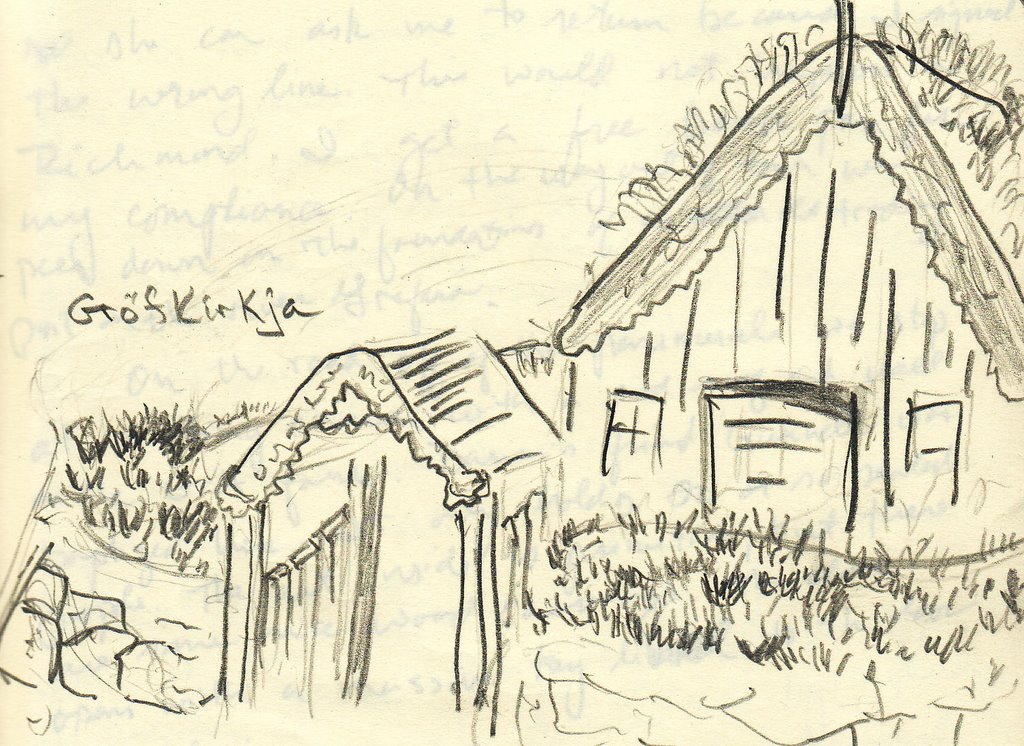
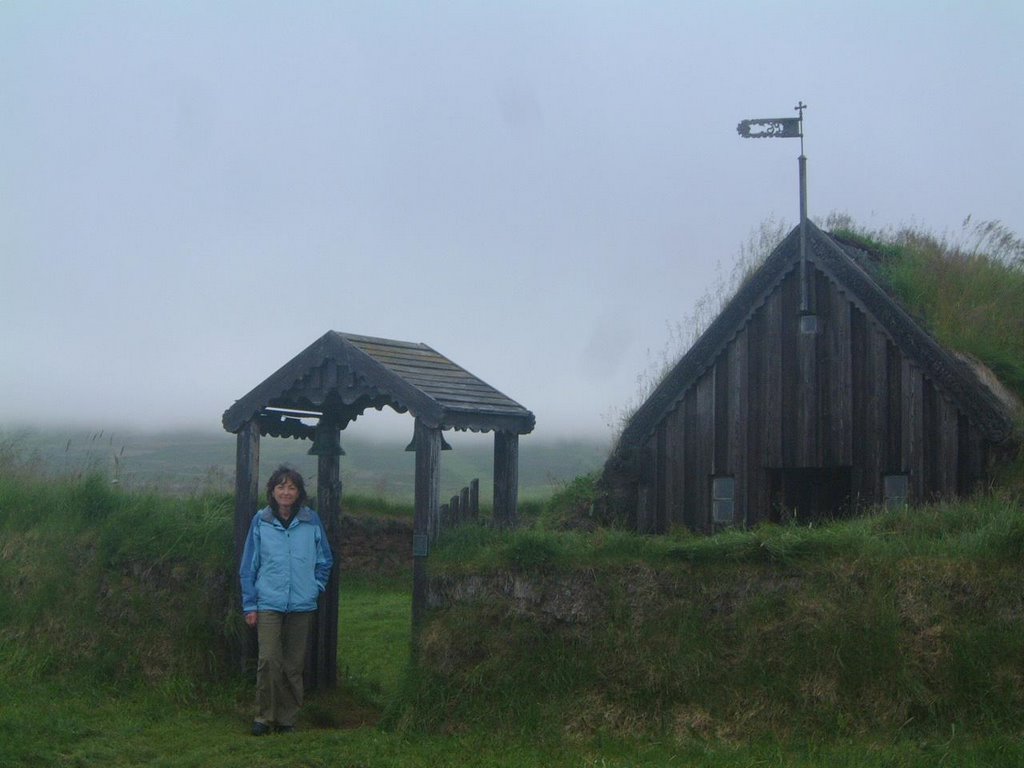
We pack up and, after a phone call to the owners, we simply leave our payment on the table, door unlocked (we never had or needed a key). Outside of town we stop by the little turf church at Grof where Gunnella was baptised. The picture doesn't convey how little--it seats just 20 people, and those people had better be careful when they stand up! Even shorties like me will bump their heads on the low rafters.

Next stop is the Glaumbaer Folk Museum, which features a large complex of 7 or more turf houses once owned by a wealthy priest named Snorri. The adjacent church has flowers and bushes planted on top of the graves, and inside the church is an organ made entirely of pine--keys, pipes and all.
In Blonduos, where Gunnella once lived and taught school, we stop at an Information Center and we meet a very gregarious young man who tells us about his trip to Drangey: how his friend pushed him off Jon's boat into the water, and how he exacted revenge.
The rest of the drive to the Snaefellsness penninsula is through lovely, scenic areas where many of the saga stories took place. We arrive at Arnarstapi late--too late for dinner, due to an infestation of Danish tourists and the fact that it is so remote that there is no alternate place to eat. They agree to fix us sandwiches, however, so that we don't starve.
 The dining area is a lovely turf roof building with clean, light pine walls and ceiling. The building we are lodging in, however, is the most institutional of any place that we have stayed, resembling dorm rooms. But there is a very pleasant common room with a remarkably well-equiped kitchen for all of us to use.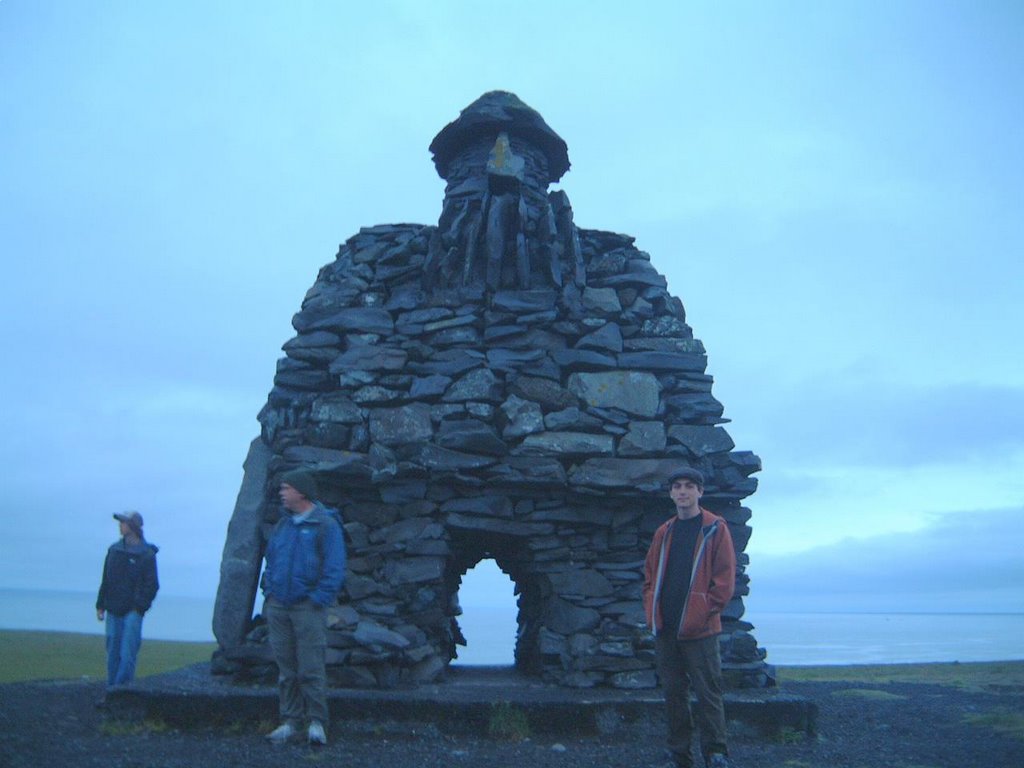
We follow our light dinner with a late evening walk in the longlasting twilight, a walk fraught with peril due to the kria. Kria are birds that are fiercely protective of their nests. Unfortunately, they are well equiped to defend with their long, curved, sharp beaks. The birds screech while dive-bombing any intruders. Their intimidation techniques are very effective: smart people steer clear of their nesting areas. As we walk out to the huge rock statue of Barthur, guardian of the area, we meet a mother who tells of being on a golf course where kria attacked her head and drew blood!
Enough excitement. Time for sleep.
Jul 24, 2006
An Epic Climb
Up early, with butterflies in my stomach. John and I go to buy groceries, and process some more laundry. While in Hofsos we wash 5 loads, driving the car back and forth from our house to the apartment with the laundry facilities. It would have been much more practical to have had the use of a bicycle for going back and forth...Hofsos is so small, and the locals must be hard pressed to think of an explanation for why these crazy foreigners could possibly need to made so many shorts trips in a car, right in town!
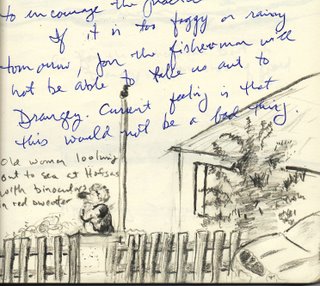
Still foggy. With a growing sense of relief I call Farmer Jon. (Why is he called Farmer Jon, when he is a boat captain? That's because he owns a farm on the fjord, an ancient one called Fagranes, where the body of Grettir is supposedly buried. Grettir's head is elsewhere.) Farmer Jon, his sons, and other assorted relatives man the boat when it goes out, in addition to farming. Similarly, Valgeir's daughter got us settled in our lodging because Valgeir and Gudrun, her parents, were out on their farm doing end-of-summer farm chores.
I ask Farmer Jon's son if our trip will be postphoned due to the fog. "We will go, absolutely," he says. We quickly pack our warm clothes and lunch, and drive around the fjord to the harbor, in such a rush that there isn't time to worry. We pull away from shore in a small boat with about 20 other people on board.
The trip is windy, cold and wet. Water splashes into the small craft; my jeans are soaked before we even arrive at Drangey. The trip takes a little more than an hour. I am feeling r eally keyed up, between excitement at seeing the sight I have longed to see the most in Iceland, and a great deal of nervousness regarding the dangerous climb ahead. Gabe and Pete compare notes along the way.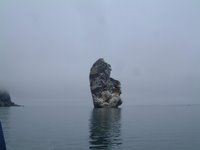
First we glimpse the tall escarpment next to Drangey, then Drangey itself rises majestically out of the mist. We hear an incredible din...the sound of millions of birds swooping and calling. The cliffs of Drangey are whitewashed in huge swatches. After sailing alongside a number of craggy inlets our boat pulls up to a dock, where we are dwarfed by the vertical cliff at our side.
Our g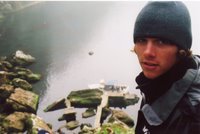 uides up Drangey are Farmer Jon's son and his nephew. Jon himself is about 75 years old, and has made the climb thousands of times. He may be old enough to enjoy staying back on the boat this trip, but he is still "frisky," as Bill Holm describes him...after all, he has a son who is 20 years old. We thought Steinn was Jon's grandson but Holm enlightened us: "that's his son, the sly Fox!" Steinn and Ajalti shepherd us up the cliff, carefully providing assistance or confidence to those of us who are feeling less than heroic.
John describes the path:
We arrive at a large meadow. All of the island is covered in lush green grass that you sink into up to your knees. Wildflowers and colorful mosses are everywhere. To our surprise, it isn't just one or two meadows atop the huge cliffs: it is one followed by another which you reach by climbing little hills. There are about five meadows in all, but in each one you can see just the one that you are in. I had thought that the best view of the day would be arriving back at the harbor alive, but I was wrong. The best views of the day are on Drangey!
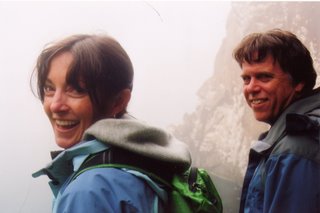
The group of us wanders from meadow to meadow, and we gradually regroup in the grassy area that contains the rocky remains of outlaw Grettir's abode. A plaque informs us that here he lived, and died in the year 1037.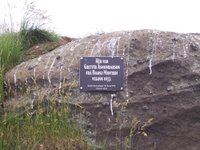 We sit or lay down in the grass and listen to Steinn relate the story of Grettir.
Steinn is an art student who wears Buddy Holly-style glasses. (Cousin Ajalti is an appealing 15-year old, following in Steinn and Jon's footsteps--fast becoming a competent guide and storyteller himself.) Steinn's sense of humor is dry, and his descriptions are sometimes quaint. When he talks about Grettir's half-brother being put in prison, he calls it a "dirty basement." He refers to the bewitched log with runes that was Grettir's undoing as "bad wood." Steinn is competent in 4 or 5 languages, and easily switches from one to another as he tells the story in 2 languages, with asides and explanations in several others. I sit rapt at his feet. I know the story and anticipate each event as he relates it. It completely chokes me up to find myself here, in the place where Grettir once lived, hearing his story told in person by someone who grew up climbing these cliffs and hearing this story. Steinn does the tale perfect justice in his telling of it.
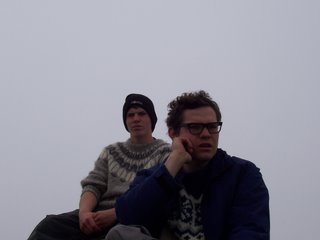
As we continue our walk along the periphery of the island I think that it would be impossible to be any happier than I am right now. The clouds are low, so that we can seldom see the water below. While it is unfortunate not to see the 360-degree views of the huge fjord, it is wonderful in a different way. The height isn't so scary, and we feel warm, cozy and enclosed in our own little world on the island.
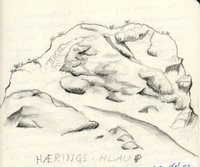
We see Haering's Hlaup, and as we sit in the meadow to rest and eat, John sketches the Hlaup, or Leap, where Haering escaped Grettir and found death on the rocks below. Steinn compliments John's art. In return, we teach Steinn and Ajalti cool US slang such as "the Whole Steamboat" and "Boy Howdy!" No doubt these will come in useful for them when they want to impress female tourists.
At one point Steinn reaches in a little hummock where birds nest and pulls out a baby fulmar, all white. "He spits a vile-smelling vomit on you," he informs us. When we ask if the mother will return to the nest after he has handled the baby, he gives a philosophical "who knows" shrug.
Ajalti is spending the next week on the island with his father, puffin hunting (which they do with nets at the end of long p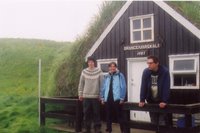 oles, catching the birds as they fly). They will stay in a little hut on one of the meadows, which has several bunks, a kitchen and a loft. Everything must be hoisted to the top of the cliffs via a winch and long cable from the dock. There is a guest book, which we sign. We get much closer to puffins, here on Drangey, than we ever imagined that we might. They are everywhere here, by the hundreds of thousands.
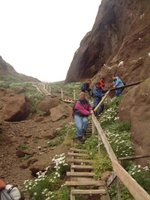
The descent is worse than the ascent, but not by much. We see seals on our boat trip circling the island on the way back, and more birds.
When we get back to harbor in Saudarkrokur, we feel we can't miss the opportunity to drive 20 km up the coast to Grettir's Laug, or pool, which is a natural hot spring. It has been nicely fixed up with stone benches inside and out. It is right on the edge of the shore. After Gabe and Peter get steamed in the pool, they actually get into the ocean to cool off! (Not for long, though.) There are two sod roof cabins with bathrooms, kitchen, and changing areas as well. All this, out in the middle of nowhere!
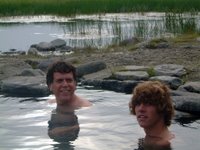
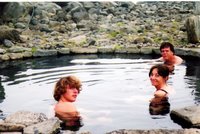
We call back to Solvik restaurant in Hofsos, afraid that we will arrive too late to be able to dine there. They assure us they will stay open to await our arrival. We don't want to miss Bill Holm's recommendation of the best fresh trout around. We aren't disappointed: it IS the best fresh trout around, and probably one of the best meals we will have in Iceland.
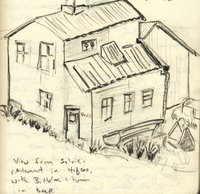
A perfect day. The reason why I came to Iceland. Heaven!
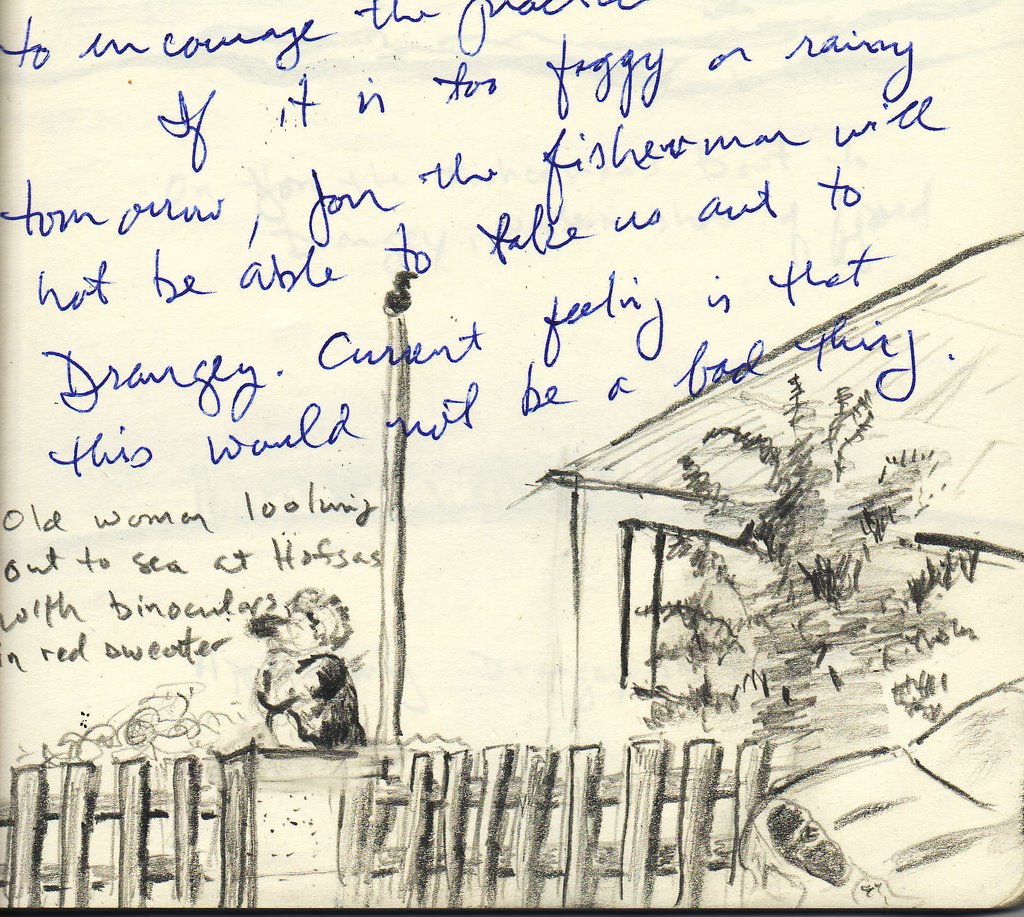
Still foggy. With a growing sense of relief I call Farmer Jon. (Why is he called Farmer Jon, when he is a boat captain? That's because he owns a farm on the fjord, an ancient one called Fagranes, where the body of Grettir is supposedly buried. Grettir's head is elsewhere.) Farmer Jon, his sons, and other assorted relatives man the boat when it goes out, in addition to farming. Similarly, Valgeir's daughter got us settled in our lodging because Valgeir and Gudrun, her parents, were out on their farm doing end-of-summer farm chores.
I ask Farmer Jon's son if our trip will be postphoned due to the fog. "We will go, absolutely," he says. We quickly pack our warm clothes and lunch, and drive around the fjord to the harbor, in such a rush that there isn't time to worry. We pull away from shore in a small boat with about 20 other people on board.
The trip is windy, cold and wet. Water splashes into the small craft; my jeans are soaked before we even arrive at Drangey. The trip takes a little more than an hour. I am feeling r
 eally keyed up, between excitement at seeing the sight I have longed to see the most in Iceland, and a great deal of nervousness regarding the dangerous climb ahead. Gabe and Pete compare notes along the way.
First we glimpse the tall escarpment next to Drangey, then Drangey itself rises majestically out of the mist. We hear an incredible din...the sound of millions of birds swooping and calling. The cliffs of Drangey are whitewashed in huge swatches. After sailing alongside a number of craggy inlets our boat pulls up to a dock, where we are dwarfed by the vertical cliff at our side.
Our g
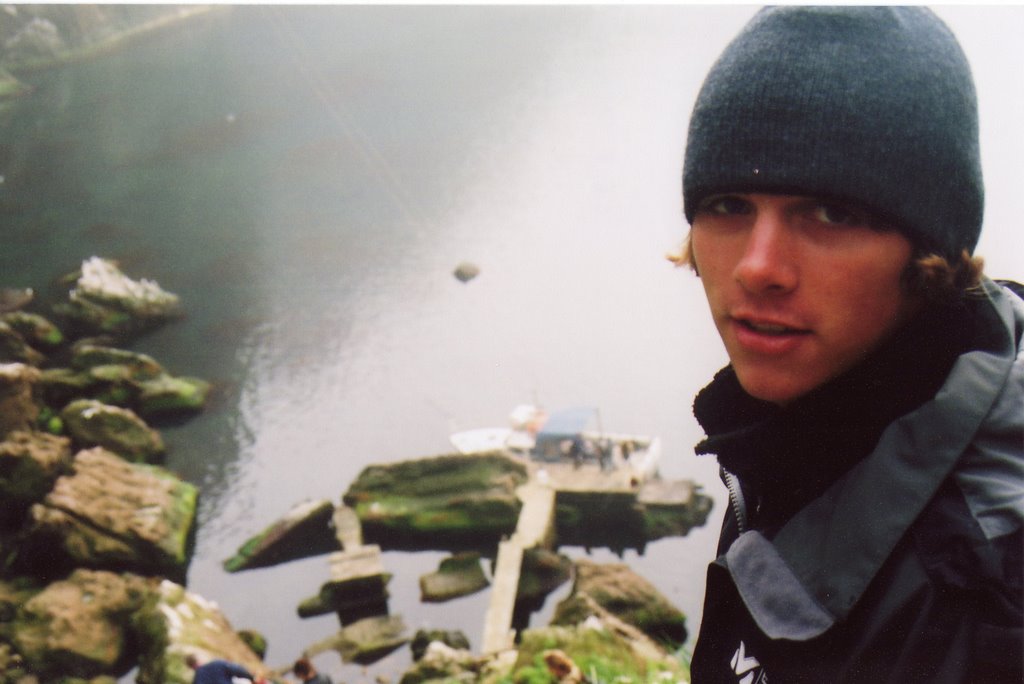 uides up Drangey are Farmer Jon's son and his nephew. Jon himself is about 75 years old, and has made the climb thousands of times. He may be old enough to enjoy staying back on the boat this trip, but he is still "frisky," as Bill Holm describes him...after all, he has a son who is 20 years old. We thought Steinn was Jon's grandson but Holm enlightened us: "that's his son, the sly Fox!" Steinn and Ajalti shepherd us up the cliff, carefully providing assistance or confidence to those of us who are feeling less than heroic.
John describes the path:
...daunting, but not as frightening as we had feared. The slope is steep, and wooden boards are dug into the earth, or primitve stairs, switchback up. Ropes are fastened to poles a good way to give some security. An iron rod is driven into the cliff at one tight turn to grip. The last 40 or 50 feet take us up a steel pipe ladder that is vertical.A short way into the climb we encounter a little alcove/altar in the rock, with a large bronze plaque that has the Lord's Prayer in Icelandic. One of our party is a baker from Reykjavik--the only supplier of natural sourdough bread in Iceland--and he drops to his knees and crosses himself as he prays (he has completed this climb previously, so presumably knows the need for divine intervention). I ask Steinn if it must be prayed in Icelandic and he reassures me: "I think He speaks many languages."
We arrive at a large meadow. All of the island is covered in lush green grass that you sink into up to your knees. Wildflowers and colorful mosses are everywhere. To our surprise, it isn't just one or two meadows atop the huge cliffs: it is one followed by another which you reach by climbing little hills. There are about five meadows in all, but in each one you can see just the one that you are in. I had thought that the best view of the day would be arriving back at the harbor alive, but I was wrong. The best views of the day are on Drangey!

The group of us wanders from meadow to meadow, and we gradually regroup in the grassy area that contains the rocky remains of outlaw Grettir's abode. A plaque informs us that here he lived, and died in the year 1037.
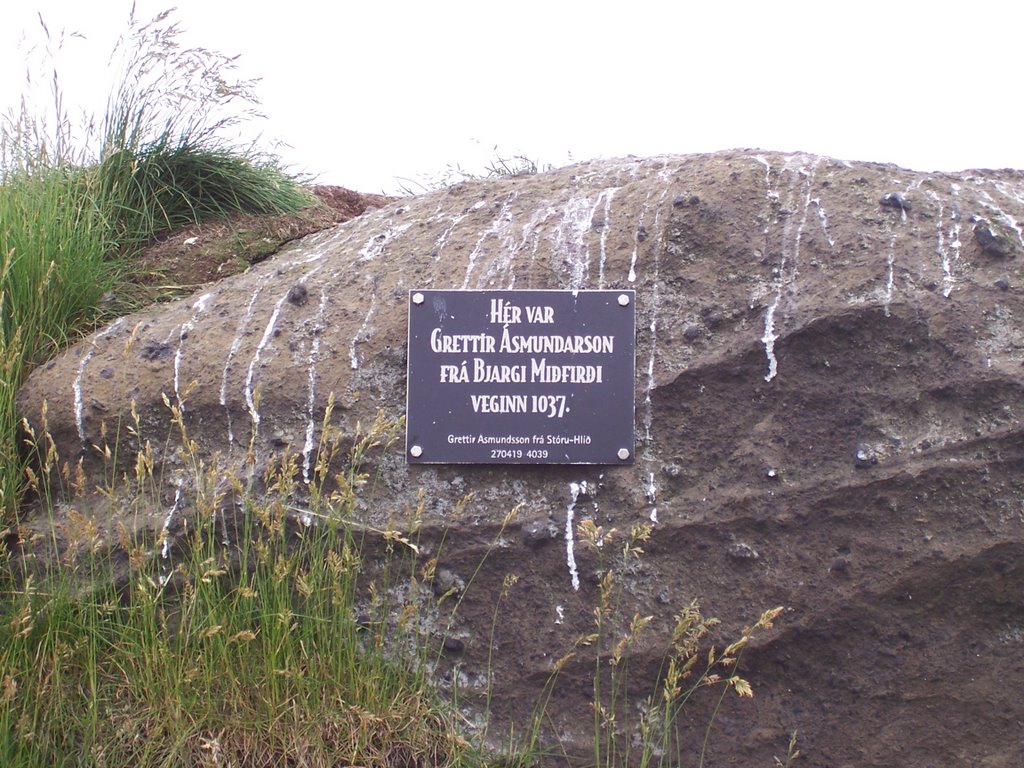 We sit or lay down in the grass and listen to Steinn relate the story of Grettir.
Steinn is an art student who wears Buddy Holly-style glasses. (Cousin Ajalti is an appealing 15-year old, following in Steinn and Jon's footsteps--fast becoming a competent guide and storyteller himself.) Steinn's sense of humor is dry, and his descriptions are sometimes quaint. When he talks about Grettir's half-brother being put in prison, he calls it a "dirty basement." He refers to the bewitched log with runes that was Grettir's undoing as "bad wood." Steinn is competent in 4 or 5 languages, and easily switches from one to another as he tells the story in 2 languages, with asides and explanations in several others. I sit rapt at his feet. I know the story and anticipate each event as he relates it. It completely chokes me up to find myself here, in the place where Grettir once lived, hearing his story told in person by someone who grew up climbing these cliffs and hearing this story. Steinn does the tale perfect justice in his telling of it.
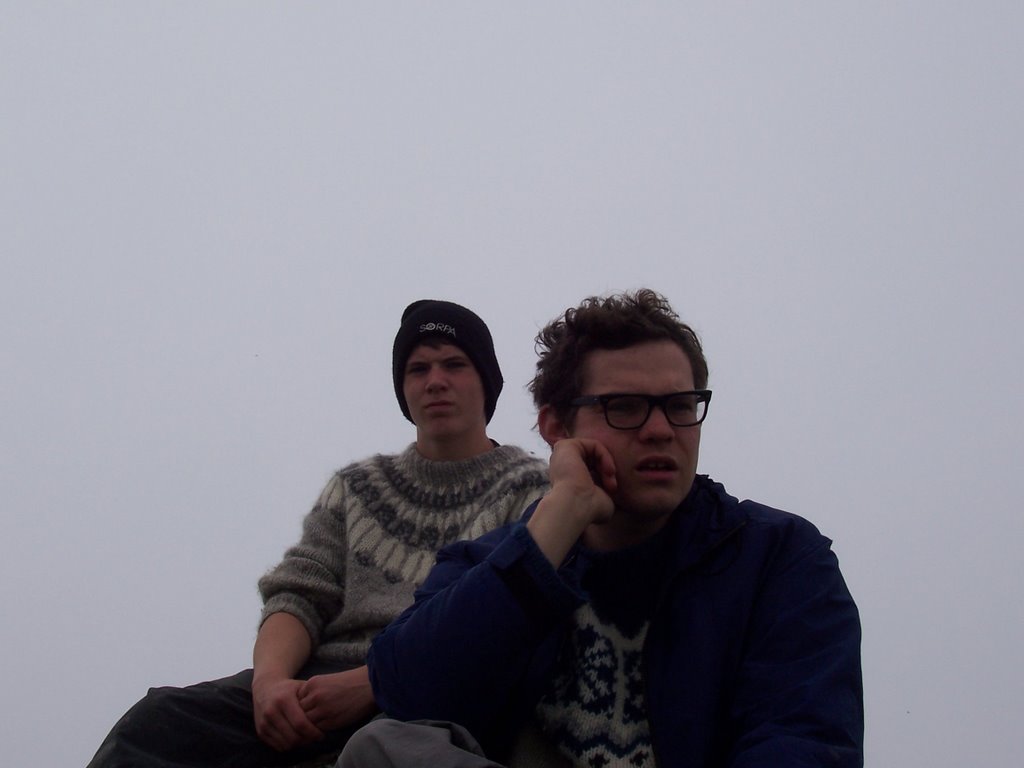
As we continue our walk along the periphery of the island I think that it would be impossible to be any happier than I am right now. The clouds are low, so that we can seldom see the water below. While it is unfortunate not to see the 360-degree views of the huge fjord, it is wonderful in a different way. The height isn't so scary, and we feel warm, cozy and enclosed in our own little world on the island.
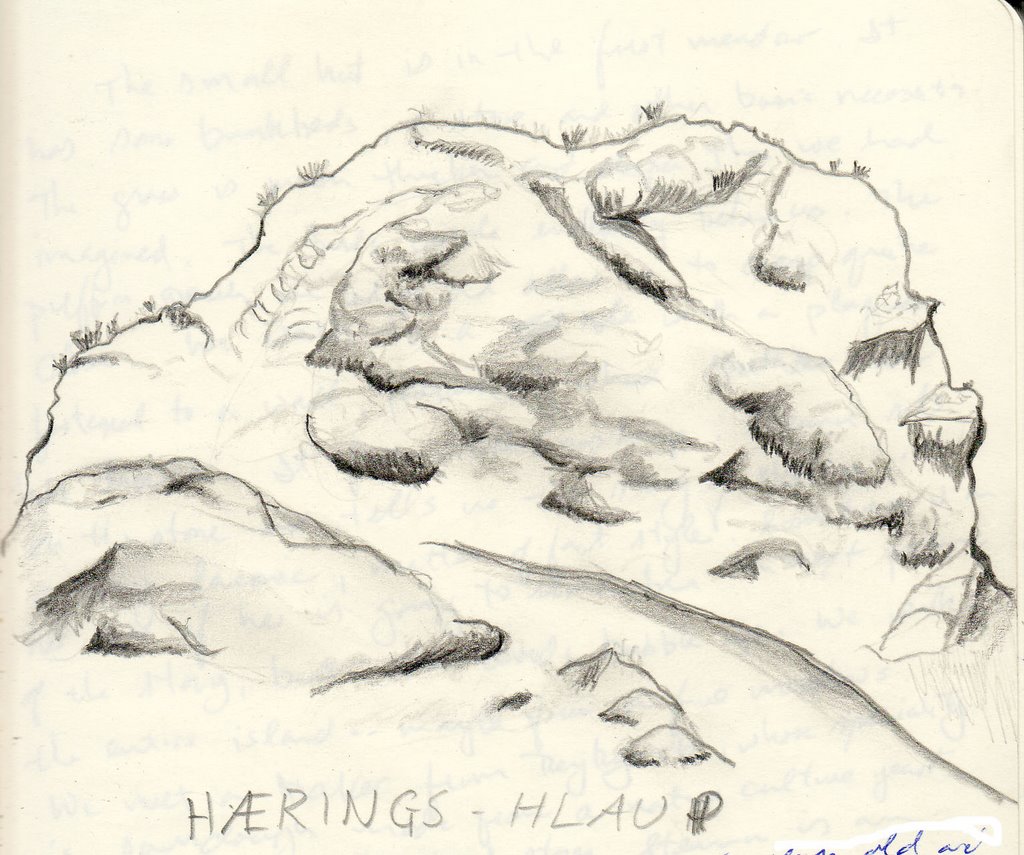
We see Haering's Hlaup, and as we sit in the meadow to rest and eat, John sketches the Hlaup, or Leap, where Haering escaped Grettir and found death on the rocks below. Steinn compliments John's art. In return, we teach Steinn and Ajalti cool US slang such as "the Whole Steamboat" and "Boy Howdy!" No doubt these will come in useful for them when they want to impress female tourists.
At one point Steinn reaches in a little hummock where birds nest and pulls out a baby fulmar, all white. "He spits a vile-smelling vomit on you," he informs us. When we ask if the mother will return to the nest after he has handled the baby, he gives a philosophical "who knows" shrug.
Ajalti is spending the next week on the island with his father, puffin hunting (which they do with nets at the end of long p
 oles, catching the birds as they fly). They will stay in a little hut on one of the meadows, which has several bunks, a kitchen and a loft. Everything must be hoisted to the top of the cliffs via a winch and long cable from the dock. There is a guest book, which we sign. We get much closer to puffins, here on Drangey, than we ever imagined that we might. They are everywhere here, by the hundreds of thousands.
The descent is worse than the ascent, but not by much. We see seals on our boat trip circling the island on the way back, and more birds.
When we get back to harbor in Saudarkrokur, we feel we can't miss the opportunity to drive 20 km up the coast to Grettir's Laug, or pool, which is a natural hot spring. It has been nicely fixed up with stone benches inside and out. It is right on the edge of the shore. After Gabe and Peter get steamed in the pool, they actually get into the ocean to cool off! (Not for long, though.) There are two sod roof cabins with bathrooms, kitchen, and changing areas as well. All this, out in the middle of nowhere!


We call back to Solvik restaurant in Hofsos, afraid that we will arrive too late to be able to dine there. They assure us they will stay open to await our arrival. We don't want to miss Bill Holm's recommendation of the best fresh trout around. We aren't disappointed: it IS the best fresh trout around, and probably one of the best meals we will have in Iceland.
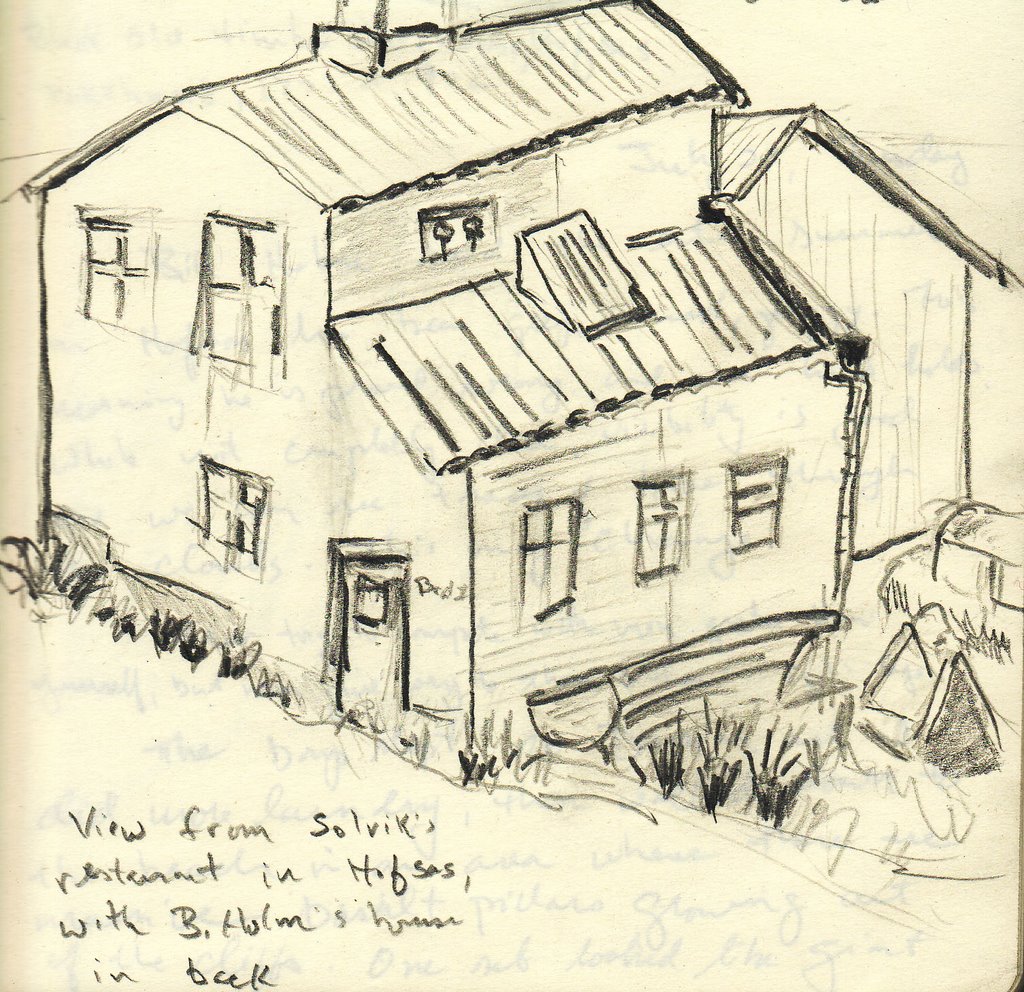
A perfect day. The reason why I came to Iceland. Heaven!
Jul 20, 2006
Atop a Volcano
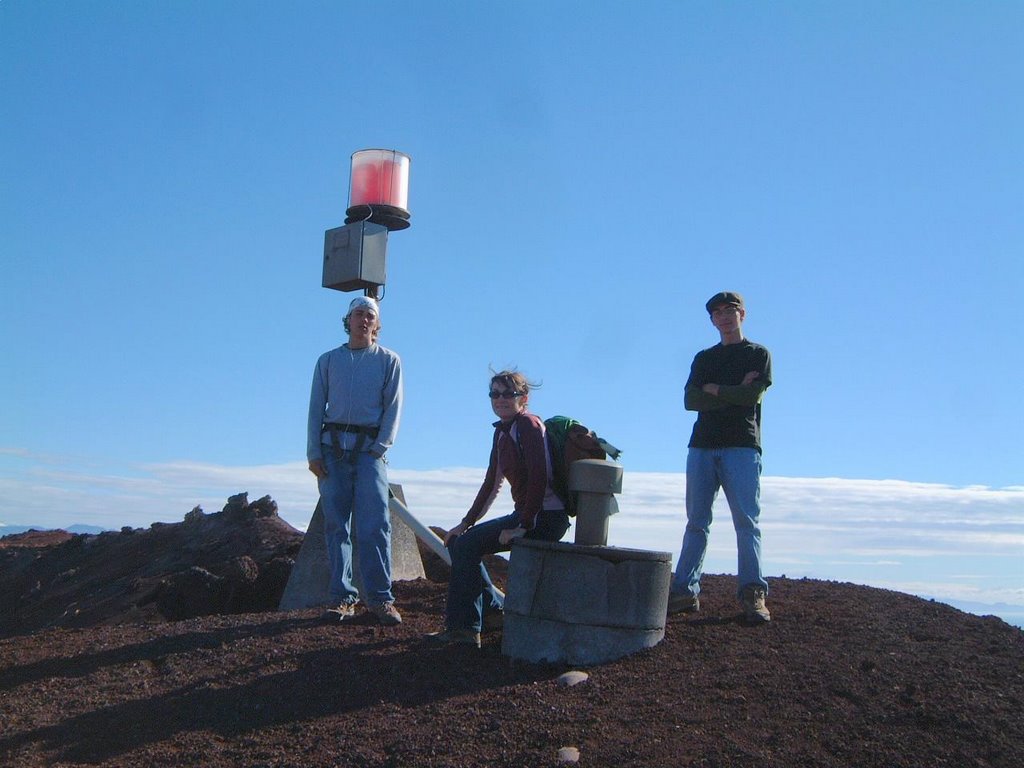 Out of the house at 8 a.m., a record for this holiday so far! We walk a few blocks to the Kokuhus bakery and sample 6 different pastries for breakfast. This is a great place! We determine to come back and buy sandwiches for our return trip on the ferry late this afternoon.
As I write in my little journal I am seated on lava at the top of Mt. Eldfell, 725' high. It is a perfect day: warm, slight breeze, cloudless, and I have a 360° view of all the islands, the mainland, the glaciers, and the sparkling ocean. This is heaven, as long as I don't allow myself to think of the scary hike back down. The "boys" (all three) are exploring the summit. They find a puffin colony below, and Ruth's "bread oven."
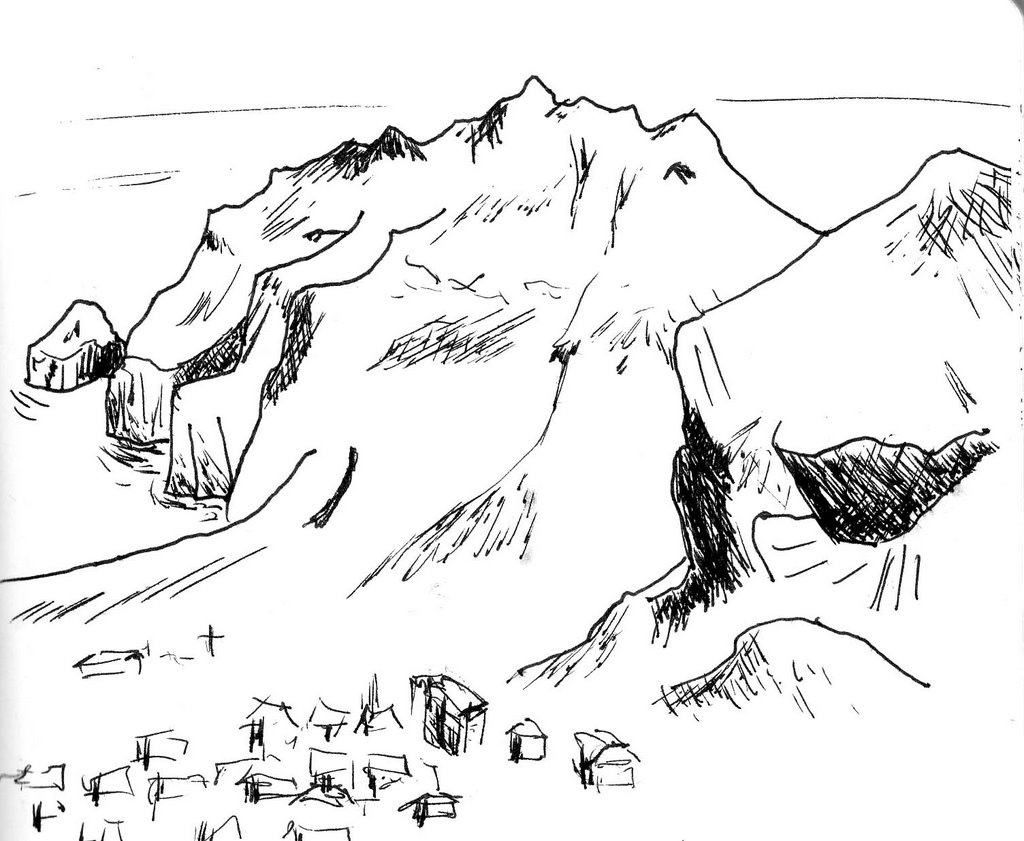
The story behind this volcano and its eruption is fascinating. John McPhee creates a dramatic cliffhanger in The Control of Nature (1989)--a book about "places in the world where people have been engaged in all-out battles with nature." A large section of the book describes the 1973 eruption on Heimaey and the ensuing campaign to save the island's all-important harbor. A six-month battle took place in which sea water was pumped, with hand-held hoses and by boat, in an effort to cool and direct the lava. Not only was the harbor saved and the future of the island guaranteed, but the harbor was actually improved and made more secure by the extended lava flow. John's drawing shows the view west from Eldfell.
We hike back down to the guesthouse, and speculate that the temperature must be close to 75°F. Later we find that it was only 61°--are we becoming acclimated to Iceland? Whatever the temperature, we spend some quiet moments enjoying the flowers in Ruth's garden before we embark on our next adventure, which is...Peter's first horseback ride!
Ruth's daughter Sudrun ("Sunray") accompanies us to the horsefarm, and acts as a co-guide. The other guide is Fannay (possibly spelled differently), the new school principal for the island. Since Icelanders use first names almost exclusively, we ask Fannay what the students will call her when school begins. She replies that they will address her by her first name, of course--"we want to be friends."
They take us on spirited, surefooted Icelandic horses, which are the size of ponies. We ride
 English-style, and get to experience the famed tolt, or 5th gait of the Icelandic horse. We find the tolt to be somewhat between a fast walk and trot, and incredibly smooth. Fannay takes us down country roads, across fields, along the black sand beach, and to steep cliffs where sheep graze and puffins fly. (The sheep come in many colors, and apparently the genuine Icelandic sweather need use no artificial dyes.) The horses are comfortable moving at a tolt through rough, rocky terrain. We are able to see a lot of the island, for Fannay keeps us at a quick pace. Unlike the sluggish walk that trail horses in the U.S. are encouraged to maintain (by guides who probably want to ensure the riders' safety at the expense of their pleasure) Fannay frequently breaks us into a tolt or canter, glancing mischieviously over her shoulder to assess our progress and our enjoyment. This is exhilarating fun on a lovely, hot sunny day: the still ocean is spread out before us, with grassy-topped islands in crazy shapes scattered about.
Fannay and Sudrun deliver us back to town with just enough time to spare so that we can pack, pay for our room, get to the bakery, and race over to the ferry--at a human trot, rather than a tolt. Just in time, we board the ferry, select our seats, eat our late lunch, and lay down on comfortable couches inside, or stretched out on benches outside, for some serious naps.
Back on the mainland we pile back into our car and drive east, counterclockwise along the Ring Road, with Heimaey visible offshore. We stop in Selfoss for groceries and a Thai meal, where our waitress enlightens us to the fact that people don't tip in restaurants in Iceland. News to us! Later I scour my three guidebooks and find absolutely no mention of this key fact: key, because food prices are extremely high even without tipping!
We stop at Skogafoss so that I can see the lovely falls at twlight. You may recall that John, Gabe and Pete saw them on their ice-climbing expedition...so, we have retraced their journey of two days ago, and are now going beyond the point where they traveled. We hike to the top of the falls, in the lovely light of 10:30 in the evening, and Peter steps close to the falls to take pictures, probably enjoying John's discomfort. I look the other way, for on this trip I have already discovered that teenage boys on steep cliffs are best ignored if one requires peace of mind.
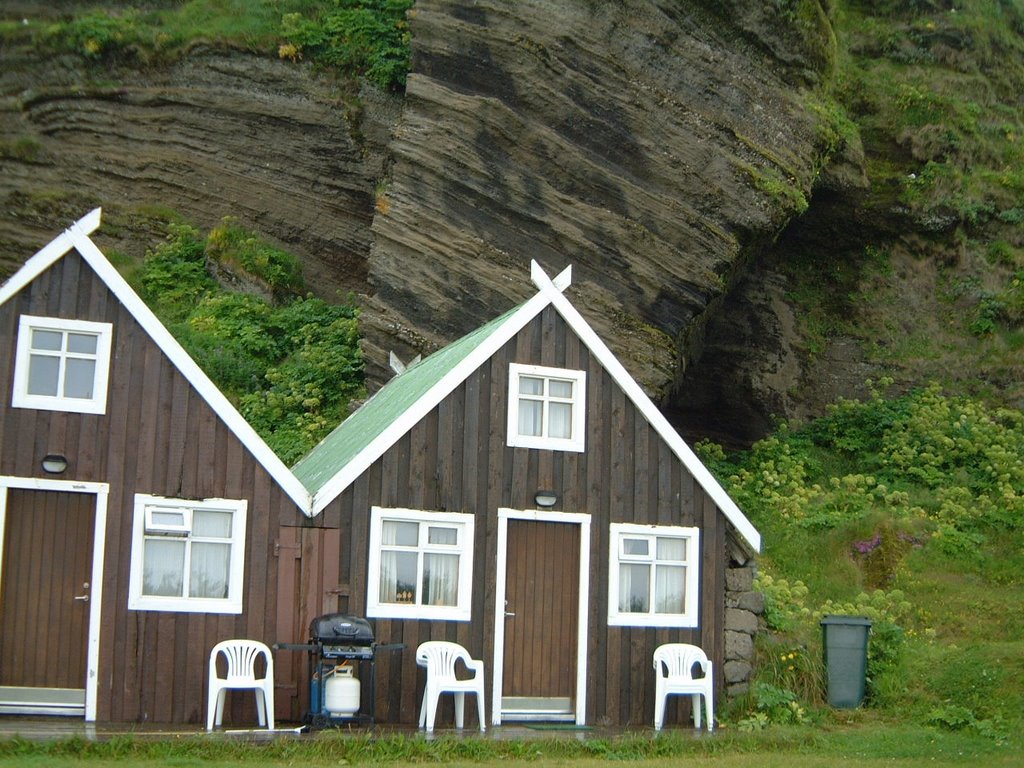 Our lodging consists of a quaint cabin in Vik (pronounced "week") and is surely one of the best places in town, situated at the base of a huge, rocky overhang where noisy fulmars nest. A waterfall runs next to our cabin, "Sumarhusid Hotturinn." We have a kitchen, living area, loft and bath. In the guestbook we discover a fine drawing by a previous guest, showing a family cozily inside the cottage while behind, deep in the rocky cliff, a troll in a cave stirs a great pot of human limbs! I really want to steal this drawing. I refrain. We sleep very well in this idyllic, troll-infested setting.
High 61°F Low 51°F
Jul 19, 2006
Top Three
Happy Birthday to Antonia (#24) back in the States, and Happy Anniversary to Antonia and Jonathan (#2)!
Gabe and Pete are sleeping, so John and I head out of town, down the same road we took two days ago to Thingvellir. It's our last day in Reykjavik, unless we decide to return on the day before we leave Iceland. We don't want to waste time: already we are faced with the unfortunate fact of not having visited one museum in Reykjavik! (A good wintertime activity? Reasons for returning to Iceland #2 and #3: Reykjavik museums and the Northern Lights.)
So today we are going to visit Gljufrasteinn, the home and museum of author Halldor Laxness. Thingvellir, Gljufrasteinn, and Drangey Island are the top three personal shrines on my Iceland list.
Halldor Laxness (1902-1998) won the Nobel prize in 1955, in part for his book Independent People. In an introduction to this book Brad Leithauser says:
Gljúfrasteinn is nestled in a large, lovely valley with imposing mountains nearby, across the road from Laxnes horse farm. Laxness's name, a pseudonym he took in 1923, means "of Laxnes."
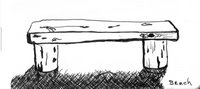
First we walk around through the gardens to the back of the house, and have our picnic lunch on a bench in an alcove shaded by small birches and wildflowers. The nearby stream tumbles over smooth boulders and forms myriad small waterfalls.
The house itself is elegantly plain: medium sized, white plaster with lots of windows. It isn't a showplace; it's a house meant to be lived in. The orginal furnishings, art, music and books are still in place, so it's very easy to imagine Laxness and his family living here. The audio tour is excellent: it is less obtrusive than a tour guide, and the recording includes the voices of Laxness and his wife. You can stand in his study, see the desk he stood at to write, look out the window at the very view that he saw daily. You can enter his bedroom, and see the art and objects he kept close to him. You can see his Steinway piano--the very same one that Bill Holm has played. When I see the grandfather clock in the hallway--ticking et-ERN-it-Y---(the one that the clock in The Fish Can Sing was modeled on) my throat closes up and I choke back tears.
We have an interesting talk with a man who works in the visitors center about our favorite Laxness books, and about movie versions of them. They have many copies of his books for sale, in a variety of languages. I would next like to read: Salka Valka, The Atom Station, and the story about Mosfellskirkja.
As we drive back to Reykjavik, we see (for the first time) the snow-covered mountain Snaefellsjokull in the far distance. You can't always see this from Reykjavik, but it's a beautiful sight. This is the glacier that Jules Verne used for the setting of Journey to the Centre of the Earth, and it is believed to be one of the world's most powerful and spiritual places.
Back to town, it's time to each lunch and pack up. We go with Gabe and Peter down to the harbor to eat at Tommy Burger. I have an absolutely delicious veggie burger accompanied by a coffee milkshake. What makes the veggie burger so good is that they use a mix similar to what is used for felafels, and it really works. Try it yourself!
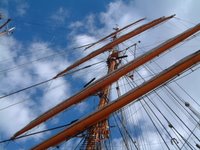 It's a sunny day in Reykjavik which means that, even though the temperature is only about 60°F, many of the natives are walking around in shorts and sandals, eager to soak up the sun. We find a large, four-masted schooner docked in the harbor, and as we approach it we find that it is a Russian training vessel, the shipmates are offering tours, and the tours are free! We take one.
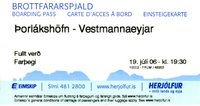
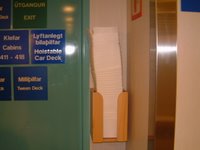 Leaving Reykjavik we have a 45-minute drive to catch the ferry for the Westmann Islands, where we will be staying on Heimaey. Our ferry trip is almost 3 hours. We admire features of our ferry, Herjolfur. First, we observe a stack of containers that look like large chinese take-out boxes. We suspect that these are conveniently provided for when the seas aren't so smooth as they are today. Convenient! Plus, we discover original art hung throughout the ship: oils, watercolors, photographs. Many of them feature Icelandic landscapes, and are quite good.
As we approach the fourteen Westmann Islands, they emerge as unique, odd shapes on the horizon that become steadily more bizarre as we approach. Like Iceland, these are volcanic islands, and our destination, Heimaey, is the only one that is inhabitated, unless you count sheep. Count sheep? We're not even tired yet!
The sheer black/green cliffs of Heimaey are beautiful, with birds everywhere as we come in to the harbor at 10:45 p.m. We disembark and walk through the quiet town until we find Guesthouse Hrithrith, and meet the German owner Ruth, who gives tours to the volcano and bakes bread there in the hot lava. (She is a full-time baker in the winter.) We have interesting midnight conversations in the guesthouse kitchen with a geologist from Scotland and a Chinese translator and his friend from the UK.
John and Gabe go for separate midnight walks on Heimaey. John walks by the cemetary without incident, and then to the lava area. Back at the guesthouse, the boys and I compare the cool features of our different sleeping bags. Gabe wins, with his "Penguin" bag. (That's not the name of the bag, but just that he looks like a penguin in it due to the color design. We offer to get him an orange bill and feet so we can rename it the Puffin bag.)
High 60°F Low 48°F
Gabe and Pete are sleeping, so John and I head out of town, down the same road we took two days ago to Thingvellir. It's our last day in Reykjavik, unless we decide to return on the day before we leave Iceland. We don't want to waste time: already we are faced with the unfortunate fact of not having visited one museum in Reykjavik! (A good wintertime activity? Reasons for returning to Iceland #2 and #3: Reykjavik museums and the Northern Lights.)
So today we are going to visit Gljufrasteinn, the home and museum of author Halldor Laxness. Thingvellir, Gljufrasteinn, and Drangey Island are the top three personal shrines on my Iceland list.
Halldor Laxness (1902-1998) won the Nobel prize in 1955, in part for his book Independent People. In an introduction to this book Brad Leithauser says:
When I tell people I meet that my favorite book by a living novelist is Halldor Laxness's Independent People and am asked what it's about, my reply is, "Sheep."We come close to hitting a herd of sheep on the road, one at a time. In case you're curious, sheep are not too smart. They exhibit that irritating characteristic common to squirrels and deer: it's impossible to predict which way they will dash when they panic--or they might just freeze. It's safer not to honk the horn, and just wait for them to amble off.
...My reply is actually less facetious than might first appear, for while the book does keep large issues constantly in mind (the largest: mortality and memory and love and duty), it is also very much about...[sheep].
Gljúfrasteinn is nestled in a large, lovely valley with imposing mountains nearby, across the road from Laxnes horse farm. Laxness's name, a pseudonym he took in 1923, means "of Laxnes."
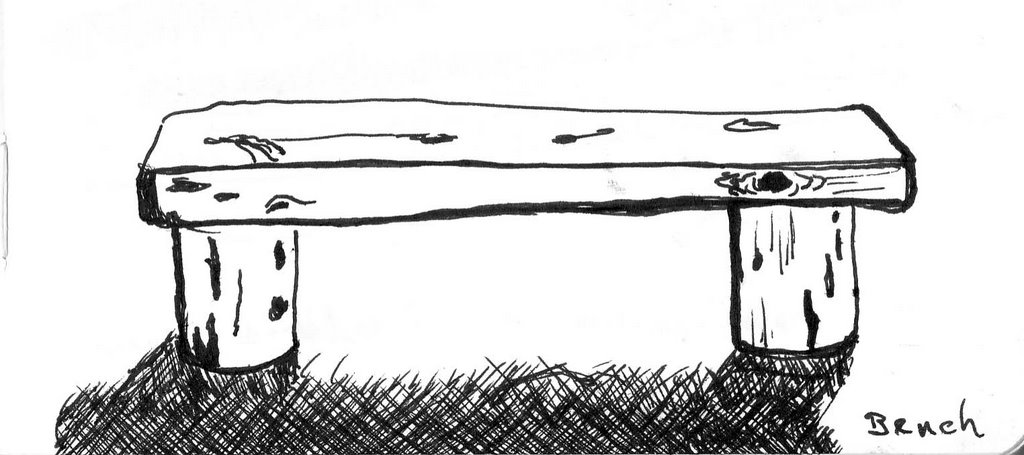
First we walk around through the gardens to the back of the house, and have our picnic lunch on a bench in an alcove shaded by small birches and wildflowers. The nearby stream tumbles over smooth boulders and forms myriad small waterfalls.
The house itself is elegantly plain: medium sized, white plaster with lots of windows. It isn't a showplace; it's a house meant to be lived in. The orginal furnishings, art, music and books are still in place, so it's very easy to imagine Laxness and his family living here. The audio tour is excellent: it is less obtrusive than a tour guide, and the recording includes the voices of Laxness and his wife. You can stand in his study, see the desk he stood at to write, look out the window at the very view that he saw daily. You can enter his bedroom, and see the art and objects he kept close to him. You can see his Steinway piano--the very same one that Bill Holm has played. When I see the grandfather clock in the hallway--ticking et-ERN-it-Y---(the one that the clock in The Fish Can Sing was modeled on) my throat closes up and I choke back tears.
We have an interesting talk with a man who works in the visitors center about our favorite Laxness books, and about movie versions of them. They have many copies of his books for sale, in a variety of languages. I would next like to read: Salka Valka, The Atom Station, and the story about Mosfellskirkja.
As we drive back to Reykjavik, we see (for the first time) the snow-covered mountain Snaefellsjokull in the far distance. You can't always see this from Reykjavik, but it's a beautiful sight. This is the glacier that Jules Verne used for the setting of Journey to the Centre of the Earth, and it is believed to be one of the world's most powerful and spiritual places.
Back to town, it's time to each lunch and pack up. We go with Gabe and Peter down to the harbor to eat at Tommy Burger. I have an absolutely delicious veggie burger accompanied by a coffee milkshake. What makes the veggie burger so good is that they use a mix similar to what is used for felafels, and it really works. Try it yourself!
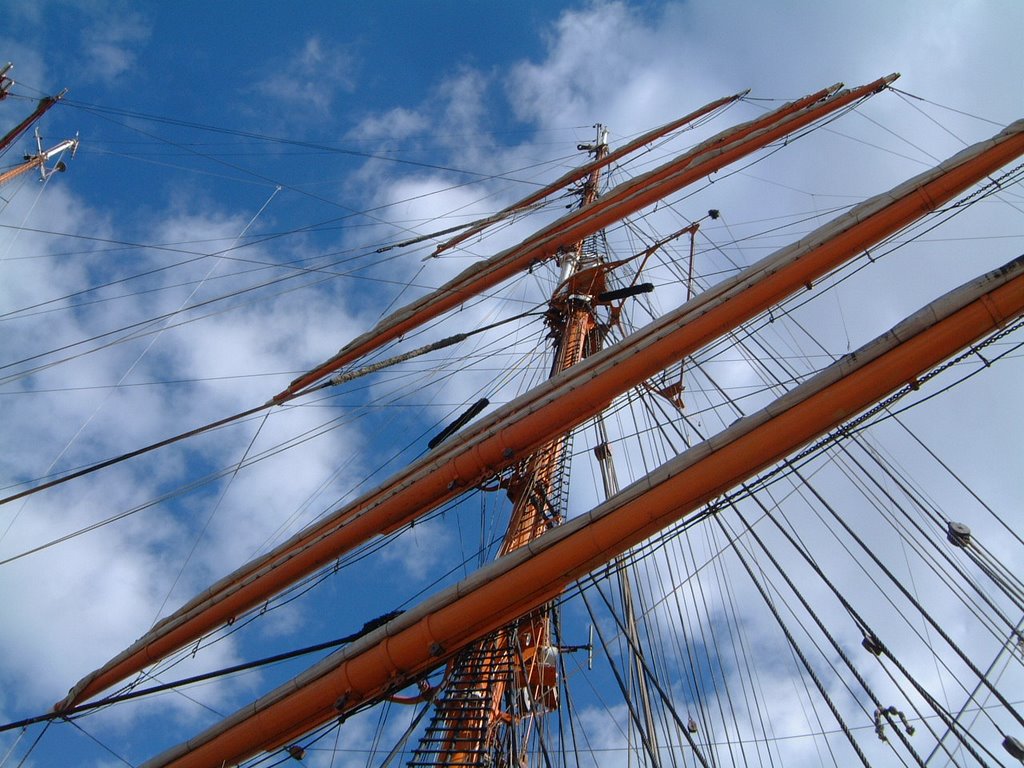 It's a sunny day in Reykjavik which means that, even though the temperature is only about 60°F, many of the natives are walking around in shorts and sandals, eager to soak up the sun. We find a large, four-masted schooner docked in the harbor, and as we approach it we find that it is a Russian training vessel, the shipmates are offering tours, and the tours are free! We take one.
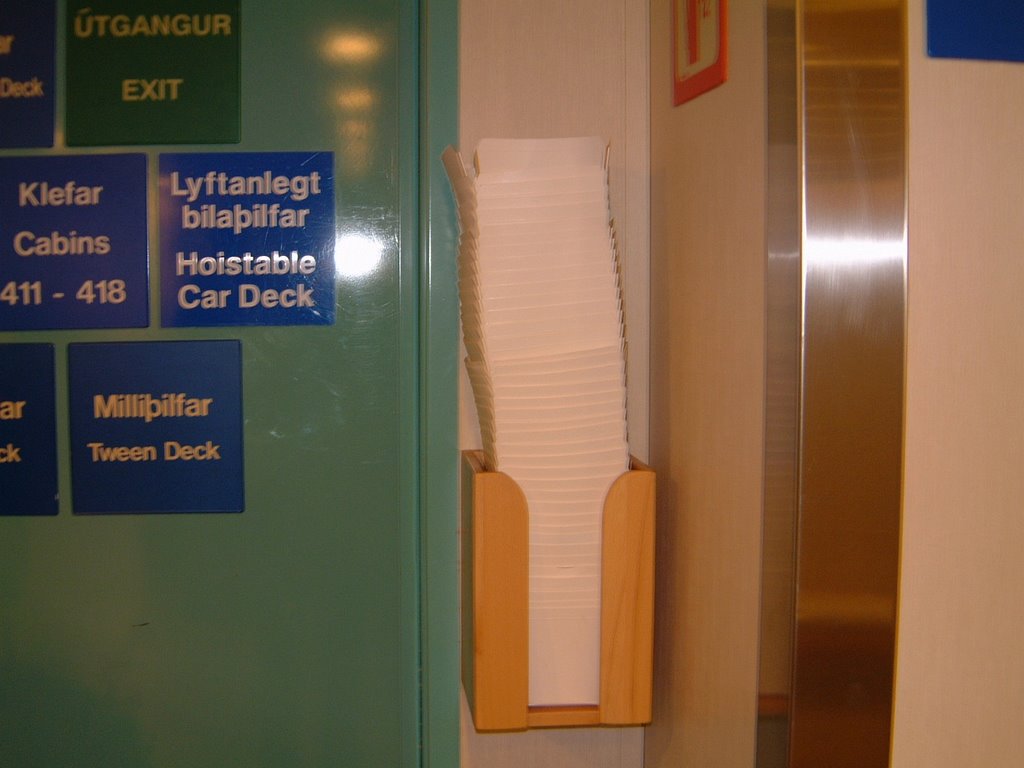 Leaving Reykjavik we have a 45-minute drive to catch the ferry for the Westmann Islands, where we will be staying on Heimaey. Our ferry trip is almost 3 hours. We admire features of our ferry, Herjolfur. First, we observe a stack of containers that look like large chinese take-out boxes. We suspect that these are conveniently provided for when the seas aren't so smooth as they are today. Convenient! Plus, we discover original art hung throughout the ship: oils, watercolors, photographs. Many of them feature Icelandic landscapes, and are quite good.
As we approach the fourteen Westmann Islands, they emerge as unique, odd shapes on the horizon that become steadily more bizarre as we approach. Like Iceland, these are volcanic islands, and our destination, Heimaey, is the only one that is inhabitated, unless you count sheep. Count sheep? We're not even tired yet!
The sheer black/green cliffs of Heimaey are beautiful, with birds everywhere as we come in to
 the harbor at 10:45 p.m. We disembark and walk through the quiet town until we find Guesthouse Hrithrith, and meet the German owner Ruth, who gives tours to the volcano and bakes bread there in the hot lava. (She is a full-time baker in the winter.) We have interesting midnight conversations in the guesthouse kitchen with a geologist from Scotland and a Chinese translator and his friend from the UK.
John and Gabe go for separate midnight walks on Heimaey. John walks by the cemetary without incident, and then to the lava area. Back at the guesthouse, the boys and I compare the cool features of our different sleeping bags. Gabe wins, with his "Penguin" bag. (That's not the name of the bag, but just that he looks like a penguin in it due to the color design. We offer to get him an orange bill and feet so we can rename it the Puffin bag.)
High 60°F Low 48°F
Jul 18, 2006
Jul 17, 2006
The Center of Iceland
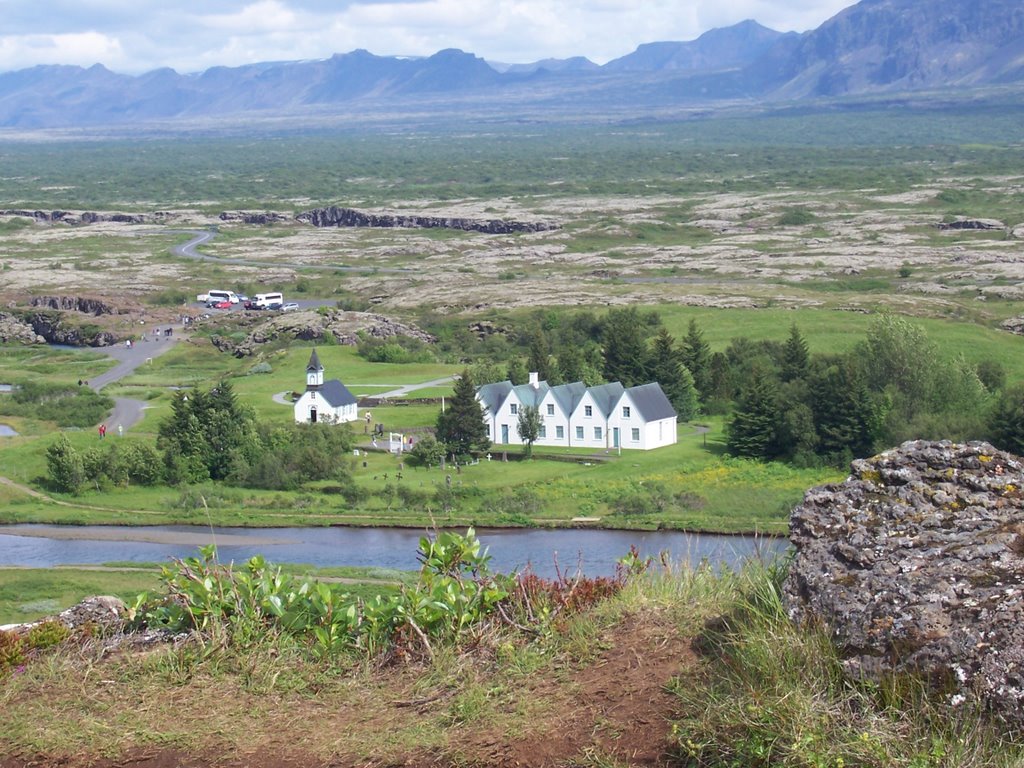 Where is the center of Iceland? Not the geographical center. The center of Icelandic consciousness, culture and history must surely be Thingvellir. It is located just 45 minutes northeast of Reykjavik, yet it has the feel of another place and another time.
What is Thingvellir? The idea that first comes to mind is the birth of government in Iceland. Around the year 930 the Althingi, or general assembly, first met at Thingvellir. Members of the assembly traveled from all over Iceland to this location, which was peculiarly suited to the purpose for a number of reasons. Thingvellir is the site of Iceland's largest natural lake, and its wide plain made it a practical place for large numbers of people to congregate.
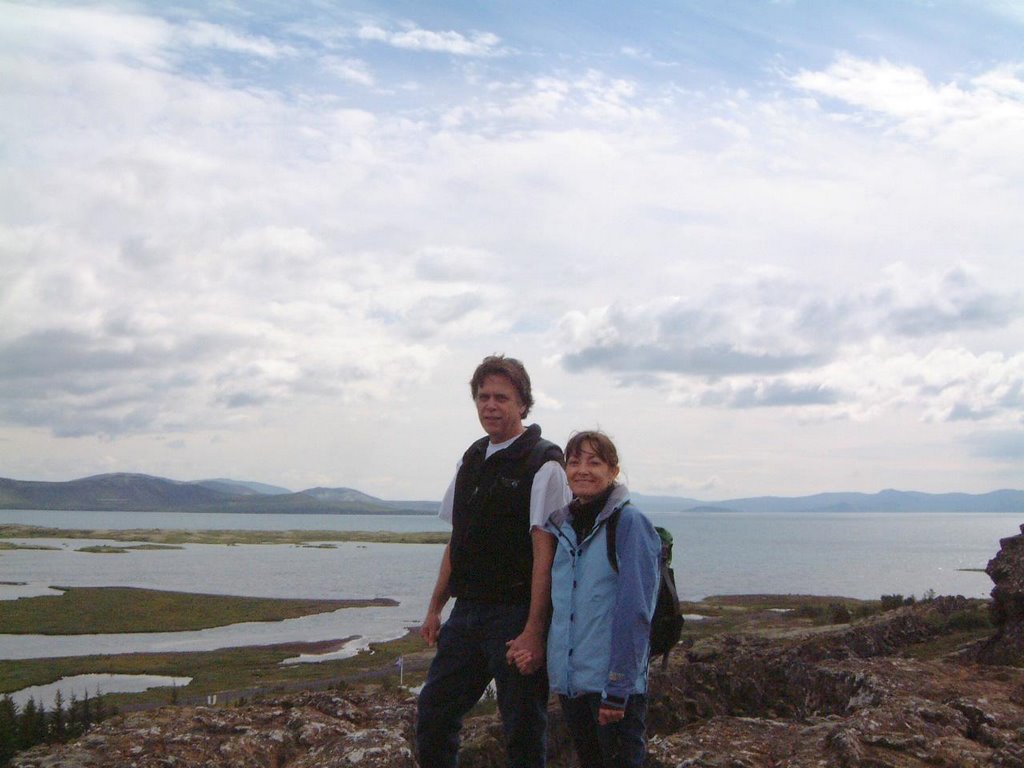
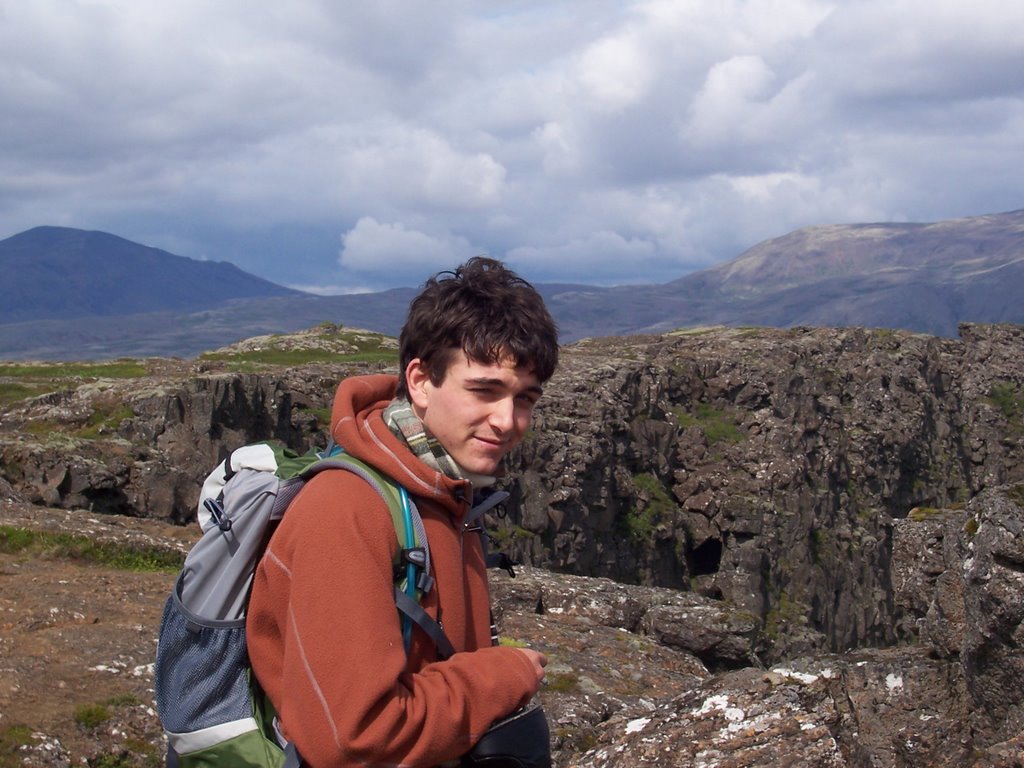
I anticipate that visiting the hangout of founders, lawmakers, heroes and outlaws of Icelandic history will be stirring. But I am taken aback by the compelling physical nature of Thingvellir. The high ridge that runs along its edge is a very imposing, dramatic backdrop to the Law Rock. Waterfalls spill down the side of the ledge, and plant life is varied and abundant.
Geologists, too, find their Mecca at Thingvellir. It is here that the
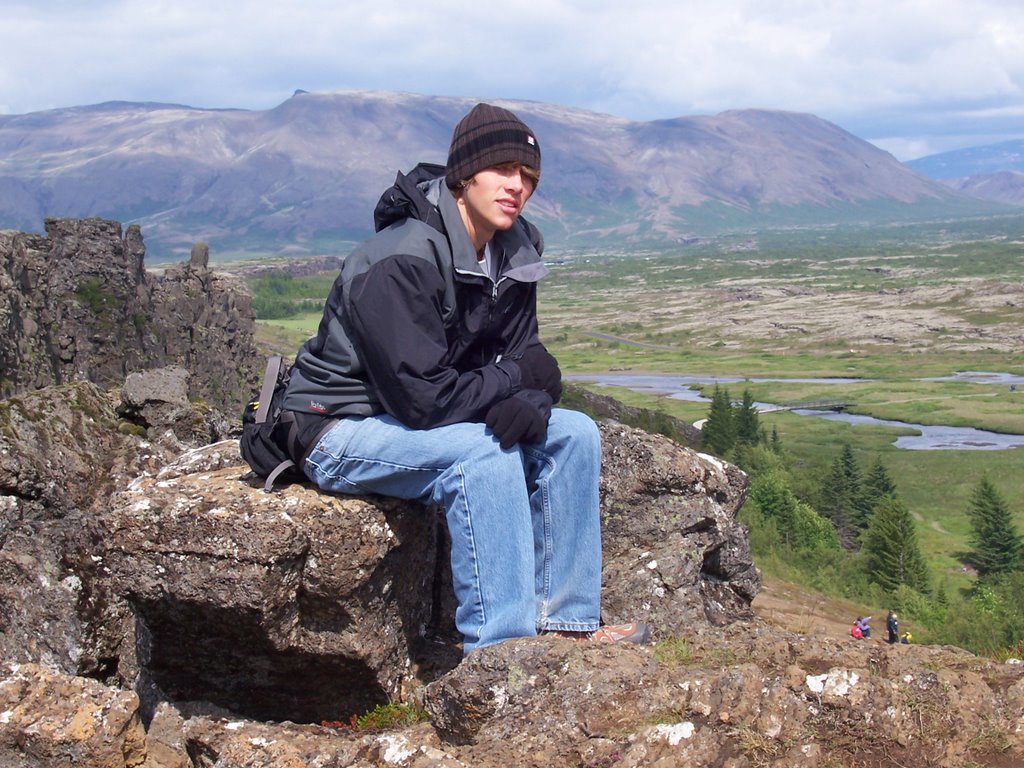 American and Eurasian tectonic plates meet, and here that the earth's crust is slowly pulling apart. In fact, John notices two small, brass knobs embedded high in the ledges that appear to be markers, indicating the extent of this movement over time. Hey, 70 meters over 10,000 years may not seem like much to you, but to a geologist...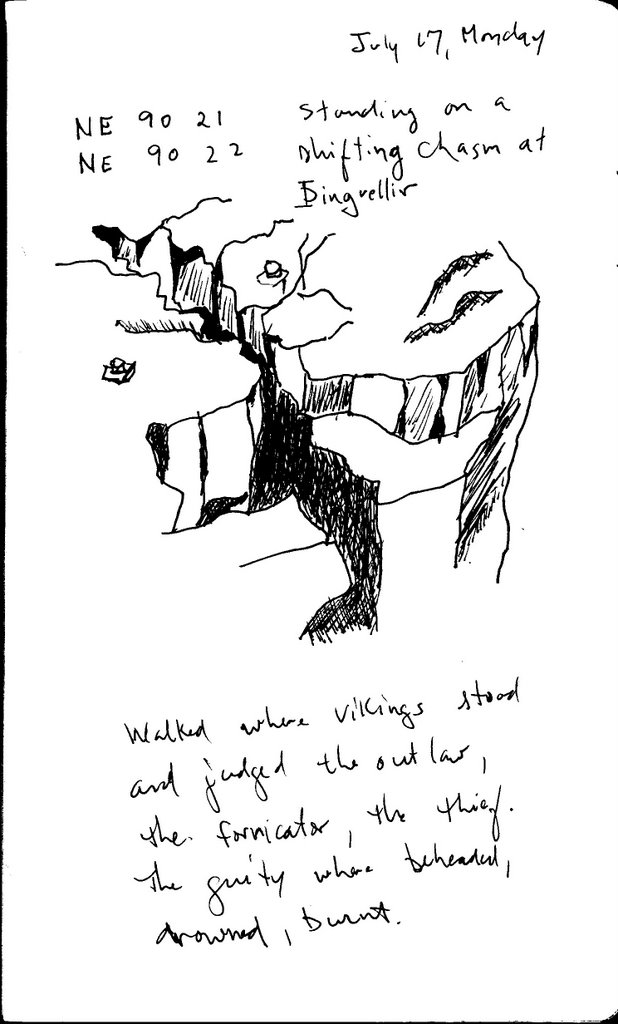
We trek all around the huge, fantastically formed gorge, ledges, and the lovely plain with its small church. Gabe is curious about something on the map of the area. Skogarkot, the receptionist informs him, was an old farm that had been in use from ancient times until the 1930's. We decide to take a hike there, through the lava fields. Moss beds masquerade as lava: it's hard to tell whether your foot will sink inches into deep moss or strike hard rock until you actually step. I find places where the moss is so thick that it makes a delightful mattress when I lay down in it. Tall rock piles mark the trail with worrying frequency: they are so close together that we ask ourselves if lava-sandstorms, fog or snow make it necessary to mark the trail with such closely placed markers. We add our rock offerings to the tall rock piles as we pass by. Despite having left our picnic lunch in the car, and it is now long past l
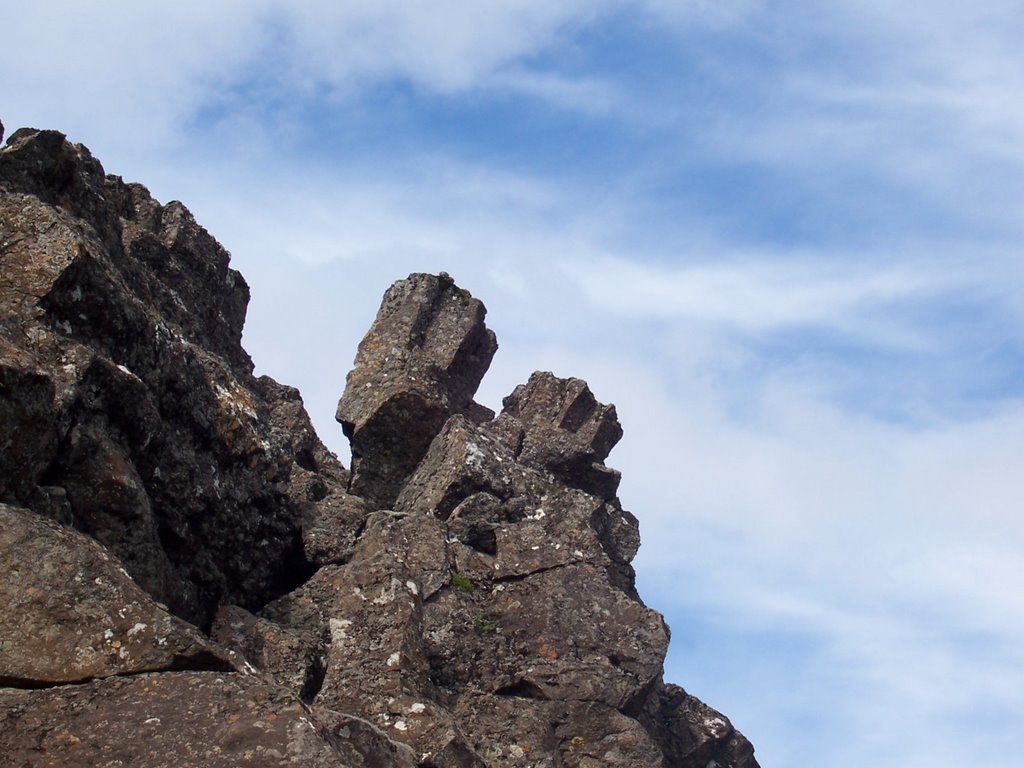 unch time, the hike is well worth it. We find the old homefield, with a rock fence delineating it and rock cellars marking the old farmhouse.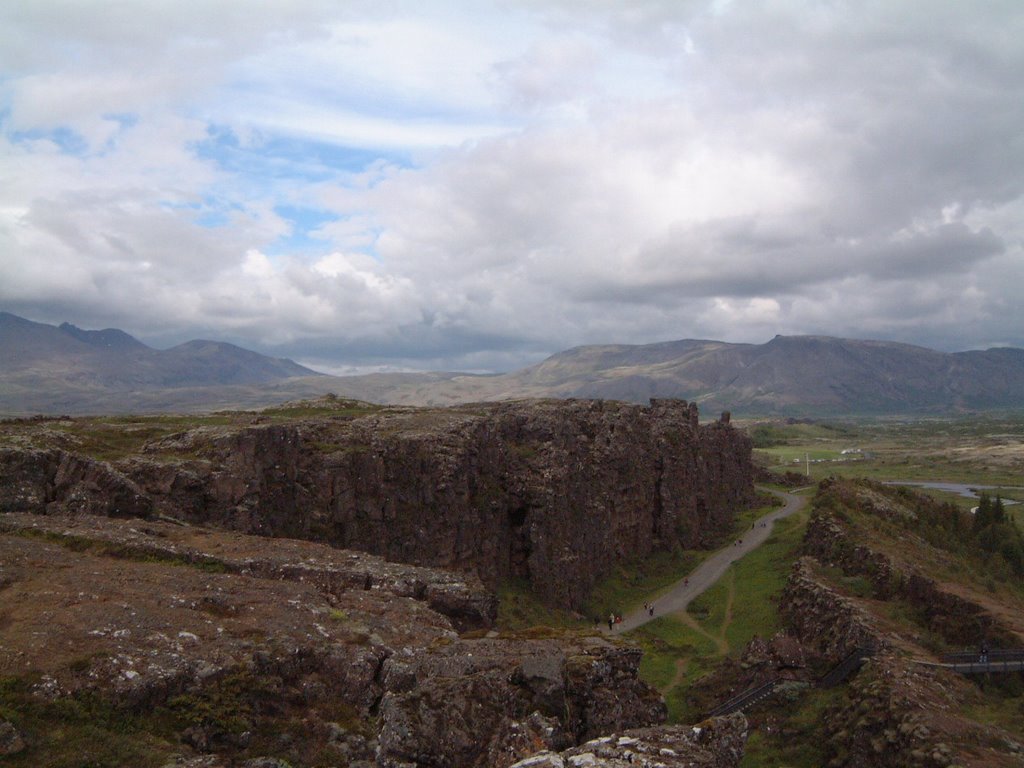
We leave the magical, evocative valley, and head off through countryside in the direction of a waterfall. We got off to a late start from Reykjavik today: in addition to other errands we stopped by Arctic Rafting, a company that provides guided outdoor adventures. We promised to call or stop by their office by 8:30 pm tonight to find out if enough people signed up for the trip and to confirm tomorrow's plans. The problem is, no cell phone coverage in this area, and it's getting close to 8. Must we skip the waterfall, after driving so far, in order to arrange our plans for tomorrow? Although we are told that there aren't pay phones at the gas stations, we decide to pull in one anyway, and ask.
As we pull into the Esso parking lot, about 45 minutes away from Reykjavik, John asks, "isn't that the Arctic Rafting van?" It is! It has pulled in right ahead of us! I go into the convenience store, and accost people until I find the employee from Arctic Rafting. He obliges by "phoning home" to the office, and all the arrangements fall into place. Love those cosmic coincidences!
On our way to the falls, Gabe asks about a plume of "smoke" that he sees far in the distance. I confess to knowledge of a geyser in the area, and it is clear that we have found it. "Geysir"--the big one--decided to go on an extended vacation years ago and no longer discharges. But "Strokkur" is very impressive, and we stay much longer than we intended to watch him perform over and over again, every 10 minutes.
We reach the waterfall, the famous Gullfoss, when it should be dark. But it isn't, it's misty and dusky, and a lovely light in which to view the falls. You can get as close as you like...no danger signs and fences. I don't like to get too close...but other people in our party do. The cafe at the falls is still open, so we can have a late dinner. The view even includes a glacier in the distance. We buy an Icelandic bumper sticker and patches for our backpacks, and drive back along a route dotted with steam rising from geothermal pockets, marveling at the good fortune we've had throughout the day...especially when the Arctic Rafting van materialized right before our eyes. What a day! Home at 11:30; still light. High 54°F Low 42°F
Jul 16, 2006
Meeting Iceland
Note: You can click on any of the pictures to enlarge them!
6 a.m., and I see Iceland for the first time. As we descend through the low c loud cover I can see the outline of the coast through the fog. It's an emotional moment for me, and not because of the golf course (which you can barely see at the bottom of the picture).
The trip from the airport, in our rental car, takes us across a huge lava field with outlandish lava formations that seem even stranger in the fog. It takes us 45 minutes to reach the capital city of Reykjavik, which contains about 200,000 people (two-thirds of the total population of Iceland).
Reykjavik is situated on a large bay, and features many hills. Our overwhelming impression is of color: vibrant houses in intense, saturated hues, metal roofs of dark red or green, blue sky and sea, lots of flowers (which seem to be on steroids: I've never seen such large dandelions or lupines). Even when it is raining, Reykjavik never appears dull. The city offers a lot of visual texture, with corrugated iron siding complementing wood board and batten siding, roof lines of many shapes, and all kinds of architectural details.
But enough about Reykjavik! What about us, the Icelandic Neophytes? Over the next two weeks we will never see John without his daypack, which conveniently has a pocket for his notebook, pen and pencils.
Click on picture to enlarge:
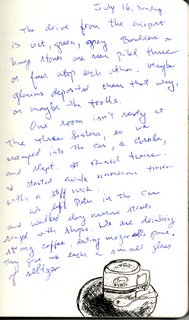 During the course of the day we investigate a variety of coffee shops. The theme for the day is rain, rain, rain and coffee, coffee, coffee! Fortunately the rain seldom lasts for long, but it ingrains in us a habit that will last the entire trip: we never go anywhere without either wearing our rain jackets, or having them tucked into our daypacks.
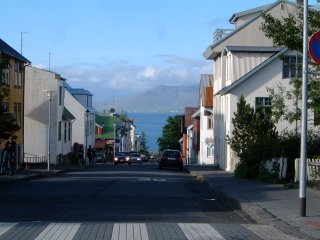 We return to Three Sisters Guesthouse where, we had been told: "We, and Iceland, will take care of you." Sonja and Thor show us to a comfortable room slightly below street level with lots of windows, room for 4, its own bath, and best of all a kitchen! We wake Peter up and move in. Three Sisters is right in City Centre, the historical part of town. You can walk everywhere, and the picture shows how close we are to the harbor.
We spend our first day getting acclimated. We buy food at the grocery store and walk all over town. We find the Tourist Office, the banks, the bookstore, and the landmark Hotel Borg (like a trip back to the 1930's with its art decco designs).
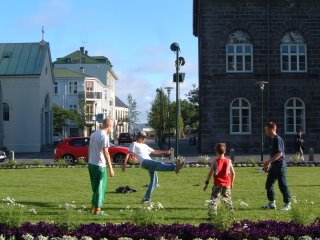
Peter meets up with some Icelanders and finds that hacky sack is an international language.
Late in the evening John, Gabe and I walk along the shore that borders the city. We encounter some women who tell us about an art exhibit they have just installed in a lighthouse offshore that can only be reached during low tide.
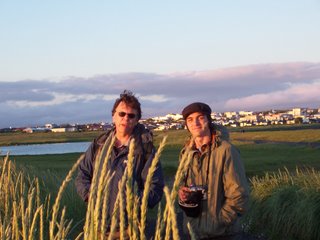
Light extends the day--night and darkness never come--and it is difficult to go to bed with the late evening light beckoning. These two pictures were taken at about 11:00 in the evening:
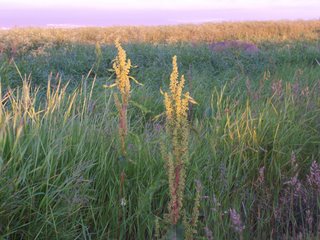


Iceland High Today: 52°F
Low 46°F
6 a.m., and I see Iceland for the first time. As we descend through the low c
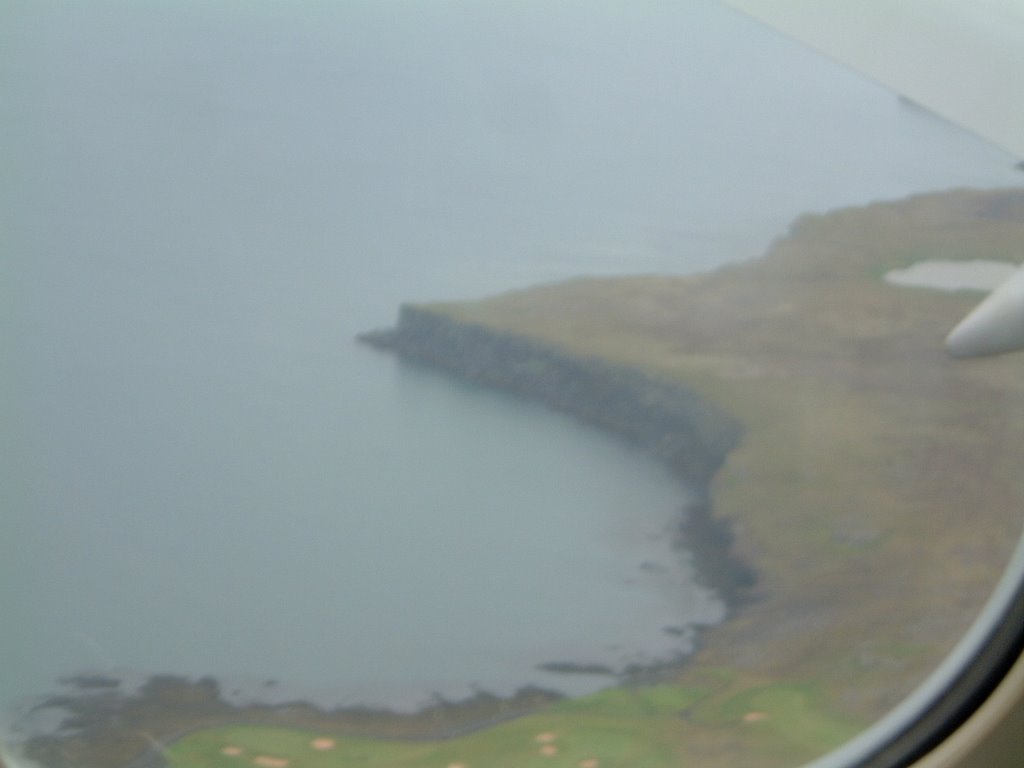 loud cover I can see the outline of the coast through the fog. It's an emotional moment for me, and not because of the golf course (which you can barely see at the bottom of the picture).
The trip from the airport, in our rental car, takes us across a huge lava field with outlandish lava formations that seem even stranger in the fog. It takes us 45 minutes to reach the capital city of Reykjavik, which contains about 200,000 people (two-thirds of the total population of Iceland).
Reykjavik is situated on a large bay, and features many hills. Our overwhelming impression is of color: vibrant houses in intense, saturated hues, metal roofs of dark red or green, blue sky and sea, lots of flowers (which seem to be on steroids: I've never seen such large dandelions or lupines). Even when it is raining, Reykjavik never appears dull. The city offers a lot of visual texture, with corrugated iron siding complementing wood board and batten siding, roof lines of many shapes, and all kinds of architectural details.
But enough about Reykjavik! What about us, the Icelandic Neophytes? Over the next two weeks we will never see John without his daypack, which conveniently has a pocket for his notebook, pen and pencils.
Click on picture to enlarge:
 During the course of the day we investigate a variety of coffee shops. The theme for the day is rain, rain, rain and coffee, coffee, coffee! Fortunately the rain seldom lasts for long, but it ingrains in us a habit that will last the entire trip: we never go anywhere without either wearing our rain jackets, or having them tucked into our daypacks.
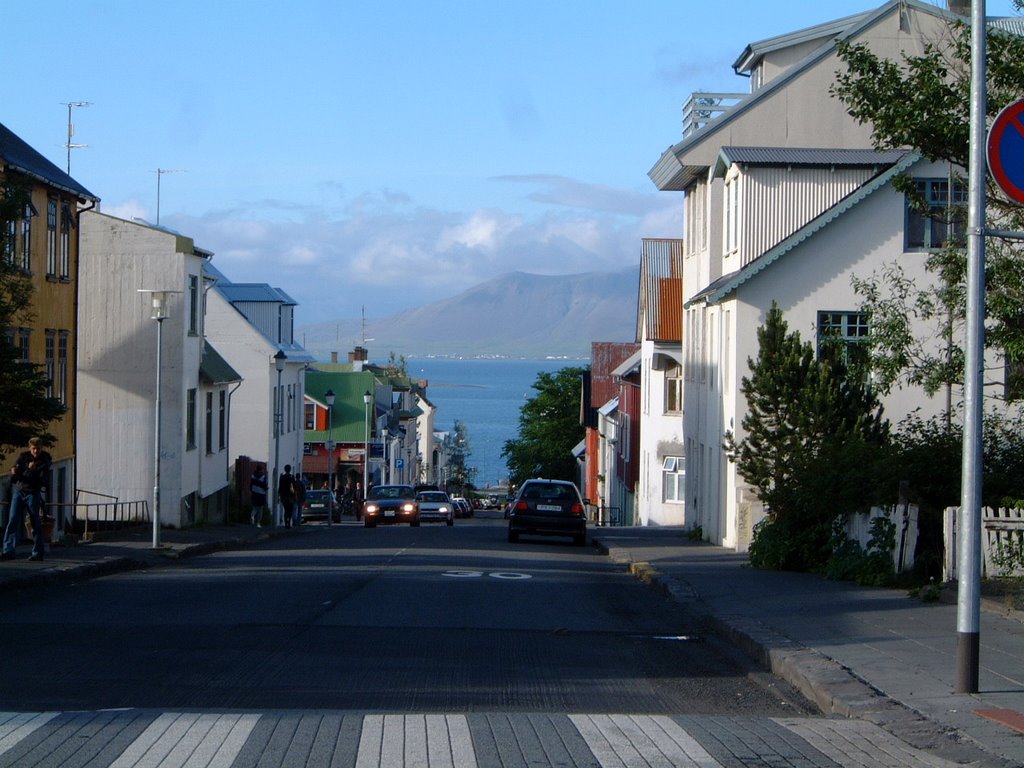 We return to Three Sisters Guesthouse where, we had been told: "We, and Iceland, will take care of you." Sonja and Thor show us to a comfortable room slightly below street level with lots of windows, room for 4, its own bath, and best of all a kitchen! We wake Peter up and move in. Three Sisters is right in City Centre, the historical part of town. You can walk everywhere, and the picture shows how close we are to the harbor.
We spend our first day getting acclimated. We buy food at the grocery store and walk all over town. We find the Tourist Office, the banks, the bookstore, and the landmark Hotel Borg (like a trip back to the 1930's with its art decco designs).
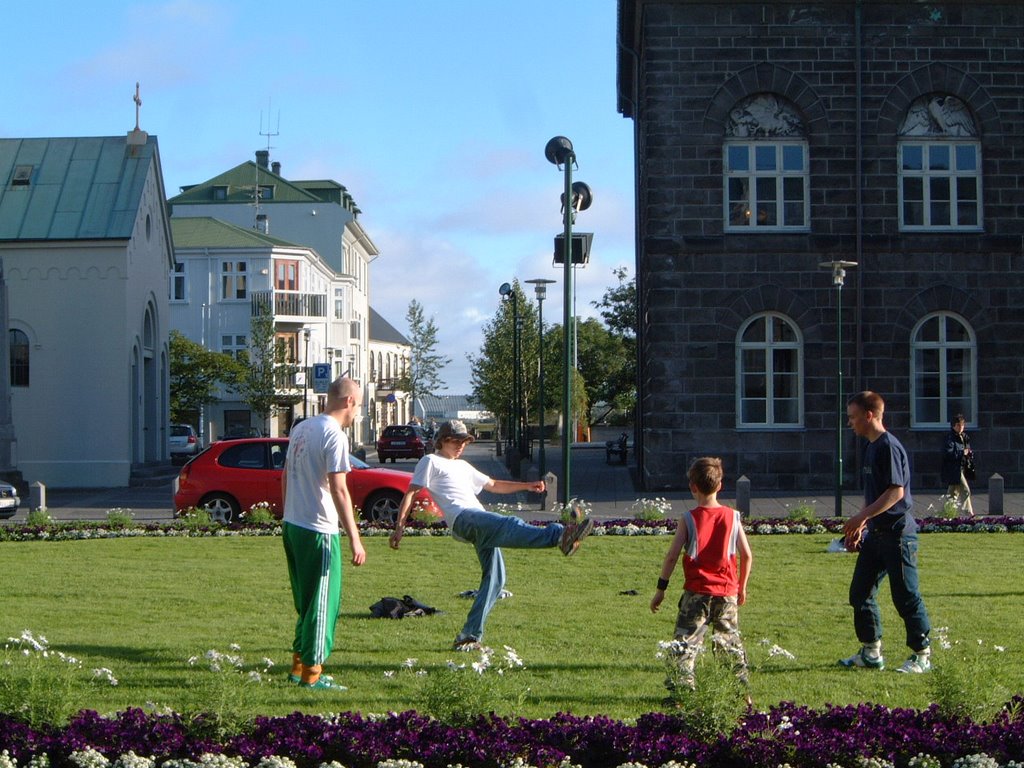
Peter meets up with some Icelanders and finds that hacky sack is an international language.
Late in the evening John, Gabe and I walk along the shore that borders the city. We encounter some women who tell us about an art exhibit they have just installed in a lighthouse offshore that can only be reached during low tide.
Light extends the day--night and darkness never come--and it is difficult to go to bed with the late evening light beckoning. These two pictures were taken at about 11:00 in the evening:
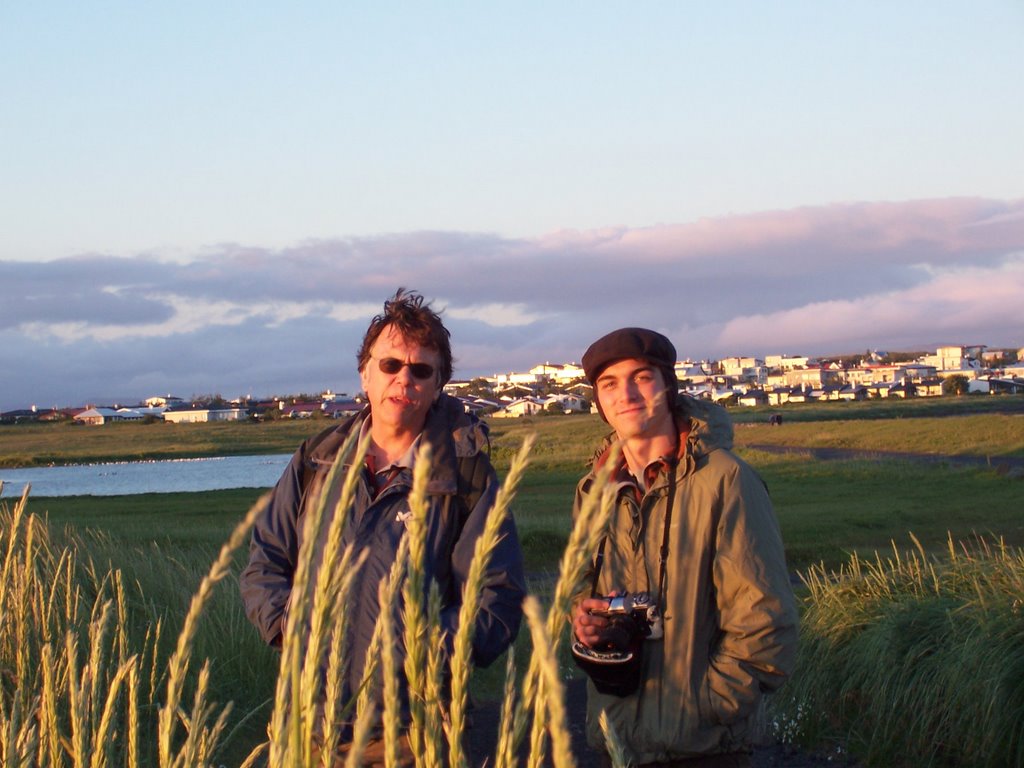
Iceland High Today: 52°F
Low 46°F
Subscribe to:
Posts (Atom)