Showing posts sorted by relevance for query "we meet bill holm". Sort by date Show all posts

Jul 23, 2006

We meet Bill Holm

Sunday: Part 2

Hosfos is small. We wander along the historic area, thinking to find our lodging. Crossing a bridge, we see a woman walking towards us, waving excitedly. "Hi!", I say, "are you looking for your little lost lambs?" [Gabe, Peter and John groan inwardly...but I'm thinking that this is the woman who is renting us lodging, that she was expecting us, and that she has found us!] The woman looks at me quizzically, and gently explains that she is greeting her friend--who is walking right behind us. Augggh.

Not having happened on our lodging, we decide to take a more scientific approach. We call the phone number, and are directed to a small shop where Solveig, the daughter of Gudrun and Valgeir (owners of the guesthouse), awaits us. She takes us to our lodging, which is an entire house, about 30 years old. It has a somewhat cheesy, '80's decor, and is very clean and comfortable, with 4 bedrooms, a bath, a large kitchen, and a sitting room. It is huge, by our recent standards, and less than what we paid for last night's tiny, bathroom-less cabin! It is about 9 pm so the market has closed--we'll get groceries tomorrow. In the meantime, laundry is a priority. Solveig shows us where we can do some laundry, at one of their other houses, and after we get our laundry underway I decide to go in search of Bill Holm.

[Special laundry update: a number of times during this trip we asked where a laundromat might be. This was the wrong question. The question should have been, "why are there no laundromats in Iceland?" Entrepreneurs, this is your hot tip.]

Holm, you may remember, is the author of Eccentric Islands, Coming Home Crazy, and a number of other books I have enjoyed. It was Bill who sparked my interest in Iceland. He is a Minnesotan of Icelandic ancestry. As I read his essays that mentioned Iceland I thought I should familiarize myself with some Icelandic literature, never having read any. I started with the sagas and with Halldor Laxness, and was immediately hooked. Bill teaches two, one-week writers' workshops in Hofsos each year (along with other authors). He bought an old fisherman's cottage in Hofsos, and stays here most of the summer to write.

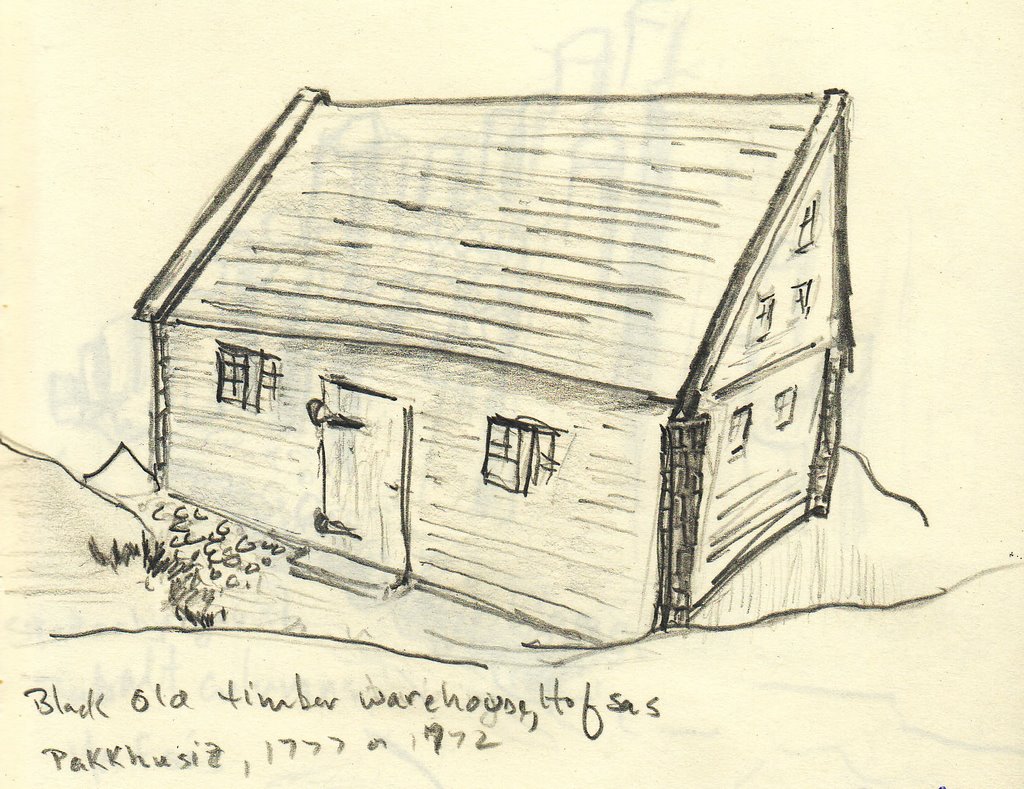
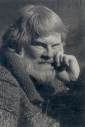
Solveig had pointed out Bill's cottage to me, so I head right up to the door and knock. No answer. It doesn't take much thinking to come to the conclusion that there is only one place that anyone could be in Hofsos at night, if they are not at home. I make an about face and walk a few yards to the Solvik Cafe...a lovely old building with a broad porch. I look in the door and sure enough, Bill is there dining with friends. How do I know it is him? Well, no one looks like Bill Holm but Bill Holm.
I don't want to interrupt his dinner, so I walk back to his cottage, and leave a note in the book I have brought him as a gift (Brighten the Corner Where You Are, by Fred Chappell). In the note I remind him of my phone call some 5 months before, tell him where we are staying, and say I'd love to meet him if he has time.

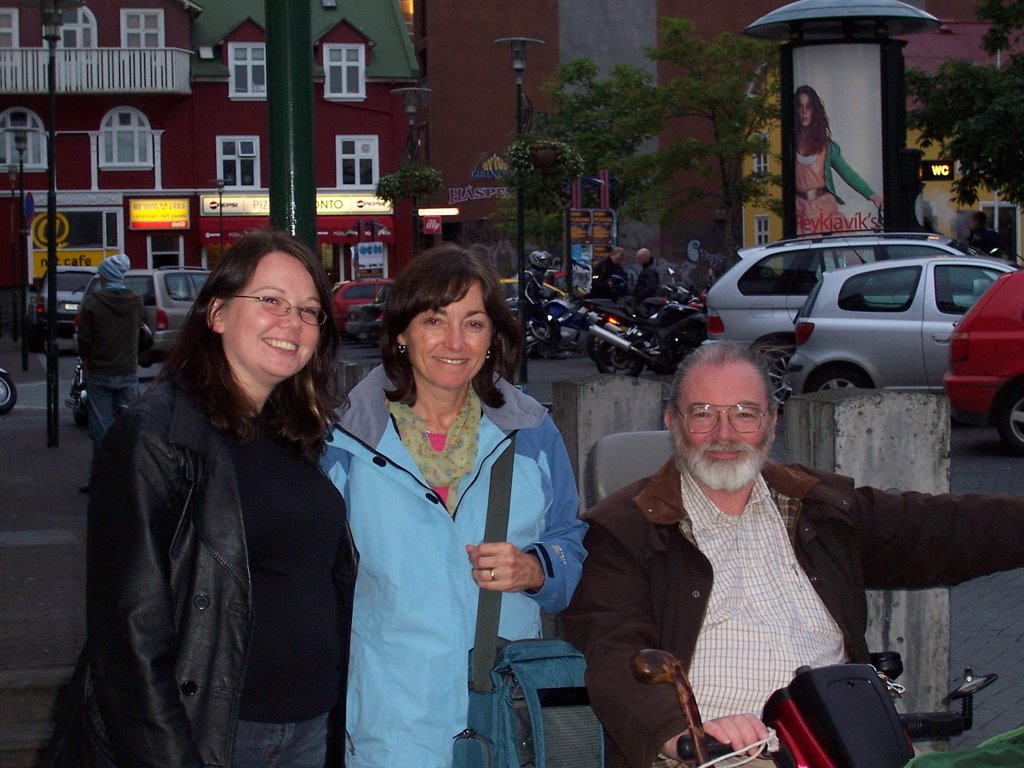
John and I go back to tend to the laundry, and by the time we return to our house guess who is standing in the driveway with Gabe, Peter, and an unfamiliar woman? Meanwhile a lot of confusion ensues regarding two women staying in a renovated garage on our property, a lack of hot water, and Bill trying to help them with his cell phone. It all gets straightened out, the woman returns to her cold shower, and we invite Bill into our kitchen.

It is fun talking to Bill, for I feel as if I know him already, having read so many of his thoughtful, funny, autobiographical essays. Gabe, Peter, John and I all sit around the kitchen table with Bill Holm as we chat about politics (the Alcoa plant, among other things), literature, and places to see in Iceland. Peter keeps Bill's water glass filled, in a most host-like fashion, that being all we have to offer. Only after Bill leaves does it occur to me that we could have offered him coffee! We find out that Bill is currently at work on two books, one of which will be called "Windows of Brimnes," the windows being those of his fisherman's cottage, Brimnes, here in Hofsos. I am really eager to read this book when it is published! Here is his "window":
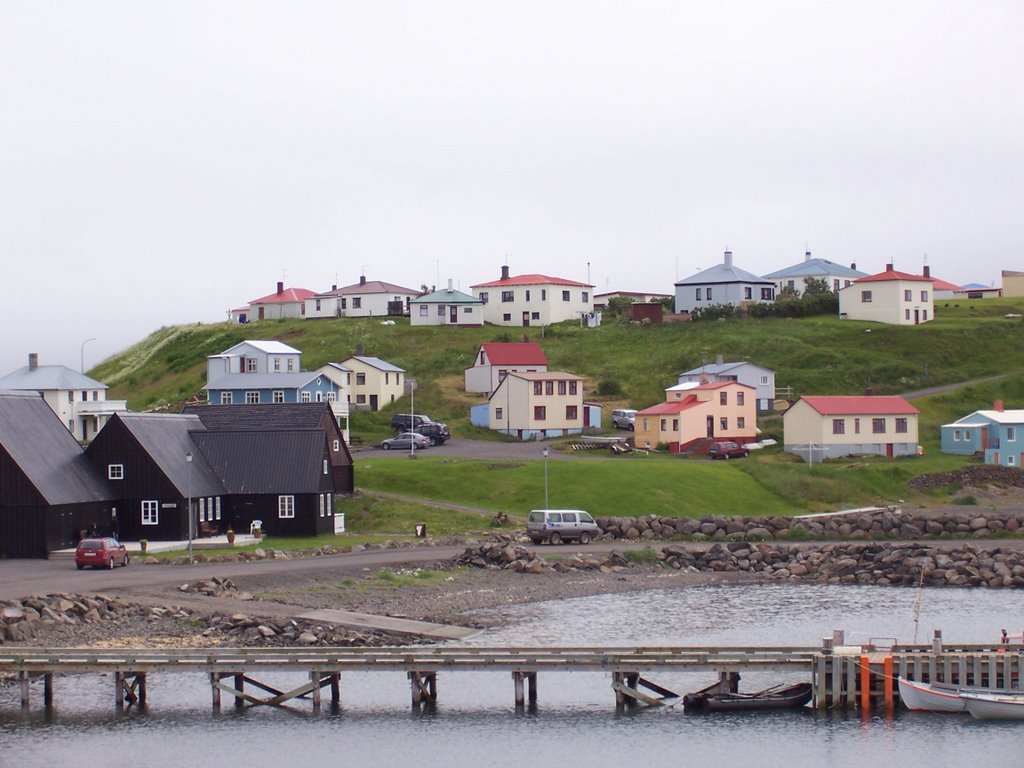

Bill complains that the weather hasn't been good this summer, and that Hofsos has been foggy for weeks. Tonight, for example, you can't see across the fjord (Skagafjordur), and you can't even see Drangey Island. You can't see at all.

This comment, however, plants an idea in my mind...

I was really scared when we climbed Mt. Eldfell in Heimaey, and I have been worrying, increasingly, about climbing Drangey. The island consists of sheer cliffs that are nearly 700 feet high. I have seen pictures of the trail up the cliff, and it is daunting...terrifying, even. On the other hand, Wincie has climbed Drangey, Judith has climbed Drangey, Bill himself has climbed Drangey. When we asked our youthful hostess, Solveig, if she had climbed Drangey (remember, she has lived in Hofsos all her life), she replied that no, she is scared of heights...

As my worrying has increased, and as I have verbalized it more, John has started to worry as well. So the idea Bill plants is that possibly it will be too foggy to go out to Drangey Island. Granted, this is one of the top three things I longed to do while in Iceland. And I have already phoned "Farmer Jon" (who is the boat captain and honorary "Earl of Drangey") to place our reservation for the trip tomorrow. But, if it is too foggy for the boat to go out, then it is out of my hands...

After Bill Holm leaves, and a perfectly wonderful day comes to a close, I go to sleep asking myself, "do I feel lucky?"

Jul 25, 2006

Goodbye Hofsos and Holm


John and I have an eventful morning while the boys sleep late. I had a great idea last night, just before I fell asleep. I was thinking about the hours Gabe and Pete have spent kicking rocks (acting like the rocks were hacky sacks or soccer balls). I figured that I could find a ball at the market, and it would be overpriced and poor qualilty, but it would get a lot of use. So John and I venture out, to the laundry, the bank, the post office and the market. Along with the obligatory pastries we buy a soccer ball! Just what you'd expect for the equivalent of $10. USD., but a very worthwhile investment-- by the end of the trip the soccer ball will be completely worn out!


After breakfast we walk along a little path down to huge basalt column stacks, hexagonal in shape, along the shore. John stops to sketch them, naturally.


We walk through town to the Icelandic Emigration Center museum, which is a wonderful place for kids and adults alike. It focuses on the Icelanders who emigrated to the U.S. and Canada, primarily at the end of the 19th century. What is so great about the museum is that it provides lots of personal histories with pictures, letters, newspaper clippings, and objects from people's daily lives. All of the exhibits are done in a very tasteful manner: not slick, but artistic and professional.


John notices Bill Holm outside talking to someone, so I go out to see him. I realized last night that during our previous conversation I never told him that his books were the impetus for my reading Icelandic literature, and that he was directly responsible both for my passion for Iceland, and our being here on this trip! I am able to convey my heartfelt thanks for the way in which his books have led me on a path to where I am right now. I confess to disappointment that I don't have his books along so that he can sign them (Antonia made me take them out during our "Take Out" packing party), and he tells me to send them to him in Minnesota to sign. Thank you, I will!

We talk some more about the book he is working on, Icelandic horses (his next chapter--I tell him about my Shih Tzu/tolt theory, and he is unable to confirm it), and he confesses amazement that we'd gone to Drangey yesterday in the fog! He is a little put out that Hofsos has been foggy every day for weeks. I am enjoying Hofsos anyway, but I can imagine how stunning the view must be when you can see across the fjord to Drangey and the snow-capped peaks beyond. Bill recomends that we visit Holar, Siglufjordur, the Icelandic Folk Music Museum and the Herring Museum--all places we want to go, but which will have to wait for our next trip. We have a hug and kiss goodbye; alas, John isn't around to take my picture with Bill Holm. I have great memories, though, of meeting the man whose words introduced me to Iceland.

We head back to our house, Karastigur, to eat lunch with the boys and pack up. Just as we sit down to eat there is a knock at the front door. Who can it be?

I open the door to discover a bank officer! There was a little misunderstanding at the bank when John signed over two traveller's checks (in the wrong place) resulting in this personal visit by the banker, who politely requests that we stop by to rectify the matter. Only in Iceland would a banker pay a house call!


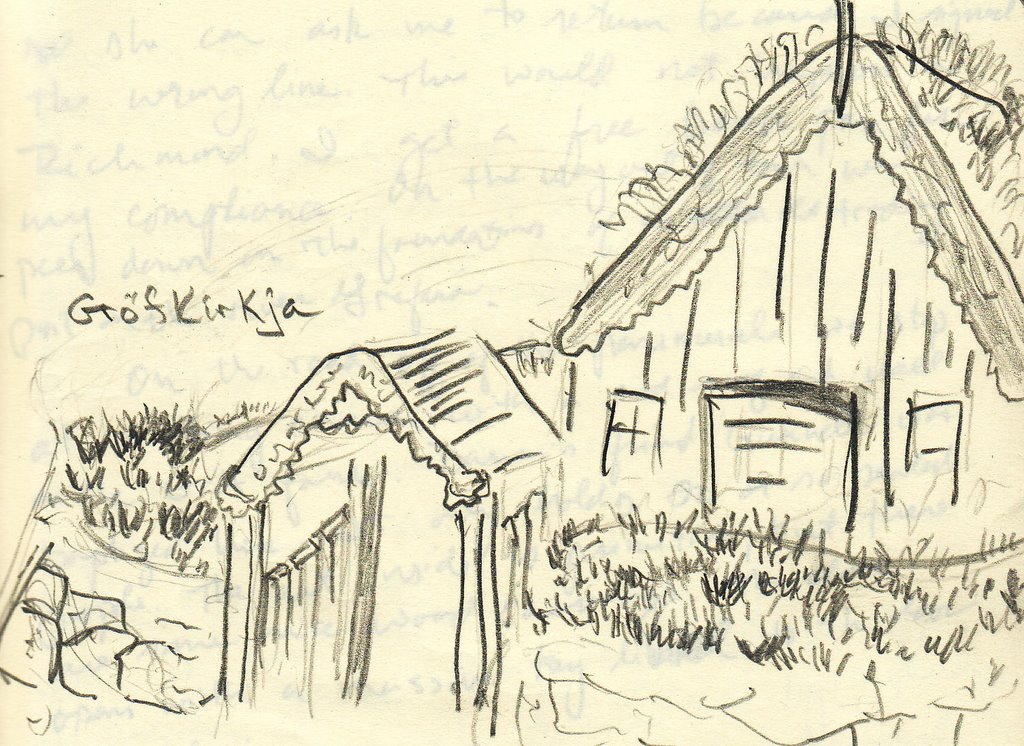
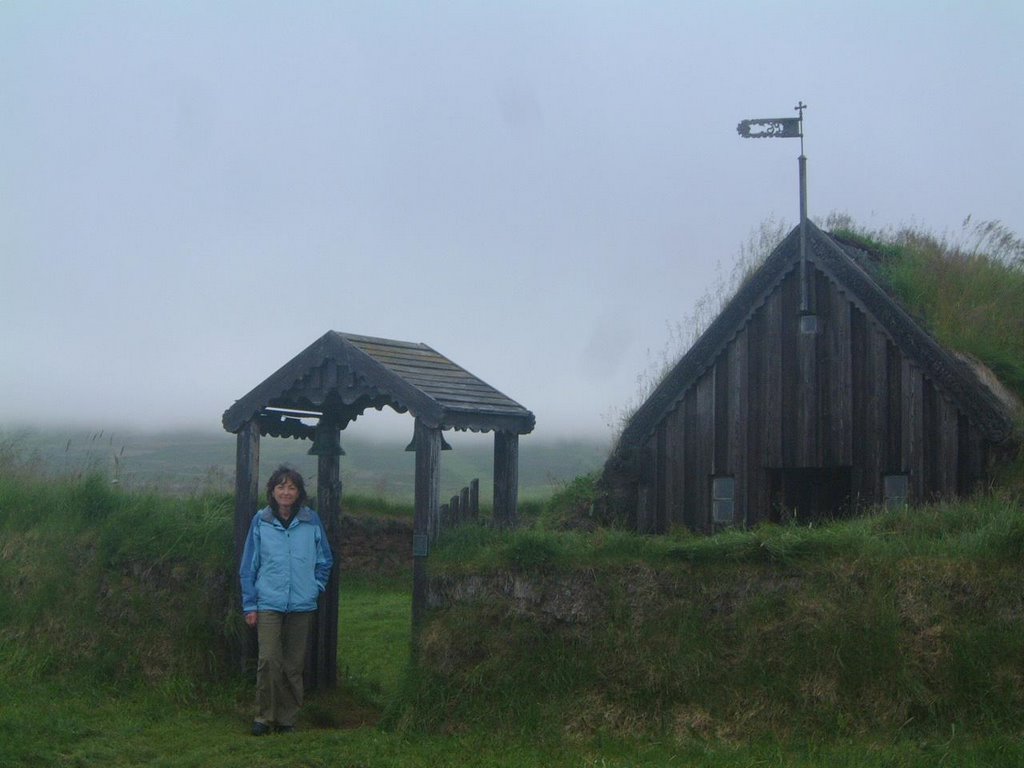
We pack up and, after a phone call to the owners, we simply leave our payment on the table, door unlocked (we never had or needed a key). Outside of town we stop by the little turf church at Grof where Gunnella was baptised. The picture doesn't convey how little--it seats just 20 people, and those people had better be careful when they stand up! Even shorties like me will bump their heads on the low rafters.


Next stop is the Glaumbaer Folk Museum, which features a large complex of 7 or more turf houses once owned by a wealthy priest named Snorri. The adjacent church has flowers and bushes planted on top of the graves, and inside the church is an organ made entirely of pine--keys, pipes and all.

In Blonduos, where Gunnella once lived and taught school, we stop at an Information Center and we meet a very gregarious young man who tells us about his trip to Drangey: how his friend pushed him off Jon's boat into the water, and how he exacted revenge.

The rest of the drive to the Snaefellsness penninsula is through lovely, scenic areas where many of the saga stories took place. We arrive at Arnarstapi late--too late for dinner, due to an infestation of Danish tourists and the fact that it is so remote that there is no alternate place to eat. They agree to fix us sandwiches, however, so that we don't starve.

The dining area is a lovely turf roof building with clean, light pine walls and ceiling. The building we are lodging in, however, is the most institutional of any place that we have stayed, resembling dorm rooms. But there is a very pleasant common room with a remarkably well-equiped kitchen for all of us to use.

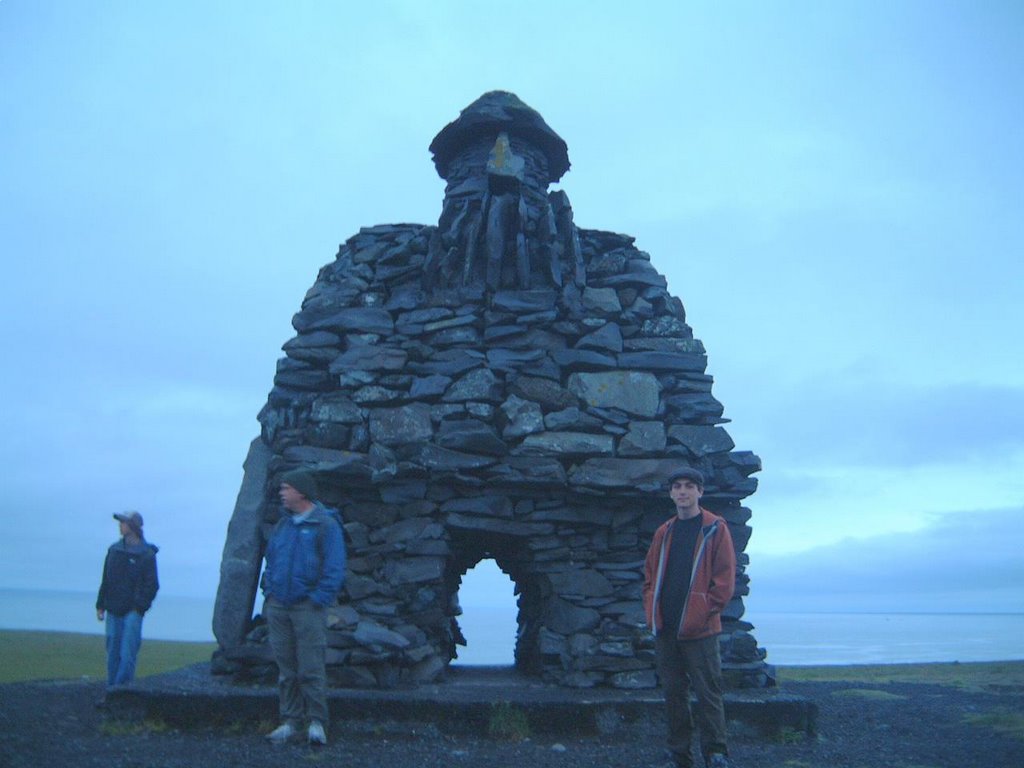
We follow our light dinner with a late evening walk in the longlasting twilight, a walk fraught with peril due to the kria. Kria are birds that are fiercely protective of their nests. Unfortunately, they are well equiped to defend with their long, curved, sharp beaks. The birds screech while dive-bombing any intruders. Their intimidation techniques are very effective: smart people steer clear of their nesting areas. As we walk out to the huge rock statue of Barthur, guardian of the area, we meet a mother who tells of being on a golf course where kria attacked her head and drew blood!

Enough excitement. Time for sleep.

Jul 18, 2006

The Reykjavik Social Club

Who is going ice climbing on a glacier today? And who is staying behind to socialize in Reykjavik? The guys are going ice climbing...even the one who is old enough to know better. The gal has other plans...plans to stay alive, warm and dry.

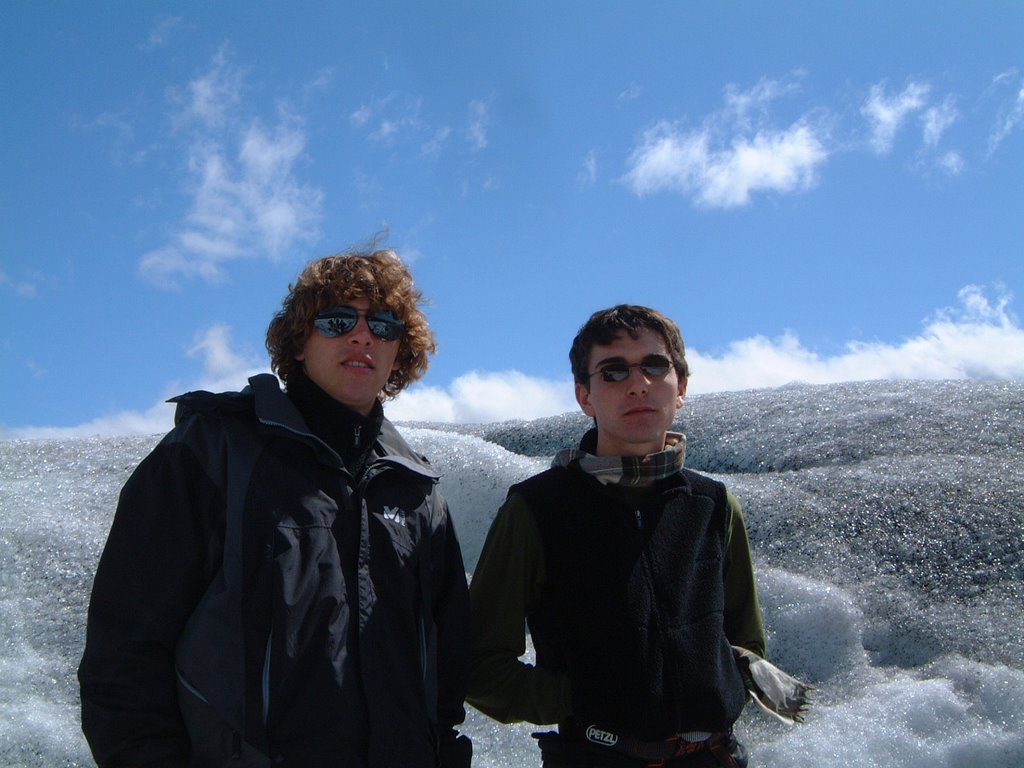
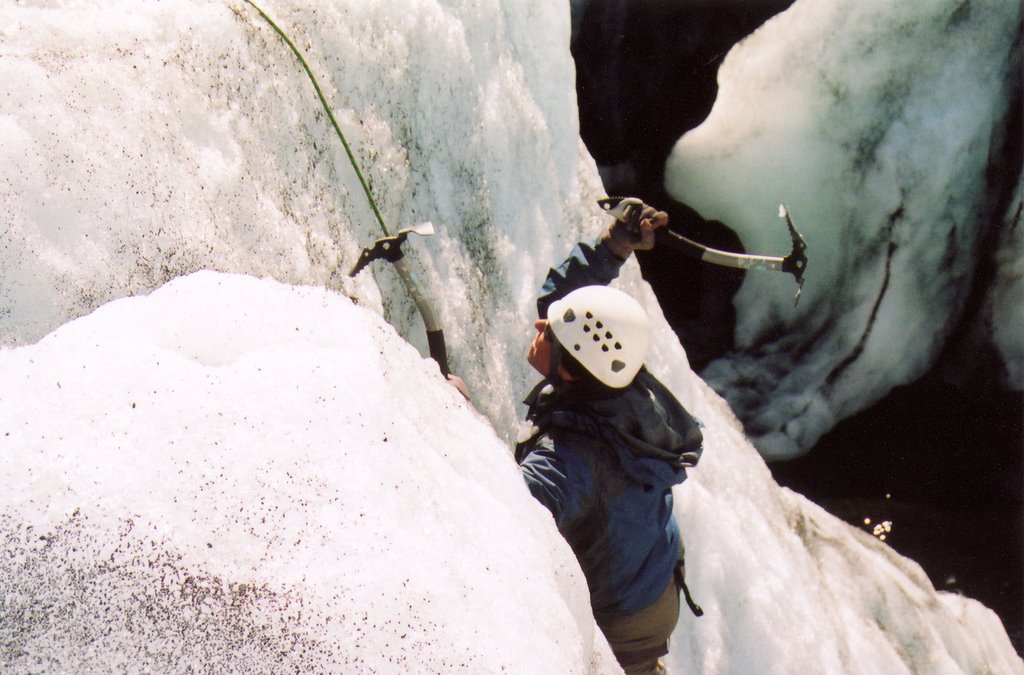
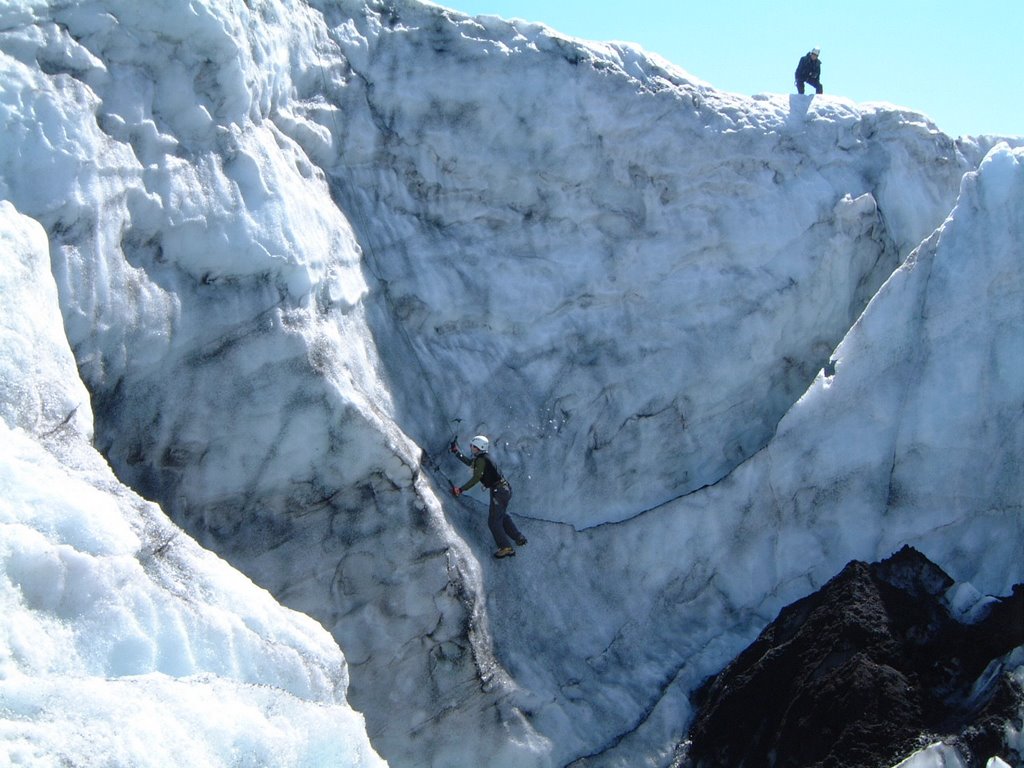
Arctic Rafting Nordic Icemeister Jon, my three guys, and Linda and Tony (a dentist and a doctor from Australia) head off to a finger of the Myrdalsjokull Glacier for a testosterone-filled day. Pete and Gabe have done some rock climbing, but this version of the sport entails spike crampons (on your shoes), helmets (take a wild guess), a harness, ice picks, and long underwear (not a legal requirement). After conquering the basics of ice-picking, rappelling, and then putting the various skills together, our Newbie Icemeisters are let down a large rim and allowed to claw their way back up. Way to go! Peter's trip evaluation: "It wasn't fun, but it was a rush."

On the way back they reward themselves with pastries and a stop at Skogafoss, where they have a New Age experience involving the waterfall and being encircled in a--yes, circular--rainbow. Far out.

Little do they know that when they return to Reykjavik they will find our guesthouse room occupied by someone else, that I have moved out, and that I haven't told them where I, or their things, have gone! But more about that later...

Today I get to spend time with some friends. I have made arrangements to meet Wincie for lunch at Hornith--an Italian cafe with delicious seafood soup. Wincie sings in the Reykjavik Cathedral Choir, and I got to know her through Bill Holm's stories. She is one of two friends who alerted me that Bill was reading one of his stories on Prairie Home Companion when it broadcast from Reykjavik last month--and the story Bill read was a funny and very poignant story about the Cathedral Choir. So I get to meet the delightful Wincie in person. We talk about literature, religion, politics, travel, music. I give her two CDs featuring the choir at St. James's Episcopal Church in Richmond: Jazz Mass, and the recording of their performance in Gloucester. John and I didn't get to hear Wincie's choir when we stopped by the Cathedral on Sunday, for they take a break during the summer. First reason to return to Iceland: to hear Wincie and her choir sing at the Cathedral.

During the afternoon I have an hour or two to spend getting to know Reykjavik a little better. I am able to identify the house where Halldor Laxness was born, as well as the one where Magnus Magnusson lived (see review of Dreaming of Iceland, April 20), each just a block apart.

Next I find the coffee shop where I am to meet Gunnella. She has recently returned from living in Edinburgh, and is getting ready to move to Tokyo for a year and a half. No one could be easier to talk to than Gunnella, and there is so much to talk about. The afternoon passes quickly, and soon her Dad, Thor, comes to the coffee shop to meet us. We discuss dinner plans, and wonder whether we should wait for the ice climbers to return. I have the bright idea of inviting them over to see if the guys have returned. Plus, I want them to see our lovely "flat": this morning I was asked by Thor and Sonja (of the guesthouse) if I would mind changing rooms, as another family was arriving that needed our quarters for a week. So, could we move a few doors down for our last night? I agreed as soon as I saw the lovely, two-storey flat, remodeled in Scandinavian modern. So much room! So, I left a note on our "old" room door, which John didn't see, and moved out.

Thor and Gunnella want me to experience dried fish and Brennivin, so we stop and pick up some of the fish, and walk up the hill to our flat. (The liquor store is closed so I am off the hook for trying Brennivin, or "the Black Death--sledgehammer schnapps" made from potatoes and caraway.) It is exciting to host friends in my new flat in Reykjavik, even if it is for just a half hour, in a flat I am to inhabit for a mere 24 hours! Still, it feels like home. When we leave, it smells like a pretty fishy home.

We are hungry and tired of waiting so Gunnella, Thor and I walk back downtown to dine at Einar Ben, a venerable establishment. Thor selects the wine, and the food is delicious, although we don't do it much justice as we are more engrossed with talking than with eating. Thor has a dry sense of humor, and Gunnella and her Dad relate memories in an endearing way, interrupting each other to finish stories ("sorry, but..."), and generally showing every sign of being on a very close bandwidth. John and Peter find us, and we all spend some time at Thor's house after dinner. Thor had travelled the Ring Road in May, so we look at his map and pictures, download pictures we have taken, and have a wonderful evening. Gunnella gives me a CD of our pictures, Thor gives me his map of Iceland, and I give Gunnella a copy I've brought her of Believer magazine. We walk home through the pre-twilight night of Reykjavik, and marvel at the day we've had.
High 54°F Low 48°F

Jul 19, 2006

Top Three

Happy Birthday to Antonia (#24) back in the States, and Happy Anniversary to Antonia and Jonathan (#2)!

Gabe and Pete are sleeping, so John and I head out of town, down the same road we took two days ago to Thingvellir. It's our last day in Reykjavik, unless we decide to return on the day before we leave Iceland. We don't want to waste time: already we are faced with the unfortunate fact of not having visited one museum in Reykjavik! (A good wintertime activity? Reasons for returning to Iceland #2 and #3: Reykjavik museums and the Northern Lights.)

So today we are going to visit Gljufrasteinn, the home and museum of author Halldor Laxness. Thingvellir, Gljufrasteinn, and Drangey Island are the top three personal shrines on my Iceland list.

Halldor Laxness (1902-1998) won the Nobel prize in 1955, in part for his book Independent People. In an introduction to this book Brad Leithauser says:
When I tell people I meet that my favorite book by a living novelist is Halldor Laxness's Independent People and am asked what it's about, my reply is, "Sheep."

...My reply is actually less facetious than might first appear, for while the book does keep large issues constantly in mind (the largest: mortality and memory and love and duty), it is also very much about...[sheep].
We come close to hitting a herd of sheep on the road, one at a time. In case you're curious, sheep are not too smart. They exhibit that irritating characteristic common to squirrels and deer: it's impossible to predict which way they will dash when they panic--or they might just freeze. It's safer not to honk the horn, and just wait for them to amble off.

Gljúfrasteinn is nestled in a large, lovely valley with imposing mountains nearby, across the road from Laxnes horse farm. Laxness's name, a pseudonym he took in 1923, means "of Laxnes."

First we walk around through the gardens to the back of the house, and have our picnic lunch on a bench in an alcove shaded by small birches and wildflowers. The nearby stream tumbles over smooth boulders and forms myriad small waterfalls.

The house itself is elegantly plain: medium sized, white plaster with lots of windows. It isn't a showplace; it's a house meant to be lived in. The orginal furnishings, art, music and books are still in place, so it's very easy to imagine Laxness and his family living here. The audio tour is excellent: it is less obtrusive than a tour guide, and the recording includes the voices of Laxness and his wife. You can stand in his study, see the desk he stood at to write, look out the window at the very view that he saw daily. You can enter his bedroom, and see the art and objects he kept close to him. You can see his Steinway piano--the very same one that Bill Holm has played. When I see the grandfather clock in the hallway--ticking et-ERN-it-Y---(the one that the clock in The Fish Can Sing was modeled on) my throat closes up and I choke back tears.

We have an interesting talk with a man who works in the visitors center about our favorite Laxness books, and about movie versions of them. They have many copies of his books for sale, in a variety of languages. I would next like to read: Salka Valka, The Atom Station, and the story about Mosfellskirkja.

As we drive back to Reykjavik, we see (for the first time) the snow-covered mountain Snaefellsjokull in the far distance. You can't always see this from Reykjavik, but it's a beautiful sight. This is the glacier that Jules Verne used for the setting of Journey to the Centre of the Earth, and it is believed to be one of the world's most powerful and spiritual places.

Back to town, it's time to each lunch and pack up. We go with Gabe and Peter down to the harbor to eat at Tommy Burger. I have an absolutely delicious veggie burger accompanied by a coffee milkshake. What makes the veggie burger so good is that they use a mix similar to what is used for felafels, and it really works. Try it yourself!

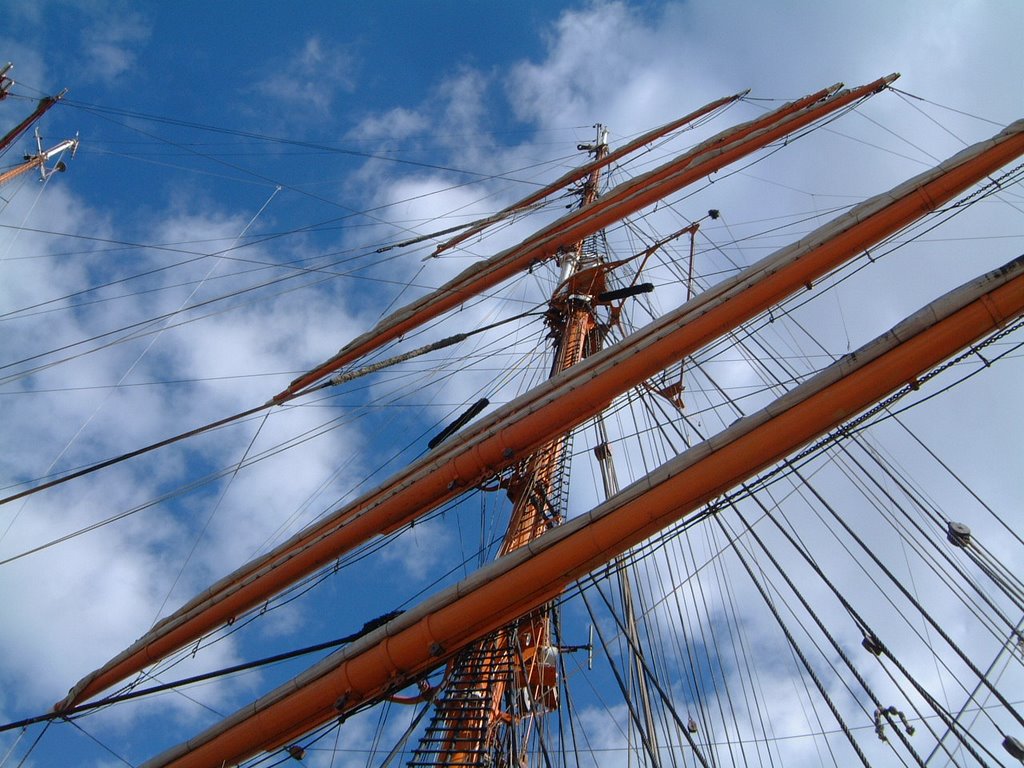
It's a sunny day in Reykjavik which means that, even though the temperature is only about 60°F, many of the natives are walking around in shorts and sandals, eager to soak up the sun. We find a large, four-masted schooner docked in the harbor, and as we approach it we find that it is a Russian training vessel, the shipmates are offering tours, and the tours are free! We take one.

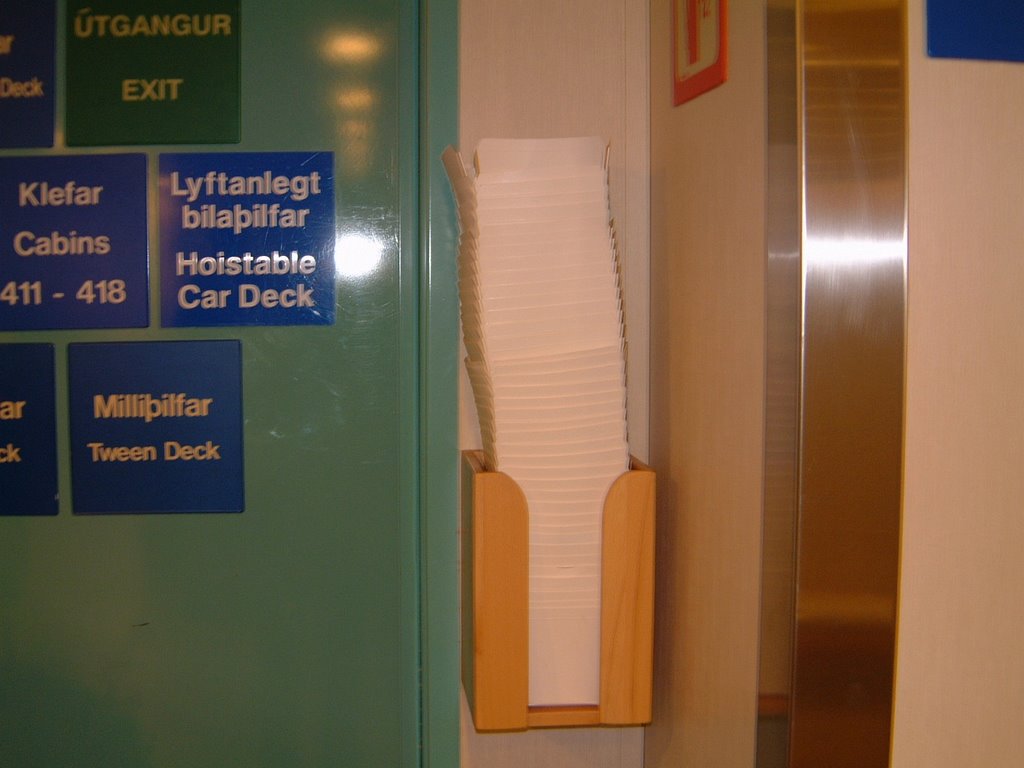
Leaving Reykjavik we have a 45-minute drive to catch the ferry for the Westmann Islands, where we will be staying on Heimaey. Our ferry trip is almost 3 hours. We admire features of our ferry, Herjolfur. First, we observe a stack of containers that look like large chinese take-out boxes. We suspect that these are conveniently provided for when the seas aren't so smooth as they are today. Convenient! Plus, we discover original art hung throughout the ship: oils, watercolors, photographs. Many of them feature Icelandic landscapes, and are quite good.

As we approach the fourteen Westmann Islands, they emerge as unique, odd shapes on the horizon that become steadily more bizarre as we approach. Like Iceland, these are volcanic islands, and our destination, Heimaey, is the only one that is inhabitated, unless you count sheep. Count sheep? We're not even tired yet!

The sheer black/green cliffs of Heimaey are beautiful, with birds everywhere as we come in to the harbor at 10:45 p.m. We disembark and walk through the quiet town until we find Guesthouse Hrithrith, and meet the German owner Ruth, who gives tours to the volcano and bakes bread there in the hot lava. (She is a full-time baker in the winter.) We have interesting midnight conversations in the guesthouse kitchen with a geologist from Scotland and a Chinese translator and his friend from the UK.

John and Gabe go for separate midnight walks on Heimaey. John walks by the cemetary without incident, and then to the lava area. Back at the guesthouse, the boys and I compare the cool features of our different sleeping bags. Gabe wins, with his "Penguin" bag. (That's not the name of the bag, but just that he looks like a penguin in it due to the color design. We offer to get him an orange bill and feet so we can rename it the Puffin bag.)

High 60°F Low 48°F

Dec 10, 2007

Halldór Laxness Day

52 years ago today, Halldór Laxness was awarded the Nobel Prize in Literature. Today is the day that Professor Batty and I chose for posting our personal rankings of our favorite Laxness novels. You, our reading audience, can be assured that we have not collaborated on or discussed these rankings ahead of time...I will be as surprised as you when I read PB's post tomorrow!

Here is my list:

1. The Fish Can Sing (1957)
Álfgrímur's coming of age. Iceland's greatest singer. A house called Brekkukot in Reykjavík at the beginning of the 20th century. My favorite book ever.

2. Independent People (1934)
Sheep, and the frustratingly stubborn Bjartur of Summerhouses.

3. Iceland's Bell (1943-46)
The Loveliest Woman in Iceland and an irascible criminal.

4. World Light (1937-40)
The Poet, Ólafur Kárason of Ljósavík.

5. Under the Glacier (1968)
The Emisary of the Bishop (Embi) investigates strange things at Snaefells.

6. Salka Valka (1931-32)
A poor fisher girl who is big, strong, and very generous.

7. Paradise Reclaimed (1960)
Steinar gives his white pony Krapi, the finest horse in Iceland, to the King of Denmark, and goes to live with the Mormons.

8. Great Weaver From Kashmir (1927)
Steinn’s quest for perfection, and his desire to avoid the sins of the flesh. Humanity and Divinity. The nature of redemption.

9. Happy Warriors (1952)
Sworn brothers Þormódur Bessason and Þorgeir Hávarsson have the souls of saga warriors. But they are misfits in their world, and don’t even realize it.

10. Atom Station (1948)
A girl from the north country encounters city ways, and learns about human values. Another Strong Woman steals our hearts.

11. The Honour of the House (1933)
Honour and pride, and what it does to a family.


I think it's interesting that many of Laxness' novels were published in separate volumes and parts over the course of several years. I also think it's interesting (although I don't expect anyone else to) that Laxness was awarded the Nobel Prize the same year I was born. His acceptance speech (audio and text) can be found at the Nobel site.

I'd love to hear from other Laxness fans about their favorites. If you'll send me your personal ranking I'll be glad to post it! And don't forget to check out Professor Batty at Flippism is the Key to see what he has to say about our favorite Icelandic Author.

To conclude, an excerpt from my Iceland diary, July 19, 2006:

Today we are going to visit Gljufrasteinn, the home and museum of author Halldór Laxness. Thingvellir, Gljufrasteinn, and Drangey Island are the top three personal shrines on my Iceland list.

Halldór Laxness (1902-1998) won the Nobel prize in 1955, in part for his book Independent People. In an introduction to this book Brad Leithauser says:

When I tell people I meet that my favorite book by a living novelist is Halldor Laxness's Independent People and am asked what it's about, my reply is, "Sheep."

...My reply is actually less facetious than might first appear, for while the book does keep large issues constantly in mind (the largest: mortality and memory and love and duty), it is also very much about...[sheep].

We come close to hitting a herd of sheep on the road, one at a time. In case you're curious, sheep are not too smart. They exhibit that irritating characteristic common to squirrels and deer: it's impossible to predict which way they will dash when they panic--or they might just freeze. It's safer not to honk the horn, and just wait for them to amble off.

Gljúfrasteinn is nestled in a large, lovely valley with imposing mountains nearby, across the road from Laxnes horse farm. Laxness's name, a pseudonym he took in 1923, means "of Laxnes."

First we walk around through the gardens to the back of the house, and have our picnic lunch on a bench in an alcove shaded by small birches and wildflowers. The nearby stream tumbles over smooth boulders and forms myriad small waterfalls.

The house itself is elegantly plain: medium sized, white plaster with lots of windows. It isn't a showplace; it's a house meant to be lived in. The orginal furnishings, art, music and books are still in place, so it's very easy to imagine Laxness and his family living here. The audio tour is excellent: it is less obtrusive than a tour guide, and the recording includes the voices of Laxness and his wife. You can stand in his study, see the desk he stood at to write, look out the window at the very view that he saw daily. You can enter his bedroom, and see the art and objects he kept close to him. You can see his Steinway piano--the very same one that Bill Holm has played. When I see the grandfather clock in the hallway--ticking E-TER-NI-TY---(the one that the clock in The Fish Can Sing was modeled on) my throat closes up and I choke back tears.

Apr 12, 2006

My Essay

Icelandair Contest, 3/1/06

Behold a desperate woman--my spirit is in Iceland, but my body is not. Unite my body and spirit in Reykjavik!

My obsession for Iceland was born in books. The words of Snorri Sturluson, Haldor Laxness, Bill Holm, W.H. Auden and Olaf Olafsson consumed me.

The Sagas ignited a passion in me. I long to commune with the spirits of the warrior poets at Pingvellir.

Laxness’ The Fish Can Sing was so mesmerizing that as soon as I finished it I turned back to page one and began again.

Laxness, his home

A shrine.

I yearn to divine

his words

still suspended in the air.

I am absorbed by Icelandic film, language, natural wonders, bloggers. I seek to share my fledgling Icelandic phrases with Icelanders in the coffee shops, museums and hot pots of Reykjavik. I crave Brennevin and pylsa, hunger for the cleanest water in the world and the freshest fish. I ache to see the Aurora Borealis, listen to rimur, and meet huldufolk. My obscure passion confuses and bewilders my family--but that does not deter me.

Meanwhile, I gaze north.

An eager whisper escapes my lips:

Iceland, O! Iceland!

This is a true story. This is me.

Winning Entry

And The Winner Is...

A big thanks to everyone who entered the Sebastian Spring Break contest. We loved your stories and are truly impressed with your creativity.

So, without further adieu, we're please to announce Elizabeth Tubergen from Lookout Mountain, GA, as the lucky winner.

.

Elizabeth has won:
- Roundtrip airfare for TWO from Baltimore/Washington (BWI), New York
(JFK), Boston (BOS), Orlando (ORL) or Minneapolis/St. Paul (MSP)
- Three (3) nights hotel in a double room in Reykjavik
- Blue Lagoon Tour
- Roundtrip Airport/Hotel transfers

Here is a copy of the winning entry:

"Ever since I was a wee lass I have wanted to visit Iceland.
Icelandic landscapes enchant me. When I was young, my dad gave me a calendar
(you know, one of those free ones from the office) that was full of rich photographs from around the world. I immediately wanted to visit all of the places, especially Iceland. I want to go to Iceland, but I can’t afford it right now because I am a college student, and I am very poor
and have debts.

In addition to the lifelong fascination that I have with Iceland, many of my favorite artists are from Iceland, which makes it all the more interesting to me. I want to go to the sculpture
museums, and see the works of sculptures that are rarely shown anywhere else. I love the music that comes out of Iceland. Besides these things, I want to go to Iceland to relax. After a tough semester at school, the Blue Lagoon looks awfully nice. Please pick me."

Comments, anyone? Which essay would you have chosen?

Jan 19, 2011

More Letters From Iceland

Letters from Iceland 1936, by Jean Young. Transcribed by Marion Agnes Harvey. University of Birmingham, 1992. 80 pgs.


Snapshots from a life: a lady scholar from England achieves her lifelong dream of visiting Iceland. We experience a summer of travel and hard manual labor first-hand, through her letters home. Just as we are getting to know her, she vanishes abruptly from our life, leaving us to wonder: was her boat home late? Did an Icelander accompany her home, to work in England? Did she ever return to Iceland? What were the basic facts of her life: when and where was she born, and when did she die; what were her successes in life, her significant relationships? I haven’t been able to answer most of these questions but--my wig!--it has been fun sharing these few months of 1936 with Jean Young.

Jean had an abiding interest in Iceland. Her post-graduate work dealt with Old Icelandic literature, and literary relations between Icelandic and Irish literature. Jean began to study Icelandic literature in 1921, but it wasn't until 1936 that she was finally able to visit Iceland in person. Her letters were published posthumously in 1992, and are readily available at  http://www.vsnrweb-publications.org.uk/Young_Letters.pdf, complete with her sketches and photographs.

W.H. Auden published a book with the same title, written in the same year, but much better known. In one section of Auden’s Letters from Iceland, he and co-author MacNeice present letters “written” by Hetty, girl scout leader extraordinaire. While Hetty is imaginary, she was likely based upon Jean Young. While in the Snaefellsness area, Jean spies the rucksack of "Auden the Oxford poet!”,  catches up with him, and discovers he's producing a book on Iceland-- little knowing it will feature a thinly disguised version of herself.

Jean's letters aren't written with the care and literary panache of Auden and MacNeice's contemporaneous accounts, but hers weren't intended for publication or a wider audience. They do convey a very personal response to Our Favorite Homeland, and are written in a conversational manner. Her account features lots of slang, which makes it seem as though she is talking to us ('em, 'tho, 'cept, summat). In one of her earliest letters she exclaims, "I feel in my bones I'm going to love Iceland just as much as I thought I should!" Followed in short order by, "Oh, my wig how I love Iceland!"

Jean faces the daunting challenge that many others have: "it is a damn hard language." She takes the option that Bill Holm, E. Paul Durrenberger and countless others have: she elects to work on a farm.  First she goes to Arkvorni,  then travels a bit through Iceland, and finally goes to another farm, Fljótshlíð (near Thorsmork), where she works for an entire month.

Jean’s farm labor includes darning, cooking for a large household, emptying chamber pots, cutting hay, and caring for children. Oh, and washing: "... then I took several pairs of heavy socks down to the stream to wash under the waterfall medieval fashion on a flat stone with a wooden clapper." The job benefits? Riding some of the finest horses in the area, learning Icelandic, and discovering  a great appreciation for simple food after 15-hour days of manual labor.  Typical meals consisted of cold porridge, salted fish, potatoes, pancakes, and always coffee with sweet cakes.

When she has a few brief minutes free from labor, she takes time to write letters and read. When Jean meets Icelanders, her standard is: have they read Laxness? She comes to understand Independent People  " ... from within as well as from outside ... which, if you read, take with much salt." She also comes to believe that many of the farm women she encounters are like Salka Valka, the heroine of another Laxness novel.

Some of my favorite quotes from Jean’s letters:

I foresee that the oilskins'l be useful.
Dolorite forms itself into octagonal columns here--and here only in the world apparently.
No railing to prevent folk from throwing themselves in [Gullfoss].
It's the space and silence that are so marvelous here.
The sanitary arrangements are good ... just the cow shed but here it's goats!
How I'd love to see the sun shine again!

When Jean finally returns to Reykjavik at the end of August, she goes shopping and forgets to take any money with her. She hasn’t used or thought about money in over a month.

I did learn that Jean returns to her studies in Great Britain and eventually becomes Dr. Jean Young, the author/translator of books in at least three languages. But alas, though she had hoped to meet Halldór Laxness and ask to translate one of his books into English, that never transpired. Nor could I learn if she ever returned to Iceland.